AustinIO > The Austin Supercluster > Giga Austin Nexus > Tesla Giga Texas Complex > Tesla Giga Texas Car Production
Tesla Giga Texas Car Production
Vehicle production at Giga Austin is the gigafactory leg of the Texas Industrial Triad — one of the three foundational recursive machine types (gigafactory, fab, datacenter) that run the new industrial-AI economy. See Texas Industrial Triad for the full anchor-facility framework.
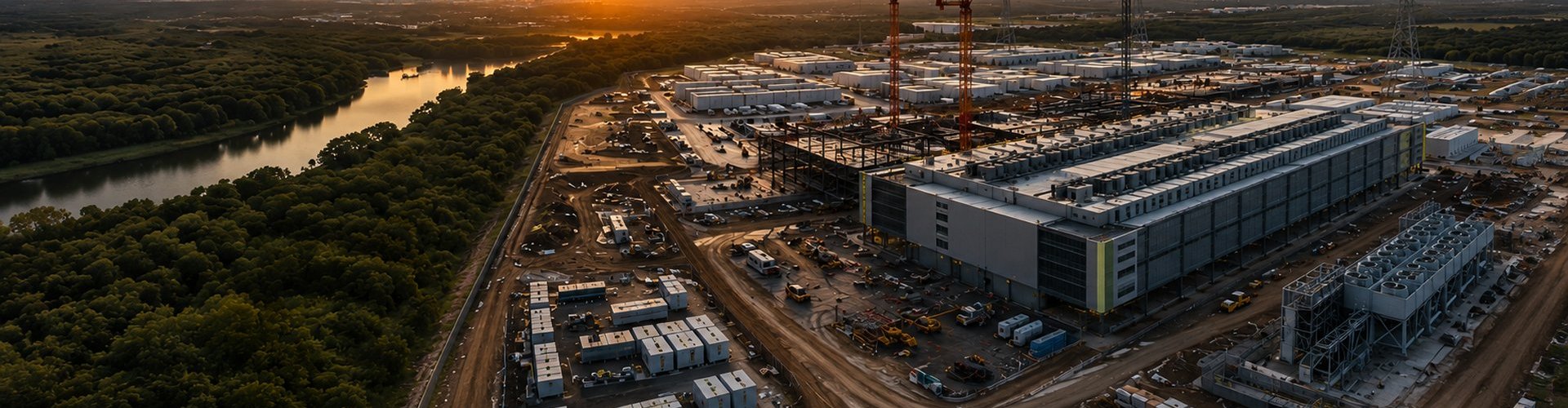
Vehicle production is the program that everything else at Giga Austin orbits. Cortex compute, Optimus humanoid manufacturing, and the Terafab Research Fab are all newer additions to the campus; the vehicle line is what made the 10-million-square-foot building exist in the first place. The site employs approximately 16,500 people across EV, battery, robotics, AI, and semiconductor programs.
As of August 2026, Giga Austin is the only Tesla site where three structurally distinct vehicles share a roof — the Model Y mid-size SUV, the Cybertruck stainless-steel exoskeleton truck, and the steering-wheel-free Cybercab two-seat robotaxi — each running on its own dedicated production architecture inside the same building. A fourth vehicle — the next-generation Roadster 2 — has been confirmed for production at Giga Texas (VP of Vehicle Engineering Lars Moravy and Chief Designer Franz von Holzhausen, Ride the Lightning podcast, May 2026), though no production date has been announced. The Roadster is currently in testing and is expected to feature a tri-motor powertrain, next-generation battery systems, and the SpaceX cold gas thruster package (10 thrusters) that Musk has discussed since the 2017 unveil.
The site is the global flagship for Tesla's manufacturing doctrine and the working laboratory where the company's three most distinctive production methodologies — single-piece megacasting, the Unboxed Process, and consumer-electronics-style high-cadence assembly — are running concurrently.
The Machine That Builds the Machine
Elon Musk's most-quoted framing of Tesla manufacturing is the assertion that the factory itself is the product. The phrase "the machine that builds the machine" first surfaced publicly during the Gigafactory Nevada grand opening and has been Tesla's stated manufacturing thesis ever since.
The corollary Musk has emphasized: building the factory is harder than building the car. For a given factory size, output equals volume times density times velocity — and the potential for improvement in manufacturing exceeds the potential for improvement in vehicle engineering by at least an order of magnitude. Competitive advantage compounds at the factory layer, not at the product layer. Other manufacturers can copy a vehicle design within a model cycle; the factory architecture that produces it cheaply, quickly, and at scale takes years to replicate.
Tesla's internal label for the end-state is "alien dreadnought" — the production line dense and fast enough that humans cannot operate near it. Giga Austin is the closest the company has come to that goal in a single building.
The Giga Press and Single-Piece Megacasting
Tesla's most visible manufacturing innovation is the use of giant aluminum die-casting machines — Giga Presses, supplied by IDRA Group — to cast structural sections of the vehicle as single pieces rather than welding together hundreds of stamped parts.
| Vehicle | Casting Architecture | Press Tonnage | Structural Parts Count |
|---|---|---|---|
| Model Y | Two-piece (front + rear underbody) | 6,000-ton class | ~200 |
| Cybertruck | Two-piece (6,500-ton front shared with Model Y; 9,000-ton rear dedicated) | 9,000-ton (rear) | ~200 (with stainless exoskeleton) |
| Cybercab | Single-piece | 9,000-ton class | ~80 (60% reduction vs Model Y) |
The 9,000-ton machines are the largest aluminum high-pressure die-casting machines in production anywhere in the world. Each weighs approximately 410 tonnes and injects roughly 80 kilograms of molten aluminum at 10 meters per second. A single megacasting can replace up to 250 individual parts, eliminate the welding fixtures and joining operations that would have produced them, and reduce body structure weight by 10–30%. The casting cell occupies a fraction of the footprint that a body-in-white welding line of equivalent output would require.
The Unboxed Process
The Unboxed Process is Tesla's redesign of the automotive assembly line itself. First announced at Investor Day in March 2023, it is now operational on the Cybercab line at Giga Austin.
The traditional automotive line is sequential — a body shell moves down a conveyor, growing as parts are added, with workers squeezing into partially assembled cars to install interiors. The Unboxed Process discards the sequential conveyor entirely. Major sub-assemblies — front section, rear section, floor with battery pack, side body panels, seats — are assembled in parallel cells in separate areas of the factory, each cell optimized for the work it performs. Workers and robots assemble each section while it is still open and accessible. The completed sub-assemblies converge at a final station and are joined in a single integration step.
| Metric | Improvement vs Conventional Line |
|---|---|
| Factory footprint per unit of output | Up to 40% lower |
| Capex per vehicle | ~50% lower |
| Cycle time | Significantly faster (parallel ops not gated on longest serial step) |
The Unboxed line for Cybercab produced its first vehicle on February 17, 2026. Volume production ramped in April 2026. Drone observers documented scaling from a handful of test units in early February to roughly 60 visible units staged in the outbound lot by April 8, and over 70 by mid-May — early evidence that the parallel-cell architecture is working in practice.
Cybercab as High-Speed Electronics Assembly
Musk has specifically distinguished Cybercab assembly from automotive manufacturing entirely, framing it as closer to high-volume consumer electronics manufacturing than to vehicle production.
| Production Cadence | Cycle Time | Theoretical Annual Output (Single Line) |
|---|---|---|
| Industry standard 500K-unit/year line | ~60 seconds | 500,000 units |
| Tesla Model Y line | ~34 seconds | ~900,000 units (~250K achieved at Giga Austin) |
| Cybercab Unboxed line (target) | <10 seconds | 2–3 million units |
| Cybercab Unboxed line (theoretical floor) | 5 seconds | 5 million units |
The architectural rationale is the structural simplicity of the vehicle. The Cybercab has no steering wheel, no pedals, no side mirrors, and no driver-facing controls of any kind. Its interior is two seats, a central touchscreen, a dashboard light strip, and inductive charging hardware. With the structural parts count at roughly 80 versus Model Y's 200, assembly resembles the way smartphones and game consoles are built — pre-tested modules snapped together at high cadence.
A critical regulatory distinction: unlike competitors Waymo and Cruise, Tesla's Cybercab does not need a federal NHTSA exemption to increase production. VP Lars Moravy confirmed the vehicle was designed to meet all Federal Motor Vehicle Safety Standards from the start, allowing Tesla to self-certify like any conventional automaker. Drone footage has confirmed compliance stickers on finished units. This eliminates the 2,500-vehicle-per-year exemption cap that constrains competitors building non-FMVSS-compliant vehicles.
Completed Cybercabs drive themselves off the assembly line using the same FSD neural network that powers consumer Tesla vehicles — eliminating the human-operated drive-off step conventional plants require.
Deployment: Tesla launched its "Robotaxi" service in Austin in June 2025 using Model Y vehicles with FSD. Production Cybercabs began testing on public roads in June 2026. Tesla held the Cybercab launch event in Austin on September 3, 2026, and Cybercabs have carried paid Robotaxi riders in Austin since September 4. Texas registrations for Tesla Robotaxi service reached 739 vehicles on October 9, 2026: 420 Model Y and 319 Cybercab. Tesla does not report a Cybercab production count; see Texas Robotaxi Deployment for confirmed figures, targets and estimates. A dedicated Robotaxi charging hub is permitted in Austin: 48 V3 Supercharger stalls (Phase 1) plus 80 wireless inductive chargers (Phase 2) — one of the first concrete deployments of Tesla's wireless charging technology at scale, designed for autonomous fleet operation without human intervention. Musk has stated material Cybercab revenue is unlikely before 2027.
Three Vehicles Under One Roof (Four Coming)
Giga Austin is the only Tesla site simultaneously building three structurally distinct vehicle architectures, with a fourth (Roadster 2) confirmed for future production at the same site.
| Vehicle | Body Architecture | Assembly Method | Status |
|---|---|---|---|
| Model Y | Conventional unibody, two-piece megacasting | Serial assembly line | Volume production; >250,000 units/yr capacity |
| Cybertruck | Stainless-steel exoskeleton, 9,000-ton rear, hydroformed panels, 48V LV | Serial assembly with specialty stations | Volume production; >125,000 units/yr capacity |
| Cybercab | Single-piece megacasting, no driver controls | Unboxed Process (parallel-cell) | In production; paid rides in Austin since Sept 4, 2026 |
| Roadster 2 | Tri-motor powertrain; SpaceX cold gas thruster package (10 thrusters) | TBD | Confirmed for Giga Texas (May 2026); currently in testing; no production date |
The three active programs share a building, a power supply, a workforce pool, a paint shop architecture, and a parking lot. They share virtually nothing else at the body, structure, or assembly level. The strategic logic inverts the conventional automotive playbook: Tesla builds platform-distinct vehicles in one factory rather than platform-shared vehicles at multiple factories. The bet is that shared overhead — building, substation, supply chain logistics, workforce gravity, rooftop solar — pays for itself across multiple programs more efficiently than separate single-program factories would.
What Comes Off the Line: A Rolling Data Center
Every vehicle that exits the Giga Austin assembly bays is one of the most semiconductor-dense products ever manufactured. A current-generation Tesla equipped with the AI4 computer contains an estimated 2,000-4,000 individual semiconductor devices spanning logic, memory, power semiconductors (SiC traction inverters, GaN onboard chargers), sensors, analog and mixed-signal, RF and networking, optoelectronics, security silicon, and dozens of embedded microcontrollers. At Tesla's Q2 2026 production of 451,758 vehicles company-wide (480,126 delivered), semiconductor demand from a single manufacturer runs into billions of devices per year — a demand signal feeding directly into the Terafab Research Fab on the same campus.
Detailed chip-by-chip stack coverage is available at SemiconductorX: Tesla Vehicle Semiconductor Census ↗.
The 30-Megawatt Rooftop Solar Array
The roof of Giga Austin hosts what Tesla has stated will be the world's largest rooftop solar installation when complete: a 30-megawatt array spanning approximately 70,000 panels across the 10-million-square-foot factory roof. Phase 1 is operational at roughly 10 megawatts. The full 30 MW design will produce, at peak, enough power to smelt over two tons of aluminum per hour or supply electricity equivalent to roughly 5,000 average American homes.
The array positions vehicle production as a direct customer of Tesla's energy business — the company manufactures solar equipment, deploys it on its own factory, and uses the output to power vehicle manufacturing, closing a vertical loop few automakers attempt. It also serves as a working demonstration for Tesla's stated 100 GW domestic solar manufacturing target by end of 2028. The array is one of several behind-the-meter generation features alongside on-site Megapack battery storage, and is part of the dependency on Texas Energy Nexus substrate.
The Recursive Factory
The most distinctive feature of Giga Austin's vehicle production architecture is recursion — the factory uses its own outputs as inputs and improves itself iteratively.
Energy: Tesla Megapacks and on-site solar power the building that builds Tesla Megapacks and solar equipment.
Logistics: Tesla Semi trucks move materials into the factory that builds Tesla Semis.
Software: Tesla vehicles using FSD navigate themselves off the assembly line, generating training data that improves the FSD software running in the next vehicles built.
Labor: Optimus humanoid robots, manufactured at the same campus, are intended to perform increasing fractions of manufacturing labor inside the building that built them.
Compute: Cortex 2 clusters at the campus train the AI models that power the vehicles, the humanoid, and the manufacturing-floor automation.
Each loop tightens the feedback between manufacturing and product over time, and each reduces external dependency for a critical input. The classic linear automaker buys energy, buys logistics, buys factory equipment, buys software, and ships vehicles. Giga Austin increasingly produces a meaningful fraction of all of those inputs internally. Whether the recursion compounds into the order-of-magnitude manufacturing improvement Musk has projected, or saturates at some lower asymptote, is one of the major open questions the 2026–2030 period will resolve.
Production Capacity Snapshot (August 2026)
| Vehicle | Installed Annual Capacity | Production Status |
|---|---|---|
| Model Y | >250,000 units | Volume production (cycle time ~34 sec) |
| Cybertruck | >125,000 units | Volume production |
| Cybercab | >125,000 units/yr installed (Tesla Q2 2026 update; capacity, not output) | First unit Feb 17, 2026; production began Q2 2026; paid rides in Austin since Sept 4, 2026 (target cycle <10 sec) |
| Roadster 2 | TBD | Confirmed for Giga Texas; currently in testing; no production timeline |
Capacity figures for Model Y and Cybertruck are from Tesla's Q1 2026 Form 8-K. Tesla's Q2 2026 production disclosure: 451,758 vehicles produced company-wide (442,936 Model 3/Y; 8,822 other models including Cybertruck and Cybercab), 480,126 delivered.
Related Coverage
Optimus Factory at Tesla Giga Texas | Giga Texas Cortex Training Cluster | Terafab Research Fab Giga Texas | Texas Robotaxi Deployment
