AustinIO > The Austin Supercluster > Giga Austin Nexus
Giga Austin Nexus
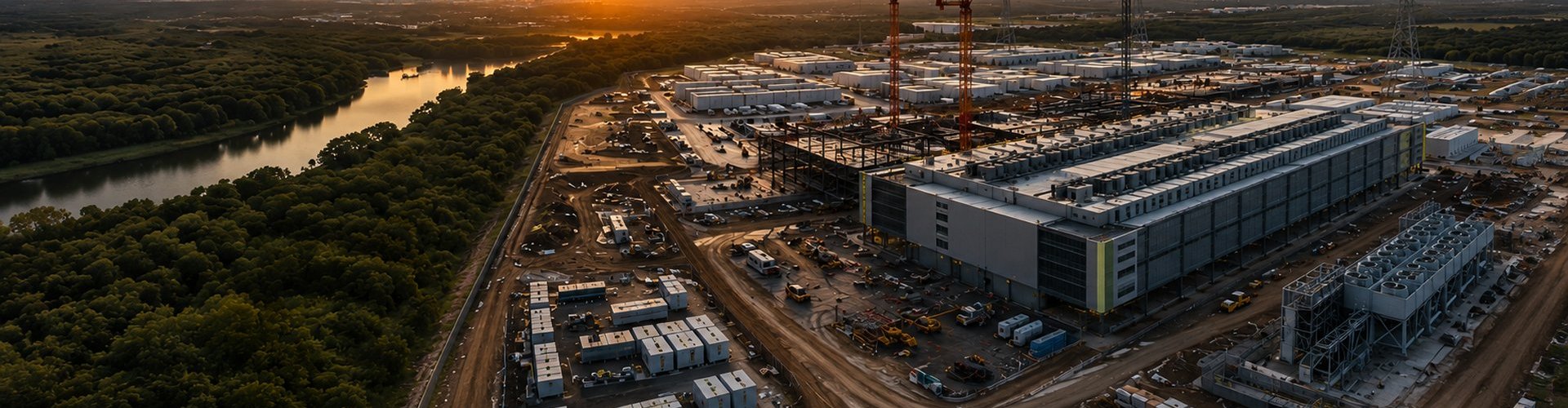
The Giga Austin Nexus is the cluster of giga-scale industrial anchors around Austin: Tesla Giga Texas in Travis County, Samsung Taylor in Williamson County, and the Musk Bastrop Complex in Bastrop County. Three operators run them, each in a different frontier category: vehicles, humanoids and AI compute at Tesla; leading-edge logic silicon at Samsung Foundry; satellites and orbital silicon packaging at SpaceX. The term comes from Giga Texas, but the cluster is wider than Tesla.
No other US metro holds this mix. Phoenix has TSMC Arizona and Intel, both chipmakers. Boise has Micron. Hillsboro has Intel. Silicon Valley designs chips at scale but builds little at gigafactory scale. Austin pairs a multi-program automotive and AI plant, a leading-edge foundry and a satellite factory within one metro.
The Three Anchors
| Anchor | Operator | Category | Location |
|---|---|---|---|
| Tesla Giga Texas Complex | Tesla | Vehicles, Optimus humanoids, Cortex AI training compute, Terafab semiconductor research | Austin (Travis County) |
| Samsung Taylor Fab | Samsung Foundry | Leading-edge logic silicon (2nm GAA) | Taylor (Williamson County) |
| Musk Bastrop Complex | SpaceX and Musk affiliates | Starlink terminals, GigaSat satellites, semiconductor R&D and advanced packaging | Bastrop (Bastrop County) |
Tesla Giga Texas sits on roughly 2,500 acres along SH 130 on the eastern edge of Austin. It opened in April 2022, employs more than 20,000 people, and runs four programs at one address: Model Y, Cybertruck and Cybercab production; the Optimus humanoid line; the Cortex 1 and Cortex 2 training clusters; and the Terafab Research Fab. No other US campus combines that range.
Samsung Taylor is the largest semiconductor capital commitment in Texas history, with more than $45 billion committed across announced phases and Fab 1 ramping to volume in 2027. It builds chips on a 2nm GAA (gate-all-around) process, and Tesla AI5 silicon comes off its line under a multi-year arrangement close to a captive foundry, with Tesla engineers working on the Samsung floor.
The Musk Bastrop Complex lies about 30 miles southeast of Austin along FM 1209, on more than 1,000 acres held by SpaceX, X Corp., The Boring Company and other Musk affiliates. It started as the Starlink terminal factory, the largest satellite-related manufacturing operation in North America by output. SpaceX added a semiconductor R&D and advanced packaging facility in 2025, backed by a $17.3 million Texas Enterprise Fund grant, and announced the 11-million-square-foot GigaSat factory for AI1 orbital data center satellites in June 2026.
One Silicon Pipeline Across Three Counties
The three anchors form one AI silicon supply chain:
- Design: Tesla designs its AI5, AI6 and AI7 chips at its Austin and global design centers.
- Fabrication: Samsung Taylor fabricates AI5 today; the Terafab Research Fab at Giga Texas develops Tesla's own process technology for later generations.
- Packaging: SpaceX Bastrop packages radiation-tolerant versions of the silicon for orbit.
- Deployment: the chips end up in Tesla vehicles, Optimus robots and Cortex clusters on the ground, and in Starlink, Starshield (SpaceX's government satellite line) and prospective Golden Dome satellites in orbit.
Why the Anchors Cluster in Austin
State-scale advantages. ERCOT (the Electric Reliability Council of Texas) runs a grid largely outside federal interconnection rules, so large loads can connect faster than in other states. Fast permitting, state incentives such as the Texas Enterprise Fund, and a policy climate that favors industrial growth apply to every operator in Texas, so Tesla, Samsung and SpaceX draw on the same advantages without competing for them.
A shared supplier ring. Linde runs an on-site gas plant at Taylor for Samsung. Tokyo Electron, Tekscend Photomask, Entegris and Valex operate in Round Rock, serving Samsung first and well placed for Terafab. Contractors such as DPR, Rosendin and Quanta build for all three anchors. Each new anchor inherits the suppliers the earlier ones attracted.
A shared workforce. Engineers and technicians move among Tesla, SpaceX, Samsung, Apple, AMD and NXP as programs ramp up and down. Cleanroom technicians, automation engineers and fab process engineers accumulate in the metro, fed by the UT Austin Cockrell School of Engineering, the wider Texas university system and the transition pipeline for soldiers leaving Fort Hood.
The Giga-Scale Test
An anchor enters the Giga Austin Nexus when it meets at least two of these tests at a single site:
- $1 billion or more in committed capital investment
- 1,500 or more direct employees
- First or largest of its kind in the United States or the world
- Several frontier programs on one integrated campus
Related Coverage
US 79 Data Center Corridor | Sandow Lakes / Xebec Megasite | I-35 South Data Center Corridor | Cedar Creek Data Center Cluster | Industrial Triad