AustinIO > Texas Nexus


The Texas Nexus


Foundational Hub of AustinIO's State-Scale AI-Industrial Coverage

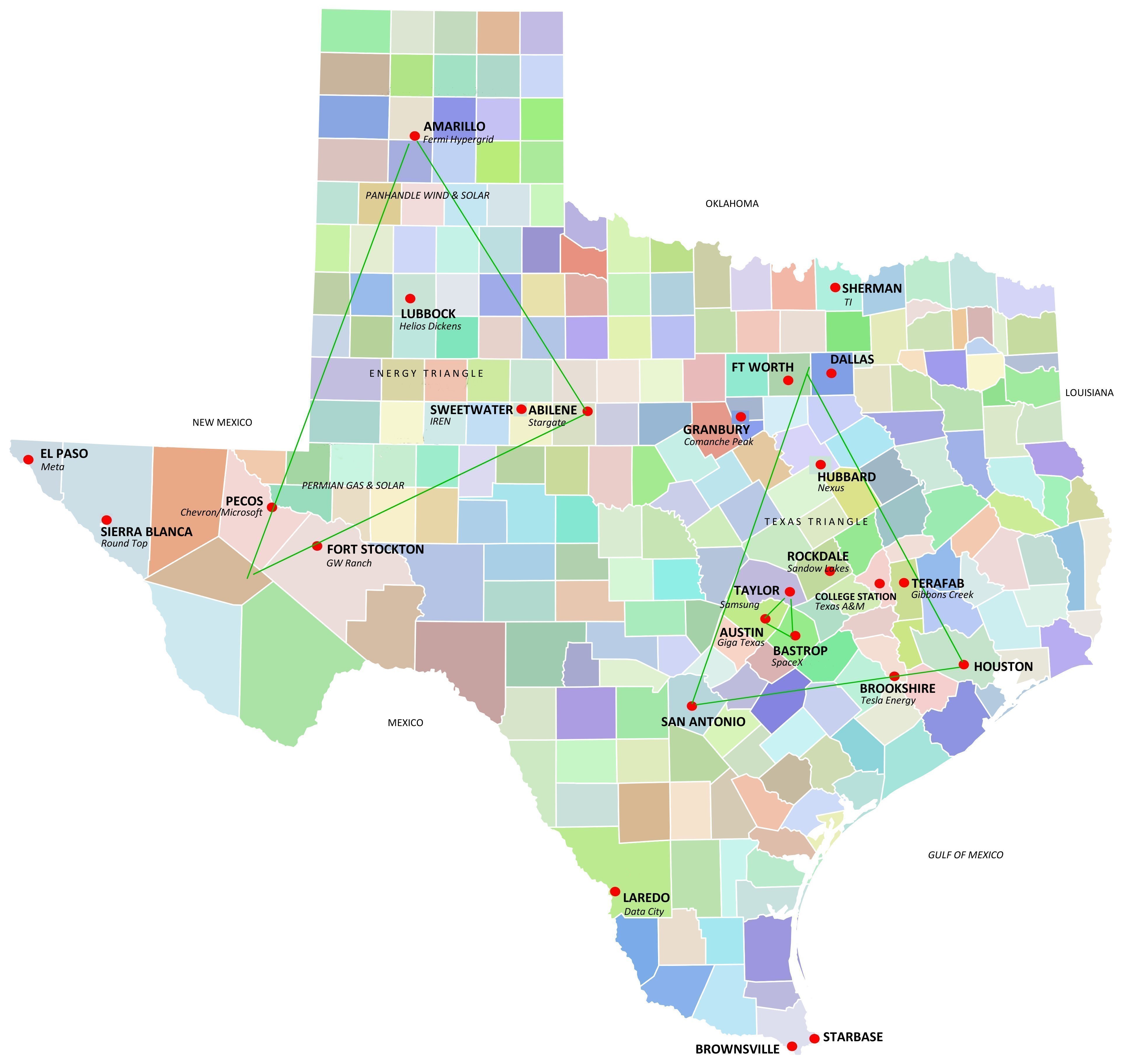
Texas is the outer geographic frame of AustinIO's coverage. The convergence concentrates densely in the Austin metro, but the structural conditions that make the convergence possible operate at state scale. Energy autonomy through ERCOT. Coastal access at the Gulf. Mexico adjacency at the southern border. Multi-region anchor distribution from the Panhandle to the Rio Grande Valley to the Trans-Pecos to the Brazos Valley. Federal strategic-infrastructure designations sited across the state's geography. Texas operates more like a quasi-sovereign country than a typical US state, and the AI-Industrial buildout reflects that scale.

The Texas Nexus is the lens that surfaces these state-level patterns. It contains the Texas Triangle as its densest metropolitan concentration, plus the other regional concentrations that hold strategically distinctive anchors: the Panhandle (Project Matador / Fermi America at Carson County), the Trans-Pecos (Permian Basin, Round Top), the Rio Grande Valley (Starbase), the Gulf Coast (Robstown lithium, Houston petrochemical, LNG export terminals, Brookshire Megapack), and the Brazos Valley (TAMU Semiconductor Institute / RELLIS, Substrate Inc.'s Project Factory One, the new Terafab Production Facility at Gibbons Creek). Each region contributes a different facet of the convergence; together they constitute the state-scale buildout.


Texas as Quasi-Sovereign Substrate

Texas operates structurally differently from other US states in ways that directly shape the convergence. The differences are not aesthetic or political; they are infrastructural and economic, and they compound over time.

ERCOT grid independence. Texas runs the only US state grid that is largely independent of the federal interconnections. The Electric Reliability Council of Texas operates under state regulation, with its own planning timelines, its own market design, its own interconnection queue, and its own risk profile. The result is generation diversity (US leadership in wind, US leadership in solar growth, substantial gas peaking, baseload nuclear, accelerating BESS deployment) and faster interconnect velocity than federally-coordinated grids typically achieve. AI compute, fab operations, and datacenter buildout at the scales currently committed in the state require this generation diversity and interconnect velocity. ERCOT independence is not incidental; it is enabling infrastructure. Foundational reference treatment at ERCOT Energy Sovereignty.

Coastal access at the Gulf. Texas operates major ports at Houston, Corpus Christi, Galveston, Port Arthur, Beaumont, and Brownsville. These ports move substantial US energy exports (LNG, refined petroleum, petrochemicals) plus general cargo plus the maritime logistics that anchor a portion of the state's industrial substrate. The Tesla Robstown lithium refinery's spodumene feedstock arrives via Port of Corpus Christi. The Brookshire Megapack factory ships into the Gulf logistics network. SpaceX's Starbase operations rely on Port of Brownsville access. The Gulf Coast is structurally part of the state's industrial geography, not a separate region.

Mexico adjacency. Texas shares 1,254 miles of border with Mexico across multiple major crossings (Laredo, El Paso, Brownsville, Eagle Pass, Del Rio, McAllen). The Maquiladora corridor across the border supplies substantial US industrial supply ring including semiconductor packaging, automotive components, electronics assembly, and broader manufacturing. Texas-Mexico industrial integration plus continued US-Mexico-Canada Agreement (USMCA) framework continuity supports continued operator concentration that depends on cross-border supplier ring development. The Lower Rio Grande Valley anchors at Starbase plus broader LRGV industrial buildout depend on continued Mexico adjacency.

Scale comparable to mid-sized nations. Texas's GDP places it consistently in the top 10 globally if measured as a standalone economy. Its land area exceeds most European countries. Its population at roughly 31 million exceeds many sovereign states. The fiscal scale, regulatory environment, infrastructure capacity, and economic-development apparatus operate at national rather than sub-national scope.

Regulatory environment optimized for industrial buildout. Texas's permitting velocity, right-of-way acquisition processes, property-tax incentive frameworks (Chapter 313 historically; subsequent program iterations including the Texas Jobs, Energy, Technology, and Innovation Act under HB5), Texas Enterprise Fund grants, Texas Semiconductor Innovation Fund, Texas CHIPS Act framework, and state-level economic-development coordination (through the Governor's Office of Economic Development and Tourism) produce a structural advantage for large-scale industrial siting decisions. Operators who choose Texas often cite regulatory certainty and execution velocity as primary factors, not tax rates alone.

The combination of these features — grid independence, coastal access, Mexico adjacency, sovereign-scale economy, and industrial-buildout regulatory posture — is what makes Texas the substrate it is. No other US state combines all five at this depth.


The Foundational Analytical Framework

Four foundational reference pages provide the analytical scaffolding that the broader Texas Nexus coverage depends on. Each page operates as the canonical destination for a specific structural question; readers seeking deeper analytical treatment than this hub page provides should follow the cross-references.

Why Texas: The Structural Logic of AI-Industrial Concentration answers the foundational question of why Texas is hosting a disproportionate share of the largest US AI-Industrial commitments. The page works through six binding constraints (power, water, land, workforce, regulatory, geopolitical) and articulates the brownfield substrate inheritance pattern as the structural distinction that distinguishes Texas's pace and scale from peer states. Coverage at Why Texas: The Structural Logic of AI-Industrial Concentration.

ERCOT Energy Sovereignty covers the power-side foundational substrate. ERCOT operates outside FERC jurisdiction, supports more rapid interconnection queue clearance, and provides the structural framework that AI compute plus fab operations plus datacenter buildout depends on at the scales currently committed. The 233-410 GW interconnection queue, Senate Bill 6 implementation, and Interconnection and Grid Analysis organization redesign collectively shape the broader power-side framework. Coverage at ERCOT Energy Sovereignty.

Texas Water Supply and Stress covers the water-side foundational substrate as a parallel constraint independent of energy. Water is the most active structural constraint on the Texas AI-Industrial buildout because it cannot be added — water availability is fixed by precipitation, aquifer recharge, and regional hydrology, and adjusts only through reallocation, conservation, treatment and reuse, or imported supply. The page covers Texas's nine major aquifers, the regional river basin systems, the regulatory framework asymmetry between power-side and water-side regulation, and the specific stress patterns by region. Coverage at Texas Water Supply and Stress.

Terafab Global Case Study covers what makes Terafab structurally singular at the global level — the combination of extreme scale, complete vertical integration, dual-facility architecture, multi-customer demand consolidation, and orbital compute target at terawatt scale that no other commercial semiconductor program has approached. The page demonstrates through specific case-study analysis how Texas's structural advantages manifest in the largest single semiconductor commitment in history. Coverage at Terafab: Global Case Study.

These four foundational references plus the Texas Nexus hub page itself plus the supporting Texas Energy Nexus pillar plus the regional concentration pages plus the corridor pages plus the spotlight pages collectively constitute the analytical architecture of AustinIO's state-scale coverage.


The Major Regional Concentrations

Texas's anchor distribution spans six major regional concentrations. Each contains distinctive anchors and supplier patterns. Together they form the state-scale geography of the convergence.

Region Strategic Anchors Distinctive Role
Texas Triangle Austin metro (Giga TX, Samsung Taylor, Apple, Dell, TIE NGMM, broader Austin-Taylor industrial corridor); DFW metro (TI Sherman, Lockheed Fort Worth, Raytheon McKinney, MP Materials Fort Worth, Comanche Peak); Greater Houston (Brookshire Megapack, ExxonMobil, petrochemical concentration); San Antonio (Toyota San Antonio, Microsoft South Central, Tower Semiconductor) Primary metropolitan concentration; densest population, GDP, and frontier-industry density; the four-metro core where most convergence anchors sit; emergence of the formally-recognized San Antonio-Austin mega-metro at 5.5M population across 13 counties
Brazos Valley Texas A&M Semiconductor Institute (TSI) at RELLIS Campus; Cyclotron Institute; AggieFab Nanofabrication; Center for Microdevices and Systems; Substrate Inc. / Project Factory One ($10-13B commercial fab on RELLIS reinvestment zone); Terafab Production Facility (Grimes County, $55-119B SpaceX-operated multi-phase semiconductor production fab at Gibbons Creek) Federally-anchored academic semiconductor research substrate plus emerging commercial semiconductor manufacturing at scales structurally distinct from Williamson County concentration; combined committed and prospective capital exceeds $80 billion at minimum and could reach $130 billion-plus at full multi-phase buildout
Panhandle Project Matador / Fermi America (Carson County, proposed 11 GW campus near Amarillo); Pantex Plant adjacency; Texas Tech University System (Lubbock); regional wind generation First nuclear-and-datacenter coupled hyperscale anchor in the US; federal strategic-infrastructure adjacency to DOE-coordinated nuclear weapons facility; emerging energy-and-AI region
Trans-Pecos & West Texas Permian Basin (multiple operators across Midland-Odessa); Round Top heavy rare earths (Hudspeth County); Roscoe / King Ranch wind cluster; Stargate Abilene (Taylor County, on the eastern edge of the region) Energy production substrate at largest US scales; emerging critical-materials supply (heavy REE); AI infrastructure scaling at Stargate
Rio Grande Valley Starbase (Cameron County, Boca Chica); Brownsville logistics; Port of Brownsville maritime operations Frontier space launch, production, and integration; SpaceX vertical-stack southern anchor; gateway between Texas AI-Industrial buildout and orbital deployment
Gulf Coast Tesla Robstown Lithium Refinery (Nueces County); Tesla Brookshire Megapack and Megablock factory (Waller County); Houston petrochemical concentration; Port of Houston, Port of Corpus Christi, Freeport LNG; SpaceX McGregor adjacency to the Gulf logistics network Maritime logistics, energy export, materials processing, lithium refining, and grid-OEM manufacturing; the supply-chain spine connecting Texas industrial buildout to global maritime trade

Each region contains its own corridors and anchor concentrations. The Texas Triangle is the densest and most-developed; the Brazos Valley is the most rapidly emerging; the other regions are emerging or distinctive in narrower categories. The convergence depends on all six. Take the Gulf Coast out and Tesla's lithium feedstock cannot land. Take the Trans-Pecos out and the Permian electron substrate that powers the AI compute disappears. Take the Rio Grande Valley out and SpaceX's Starbase operations have no home. Take the Brazos Valley out and Terafab plus the broader emerging semiconductor-research-to-manufacturing pipeline lose their substrate. The state-level frame is what connects the regions into a single AI-Industrial ecosystem.


The Mega-Metro Emergence

Within the Texas Triangle, the formally-recognized San Antonio-Austin mega-metro has emerged as a structurally distinctive sub-concentration. The 13-county region (Greater Austin's 5 counties plus Greater San Antonio's 8 counties) totals approximately 5.5 million population with combined gross domestic product of approximately $430 billion as of 2023. Approximately 3.9 million residents live along the I-35 corridor itself in Bexar, Comal, Hays, and Travis Counties — surpassing Phoenix-Mesa-Chandler in current US Census MSA rankings.

The Greater Austin-San Antonio Corridor Council, established in 1984, has coordinated economic and political unity for over four decades. State demographer Lloyd Potter projects likely US Census Bureau combined MSA designation for the 2030 census. By 2050, the mega-metro population is projected to exceed 8.3 million people, surpassing current populations of both Dallas-Fort Worth and Greater Houston metros. By 2100, the region is projected to rank among the three most populated US metropolitan regions. Tesla and Samsung have been described in regional economic reporting as "leading the business boom in the San Antonio-Austin mega-metro" — Tesla via Giga Texas at Austin's eastern edge, Samsung via Taylor in Williamson County. Coverage at Austin-San Antonio Corridor (I-35 South).


How the Convergence Operates at State Scale

The convergence is concentrated in Austin metro but operates at state scale through four structural patterns.

Multi-anchor distribution. Tesla's Texas footprint alone spans four counties: Travis (Giga TX, including the Tesla Terafab Research Fab on the North Campus), Williamson (Optimus and Cortex within Giga TX, plus Cybercab supplier connections), Nueces (Robstown lithium refining and CAM precursor production), and Waller (Brookshire Megapack and Megablock). SpaceX's Texas footprint now spans four counties: Cameron (Starbase), McLennan (McGregor engine production), Bastrop (Starlink terminal manufacturing plus semiconductor R&D and advanced packaging), and Grimes (the new Terafab Production Facility at Gibbons Creek Reservoir). Tesla and SpaceX plus xAI now operate as a coordinated Musk operating-entity portfolio across the Terafab joint venture; the combined portfolio spans eight Texas counties across four of the major regional concentrations. The largest operators in the convergence operate at state scale by design, not by accident. Their geographic dispersion is what gives them resilience to localized constraints (water, power, transportation) and what gives Texas its compounded gravitational pull on adjacent suppliers and federal programs.

Federal strategic-infrastructure overlay. Multiple federal programs site their Texas-relevant operations across multiple regions: Project Matador (DOE-coordinated nuclear-and-AI in the Panhandle), TIE NGMM (DARPA-coordinated advanced packaging in Austin), Texas A&M Semiconductor Institute (Texas CHIPS Act-anchored federally-coordinated semiconductor research substrate at RELLIS), Golden Dome SBI silicon supply chain (Space Force-coordinated, with Tesla design plus Bastrop advanced packaging plus Starbase deployment), Lockheed F-35 production (USAF, Fort Worth), Fort Hood workforce pipeline (Army, Killeen — base reverted from Fort Cavazos to Fort Hood June 2025), Pantex weapons facility (DOE, Carson County adjacent to Fermi). Each federal program anchors in a different Texas region. The state-level overlay is what makes Texas the most federally-anchored AI-Industrial geography in the United States.

Cross-region interstate supply linkage. Anchors in different regions feed each other through state-internal supply chains. Robstown lithium hydroxide flows to Giga TX cell production. Permian Basin gas and electrons flow through ERCOT to Austin metro datacenters. Carson County nuclear (when operational) will feed regional grid capacity that supports both Panhandle and broader Texas demand. Starbase consumes propellants supplied through Houston-area gas operations. Brookshire Megapack ships through Gulf Coast logistics to Texas-deployed and globally-deployed grid sites. The Brazos Valley TAMU Semiconductor Institute substrate plus Cyclotron Institute radiation testing plus the broader RELLIS plus Grimes County Terafab buildout feed the broader Tesla and SpaceX vertical integration loop. The state-level supply chain is denser than any single region's. Texas's intra-state interstate logistics — the rail, highway, pipeline, and grid networks that connect the regions — is itself a structural advantage that smaller-frame analysis cannot capture.

Brownfield substrate inheritance. The fourth structural pattern visible across Texas AI-Industrial buildout is systematic targeting of brownfield substrate inherited from prior generations of US industrial development. The pattern is not accidental — it reflects that greenfield infrastructure development in the United States has become time-prohibitive at the scale and pace AI-Industrial buildout requires. The Gibbons Creek Reservoir site for Terafab Grimes County inherits multi-hundred-MW transmission infrastructure from the prior Texas Municipal Power Agency coal plant (operational 1982-2018). The Sandow Lakes site inherits multi-hundred-MW capacity from the prior Alcoa aluminum smelter plus the on-site 1,200 MW natural gas power plant under construction. The Permian Basin behind-the-meter substrate inherits gas-fired generation from prior oil and gas operations. Stargate Abilene's Lancium Clean Campus model inherits West Texas wind substrate. The Williamson County Samsung Oncor Effect (transmission infrastructure built to serve Samsung Taylor effectively opening the door for the data center concentration that has followed) reflects the same pattern at metro scale. Texas's prior generations of industrial development created infrastructure substrate that AI-Industrial buildout now inherits and repurposes; peer states broadly do not have comparable brownfield substrate at the scale and concentration AI-Industrial buildout requires. Comprehensive treatment at Why Texas: The Structural Logic of AI-Industrial Concentration.


Constraints at State Scale

State-level capacity is not unconstrained. The structural advantages compound, but so do the structural pressures. Several constraints worth holding alongside the substrate advantages:

Water at state scale. Texas water resources face increasing stress from industrial demand (fabs, datacenters, lithium refining), agricultural demand, and population growth across all six regional concentrations simultaneously. Water is the most active structural constraint on the Texas AI-Industrial buildout because it cannot be added — water availability is fixed by precipitation, aquifer recharge, and regional hydrology, and adjusts only through reallocation, conservation, treatment and reuse, or imported supply. The structural water stress in Central Texas (Colorado River basin serving Austin metro, Williamson County corridor, Samsung Taylor) is the most likely binding constraint on regional fab and data center expansion within the 2027-2032 window. Comprehensive treatment at Texas Water Supply and Stress.

Grid resilience under accelerating demand. ERCOT's generation diversity is a structural advantage, but the demand growth from AI compute, fab operations, and electrification is testing the grid's reserve capacity. Winter Storm Uri (2021) demonstrated the failure modes; subsequent buildout has improved resilience but the underlying pressure scales with the convergence itself. Senate Bill 6 (2025) implementation plus continued ERCOT capacity expansion plus continued Public Utility Commission framework evolution supports continued grid resilience but represents continued operational pressure as the convergence scales. Comprehensive treatment at ERCOT Energy Sovereignty.

Infrastructure absorption velocity. Texas builds infrastructure faster than most US states, but the cumulative demand from simultaneous regional buildouts (Austin metro corridor expansions, Brazos Valley emerging concentration, Panhandle nuclear and gas turbine construction, Rio Grande Valley space buildout, Gulf Coast logistics expansion) is testing right-of-way acquisition and construction capacity. Current execution velocity may not be sustainable indefinitely as the simultaneous buildouts compound.

Governance continuity. Texas's state-level coordination has been favorable to AI-Industrial buildout under recent state and federal administrations. Future administrations may pursue different priorities. Some federal designations (CHIPS Act allocations, DARPA program continuation, DOE coordination) depend on specific political coalitions. State-level continuity has historically been more stable than federal-level, but capital coordination across federal-state interfaces is more dependent on policy continuity than physical infrastructure is.

Population and cost absorption. Multi-region simultaneous growth places pressure on housing, schools, healthcare, and basic services across all six concentrations. Rapid population influx into the Austin-San Antonio mega-metro is a known phenomenon; rapid growth in the Rio Grande Valley around Starbase, the Panhandle around Project Matador, the Brazos Valley around RELLIS and Terafab Grimes County, and the Gulf Coast around Robstown is more recent but operating on similar dynamics. Cost-of-living narrowing of Texas's affordability advantage is already visible in Austin metro and may follow in the other regions.


Related Coverage

Why Texas: The Structural Logic of AI-Industrial Concentration | ERCOT Energy Sovereignty | Texas Water Supply and Stress | Terafab: Global Case Study | Texas Energy Nexus | Texas Triangle Cluster | Brazos Valley Semiconductor Concentration | Permian Basin Energy | Mapping the Convergence | Austin as the Model 5IR City | Terafab Production Facility (Grimes County) | US Hwy 79 Corridor | Austin-San Antonio Corridor (I-35 South) | Austin-Waco I-35 / I-14 Defense-Industrial Spine | Austin-Taylor Manufacturing Axis (SH 130) | Georgetown-Hutto-Taylor Datacenter Corridor | US 183 N Austin/Space Corridor | Giga Austin Nexus | UT Austin Nexus | Austin Startup Nexus | Austin CapEx Nexus | Industrial Triad Buildout | Spotlights Hub