AustinIO > Industrial Triad
Industrial Triad
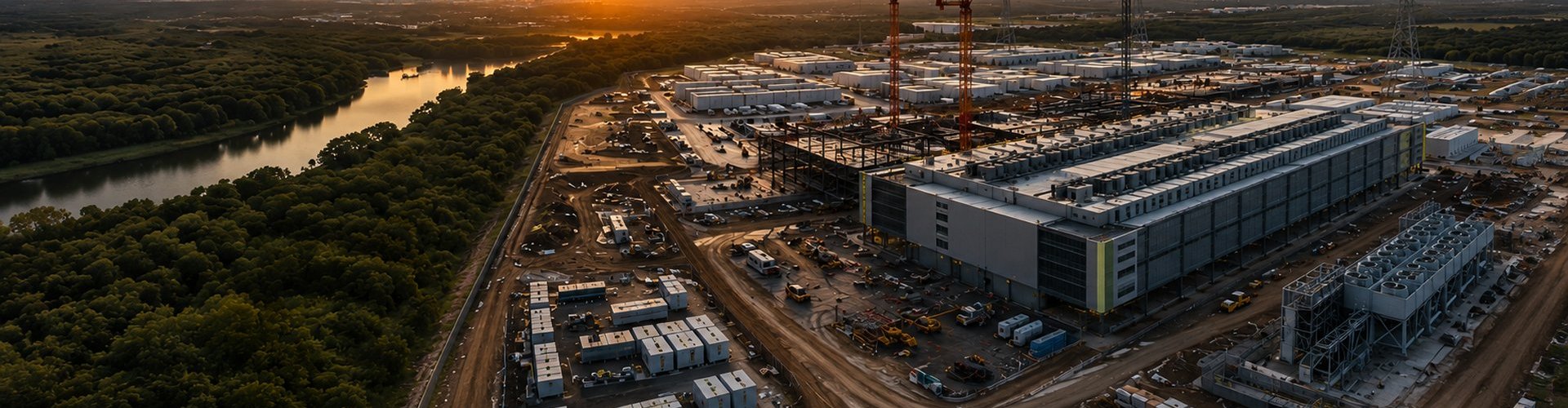
Three classes of anchor facility sit at the center of the AI-industrial complex. The gigafactory builds the physical artifacts the AI era depends on — vehicles at scale, humanoids at scale, energy storage at scale, and the supporting cell, drivetrain, and battery infrastructure that makes the artifacts viable. The fab fabricates the silicon that drives every other facility in the complex — logic semiconductors for compute, memory, power semiconductors, sensor ICs, and the photovoltaic cells that supply distributed and utility-scale solar generation. The datacenter operates the compute infrastructure that trains, deploys, and serves the AI models the rest of the complex depends on — hyperscaler-class training clusters, inference compute at scale, and the supporting power, cooling, and networking infrastructure. No other facility class in the AI-industrial complex aggregates capital, labor, energy, water, materials, supply chain, and policy attention at the scales these three do. They are the canonical anchor facility classes of the AI-industrial era, and the regional industrial geography that hosts all three concurrently is the geography where the AI-industrial complex is observable at maximum density. Texas is that geography. The Texas Triangle hosts gigafactory operations at multiple sites (Tesla Giga Austin, Tesla Megafactory Houston, Toyota Texas San Antonio), fab operations across logic semiconductor (Samsung Taylor, Texas Instruments Sherman, Samsung Austin legacy, NXP Austin) and photovoltaic manufacturing (Tesla-affiliated Georgetown, anticipated Tesla solar gigafactory), and datacenter operations at hyperscaler scale (Meta Hyperion Temple, Tesla Cortex and Dojo Austin, Stargate Abilene, multiple Microsoft, Google, and AWS regional deployments). Austin metro is the focal anchor of the concentration; Dallas-Fort Worth and Houston extend the Triad geography to the broader Triangle scope. This page documents the three anchor facility classes, the specific Texas instantiations, the regional dependencies that make concurrent operation viable, and the substrate constraints that bound the cluster's continued expansion.
The Three Anchor Facility Classes
Each anchor facility class occupies a distinct industrial function, but the three share structural features that distinguish them from non-anchor facilities in the AI-industrial complex. Each represents capital deployment at multi-billion-dollar single-facility scale. Each draws on energy, water, labor, and supply chain inputs at scales that materially affect regional infrastructure planning. Each generates downstream supplier aggregation effects that pull additional industrial capital into the surrounding region. Each operates at the technology frontier rather than at commodity-manufacturing maturity. Together, they constitute the visible physical infrastructure that the AI-industrial complex thesis describes.
| Anchor Facility Class | Industrial Function | Capital Scale (Single Facility) | Primary Inputs |
|---|---|---|---|
| Gigafactory | Vehicle, humanoid, and energy storage manufacturing at million-unit-class scale; cell and drivetrain integration; supplier aggregation at Tier 1 and Tier 2 levels | $3-15B+ at greenfield deployment; multi-billion ongoing tooling and expansion | Skilled trades labor, engineering workforce, electricity, lithium and cathode materials, semiconductors, plastics, steel, aluminum |
| Fab (Logic Semiconductor) | Advanced-node semiconductor fabrication; legacy node fabrication for analog, mixed-signal, and specialty devices; photomask and metrology supply | $15-25B+ at greenfield deployment for advanced-node leading-edge; $5-10B for mature-node 300mm; $1-3B for legacy expansion | Engineering workforce, ultra-pure water, electricity at hyperscaler-class continuity, specialty chemicals and gases, photomasks, equipment from Applied Materials, Tokyo Electron, ASML, KLA, others |
| Fab (Photovoltaic) | Solar cell and module manufacturing at gigawatt-scale; integration with broader energy infrastructure; complementary to BESS and grid integration | $1-5B+ at greenfield deployment for cell-and-module integrated facility | Engineering and skilled-trades workforce, electricity, polysilicon, specialty materials, glass, encapsulants |
| Datacenter | AI training and inference compute infrastructure at hyperscaler class; cloud and enterprise compute; power and cooling infrastructure at facility and campus scale | $1-10B+ at single-campus scale; multi-billion at hyperscaler-class campus; ongoing compute hardware refresh cycle | Electricity at gigawatt class, cooling water, fiber backbone connectivity, GPU and accelerator silicon, networking infrastructure, engineering and operations workforce |
The three anchor facility classes are interdependent at the technology and supply chain level. Gigafactories build vehicles and humanoids that consume semiconductors fabricated in fabs; the AI compute training the vehicles' autonomy stacks runs on datacenters; the photovoltaic cells fabricated in PV fabs feed energy infrastructure that powers gigafactory operations and datacenter operations; battery cells from gigafactories store energy for grid balancing that supports datacenter and fab operational continuity. The interdependence is not an abstraction — it is operationally observable at single-region scale where all three anchor facility classes are co-located.
Texas Triad — Geographic Distribution
The Texas Industrial Triad operates across the Austin metro, the Dallas-Fort Worth corridor, and the Houston corridor, with selected satellite deployments at the Triangle's edges (Abilene, Sherman, Brownsville/Boca Chica). Austin metro hosts the highest concurrent density of all three anchor facility classes. DFW extends the fab dimension through Texas Instruments Sherman and the broader analog and mixed-signal manufacturing presence. Houston extends the gigafactory dimension through Tesla Megafactory operations and the broader manufacturing-and-petrochemical industrial substrate. The geographic distribution is itself analytically distinctive — no other US state hosts the anchor Triad across multiple metro areas in the same concentration.
| Texas Triad Site | Anchor Facility Class | Operator | Triangle Metro |
|---|---|---|---|
| Tesla Giga Austin | Gigafactory (vehicle + humanoid + research silicon + AI training compute) | Tesla | Austin (Travis County) |
| Tesla Megafactory Houston | Gigafactory (Megapack energy storage) | Tesla | Houston |
| Toyota Texas San Antonio | Gigafactory (vehicle assembly — Tundra, Sequoia) | Toyota | San Antonio (Bexar County) |
| Samsung Taylor | Fab — logic, leading-edge advanced node | Samsung | Austin (Williamson County corridor) |
| Samsung Austin (legacy campus) | Fab — logic, mature node | Samsung | Austin (Travis County) |
| Texas Instruments Sherman | Fab — logic, 300mm analog and mixed-signal | Texas Instruments | DFW (Grayson County) |
| Texas Instruments Richardson and Dallas | Fab — legacy and continuing analog manufacturing | Texas Instruments | DFW |
| Tesla Terafab (Giga Austin campus) | Fab — research-grade silicon for AI inference and orbital compute | Tesla | Austin (Travis County) |
| NXP Austin | Fab — automotive and industrial semiconductors | NXP | Austin |
| Georgetown solar manufacturing | Fab — photovoltaic component manufacturing | Tesla-affiliated | Austin (Williamson County) |
| Anticipated Tesla solar gigafactory (PV fab) | Fab — photovoltaic at gigafactory scale | Tesla | Texas region (siting not publicly confirmed) |
| Tesla Cortex 2.0 | Datacenter — AI training compute | Tesla | Austin (Giga Austin campus) |
| Tesla Dojo | Datacenter — AI training compute (custom architecture) | Tesla | Austin |
| Meta Hyperion (Temple) | Datacenter — hyperscaler campus, AI training and inference | Meta | Austin metro extended (Bell County) |
| Stargate AI Center (Abilene expansion) | Datacenter — hyperscaler AI training campus | Multi-operator (OpenAI / Oracle / SoftBank Stargate program) | West Texas (Taylor County) |
| UT Austin TACC | Datacenter — academic supercomputing | University of Texas at Austin | Austin (UT campus) |
| Microsoft, Google, AWS Texas regions | Datacenter — hyperscaler cloud regions | Microsoft, Google, AWS | Distributed (San Antonio, DFW, Austin metros) |
Gigafactory in Texas
Gigafactory operations in Texas are concentrated in the Tesla footprint — Giga Austin as the four-program anchor (vehicle, humanoid, research silicon, AI training compute), Tesla Megafactory Houston for Megapack energy storage, and the Tesla Lithium Refinery at Corpus Christi as upstream feedstock to all Tesla cell operations. Toyota Texas San Antonio operates as a non-Tesla gigafactory at vehicle-only scope. The gigafactory dimension of the Texas Triad is not Tesla-exclusive in principle, but is Tesla-dominated in practice as of April 2026.
Giga Austin is structurally distinct from any other gigafactory globally — the only single-address industrial site running four frontier programs concurrently (vehicle, humanoid, research silicon, AI training compute). This concentration is documented in depth in Giga Austin Nexus. Tesla Megafactory Houston produces Megapack energy storage at scale specifically for ERCOT market integration and broader US deployment, with operational connectivity to broader Tesla Texas operations (Giga Austin vehicle programs, Lithium Refinery feedstock). Toyota Texas operates legacy vehicle assembly with continuing operations and complementary supplier ecosystem in San Antonio.
The gigafactory Texas concentration draws on regional substrate that other US states cannot match. ERCOT grid sovereignty enables behind-the-meter generation and on-site storage configurations that interstate-grid jurisdictions face regulatory friction in deploying. The Williamson County corridor master-planned community absorption provides the residential substrate for tens of thousands of gigafactory-employed engineers and operators. The Texas Triangle Tier 1 and Tier 2 supplier ecosystem is expanding in response to Tesla anchor commitments. The state regulatory environment for industrial siting, permitting, and operations is structurally favorable. The combination is not present at peer state sites in equivalent density.
Logic Semiconductor Fab in Texas
Logic semiconductor fabrication in Texas spans Samsung Taylor (advanced-node leading-edge, AI5 captive manufacturing), Texas Instruments Sherman (300mm analog and mixed-signal), Samsung Austin legacy campus (mature node), Texas Instruments legacy operations (Richardson, Dallas, broader DFW), NXP Austin, and the upcoming Tesla Terafab (research-grade silicon for AI inference and orbital compute). The Texas logic semiconductor cluster is one of two US semiconductor clusters operating at AI-industrial-era scale — Phoenix metro is the other, and the comparison between them is methodologically important to avoid Texas-exceptionalism.
Samsung Taylor is the largest single semiconductor capital commitment in Texas history at $44B+ and is one of the largest concurrent semiconductor commitments globally. The Tesla Terafab construction expands the Texas fab dimension into research-and-captive-production scope — Tesla becomes a vertically-integrated silicon operator for its AI inference programs (AI5, AI6, AI7) and for SpaceX orbital compute applications, with Terafab as the in-house fabrication anchor. Texas Instruments operates the largest US analog and mixed-signal semiconductor manufacturing presence, with Sherman as the largest 300mm capital deployment in the company's history. The combined Texas logic semiconductor footprint addresses fab manufacturing across leading-edge, mature, analog/mixed-signal, automotive/industrial, and research-grade dimensions concurrently.
The fab dimension extends beyond fabrication itself to the broader semiconductor ecosystem in the region. Williamson County hosts Tekscend photomask operations in Round Rock (specialty supply for the regional semiconductor cluster) and Dell ISG manufacturing (server manufacturing complementary to the broader semiconductor ecosystem). The UT Austin Texas Institute for Electronics (TIE) operates the DARPA-funded prototyping facility for advanced packaging and heterogeneous integration. The cluster operates as integrated regional semiconductor ecosystem rather than as isolated fab operations.
Photovoltaic Fab in Texas
Photovoltaic fab operations in Texas are emergent rather than mature as of April 2026. The Georgetown solar manufacturing facility operates Tesla-affiliated photovoltaic component production. The anticipated Tesla solar gigafactory in the Texas region — supported by the $2B+ China solar manufacturing equipment acquisition Tesla disclosed — represents the prospective major PV fab commitment in the region. Siting has not been publicly confirmed; the Texas region is the most likely siting candidate given Tesla's broader Texas operational footprint.
The PV fab dimension of the Texas Triad is the least mature of the three anchor facility classes at present. The combination of declining global PV manufacturing margins, US trade policy on Chinese PV imports, and the Tesla solar product strategy positions the prospective Tesla solar gigafactory as a strategic-capital-coordinated commitment rather than as a pure market-rate manufacturing investment. The siting decision and timeline matter for the broader Texas Triad — a Tesla-scale PV fab in the Triangle would close the gap in the photovoltaic dimension of the Triad and would represent one of the largest PV manufacturing commitments in the United States.
The PV fab dimension also has policy and infrastructure complementarities with the broader Texas Energy Nexus. Solar generation capacity in Texas is the fastest-growing in the United States; co-located solar manufacturing at gigafactory scale would integrate the manufacturing and deployment dimensions of the photovoltaic supply chain within the same regional infrastructure. The combined PV manufacturing and PV deployment density would be analytically distinctive at US peer-region scale.
Datacenter in Texas
Datacenter operations in Texas span hyperscaler AI training campuses (Meta Hyperion at Temple, Tesla Cortex and Dojo at Giga Austin, Stargate at Abilene), academic supercomputing (UT Austin TACC), and hyperscaler cloud regions (Microsoft, Google, AWS Texas regions distributed across the Triangle metros). The Texas datacenter cluster is one of the largest US regional datacenter concentrations and is expanding at velocity through the AI compute buildout window.
The datacenter dimension of the Texas Triad has structural advantages relative to peer US regions. ERCOT grid sovereignty enables interconnection timelines materially faster than Eastern or Western Interconnection states, and behind-the-meter generation and on-site storage configurations operate within state regulatory frameworks rather than federal interstate frameworks. The Texas hydrocarbon production basins supply natural gas to ERCOT generation at production-region prices, supporting datacenter power costs. Land availability in West Texas (Stargate Abilene), Central Texas (Meta Hyperion at Temple), and broader Triangle satellite locations is materially better than at peer-region datacenter clusters in California or the Northeast. The combined datacenter, fab, and gigafactory power demand is materially shaping ERCOT capacity planning, which is itself a distinguishing feature of the Texas datacenter cluster compared to peer regions where datacenter expansion does not materially shape grid planning at state scale.
The datacenter cluster's continued expansion is constrained by water (cooling water demand competing with semiconductor fab and master-planned community demand), grid capacity (despite ERCOT's flexibility, capacity is not unlimited), and regulatory friction at the local level (specific Travis County and Austin city tensions over datacenter water and power usage are active). The 2026-2030 window will determine whether the Texas datacenter cluster reaches its prospective scale or whether substrate constraints limit expansion before that point.
The Triad Concurrence in Context
The Texas Industrial Triad concurrence — gigafactory, fab, and datacenter operations at hyperscaler-class scale within a single state-controlled regional industrial system — is distinctive globally. Other regions host one or two of the anchor facility classes at scale; few host all three concurrently within a single regional industrial system. The comparative reference is methodologically necessary to avoid Texas-exceptionalism in the analysis.
| Peer Region | Gigafactory | Logic Fab | PV Fab | Datacenter | Triad Concurrence |
|---|---|---|---|---|---|
| Texas Triangle | Strong (Tesla, Toyota) | Strong (Samsung, TI, Tesla, NXP) | Emerging (Tesla) | Strong (Meta, Tesla, Stargate, hyperscalers) | All four dimensions concurrent at single-state regional scale |
| Phoenix metro | Limited (no major vehicle or humanoid gigafactory) | Strong (TSMC Arizona, Intel) | Limited | Strong (hyperscaler regions) | Logic fab and datacenter strong; lacks gigafactory and PV manufacturing |
| California (Bay Area + Greater LA) | Limited (Tesla Fremont legacy; no greenfield gigafactory expansion) | Limited (semiconductor design dominant; minimal manufacturing) | Limited | Strong (hyperscaler operations) | Datacenter strong; gigafactory limited; lacks fab manufacturing |
| Detroit / Great Lakes | Strong (legacy automotive scale; transitioning) | Limited | Limited | Limited (hyperscaler regional) | Gigafactory-only; lacks fab and concentrated datacenter |
| Columbus / Central Ohio | Limited (Honda EV in adjacent Ohio sites) | Strong (Intel Ohio commitment) | Limited | Strong (hyperscaler) | Fab and datacenter strong; gigafactory limited; lacks PV |
| Pearl River Delta (China) | Strong (BYD, multiple operators) | Strong (multiple operators including SMIC nearby) | Strong (LONGi, Trina, JinkoSolar in broader region) | Strong (cloud and AI compute at scale) | All four dimensions; different governance and capital structure; component sites distributed across broader region |
| Yangtze River Delta (China) | Strong (Tesla Shanghai, multiple operators) | Strong (SMIC Shanghai) | Strong (multiple PV operators) | Strong (cloud and AI compute) | All four dimensions at largest absolute scale globally; different governance structure |
| Hsinchu (Taiwan) | Limited | Largest globally (TSMC concentration) | Limited | Limited (regional) | Logic fab dominant; lacks gigafactory, PV, concentrated datacenter |
| Pyeongtaek / Hwaseong (Korea) | Limited | Largest single-site globally (Samsung Pyeongtaek) | Limited | Limited (regional) | Logic fab dominant; lacks broader Triad |
| Berlin-Brandenburg (Germany) | Strong (Tesla Berlin-Brandenburg, vehicle and cell) | Limited (Dresden adjacent has TSMC ESMC, Infineon, GlobalFoundries Dresden) | Limited | Limited | Gigafactory and adjacent fab; lacks PV and concentrated datacenter |
Substrate Dependencies Shared Across the Triad
The three anchor facility classes share substrate dependencies that the regional industrial system must supply concurrently. The shared substrate is what makes Triad concurrence operationally viable, and the substrate constraints are what bound continued Triad expansion.
| Shared Substrate | Gigafactory Demand | Fab Demand | Datacenter Demand | Texas Substrate Capacity |
|---|---|---|---|---|
| Electric power (firm capacity) | Hundreds of MW per site | Hundreds of MW to GW per site | Hundreds of MW to multi-GW per campus | ERCOT diverse generation; behind-the-meter optionality; storage at scale; structurally distinct interconnection |
| Process and cooling water | Material; cell and battery cooling; assembly | Critical; ultra-pure water at gallons-per-day scale per site | Material to substantial; cooling at hyperscaler scale | Colorado, Trinity, Brazos basin systems; LCRA and regional water authorities; active stress and competitive demand |
| Engineering workforce | Vehicle, mechanical, electrical, robotics, software | Process, materials, electrical, controls | Networking, software, operations, mechanical, electrical | UT Austin Cockrell, broader regional engineering pipeline; in-migration; competitive workforce market |
| Skilled trades labor | Heavy at build-out; ongoing maintenance | Heavy at build-out; specialty trades; ongoing maintenance | Heavy at build-out; mechanical and electrical specialties | Regional trades pool; allocation competition with concurrent semiconductor and master-planned community construction |
| Specialty chemicals and gases | Cell and battery materials; assembly chemicals | Critical; specialty chemistries; bulk industrial gases at scale | Limited specialty; coolants and refrigerants at scale | Gulf Coast petrochemical cluster supply; Air Liquide and Linde regional; integrated supply chain advantage |
| Logistics infrastructure | Inbound supplier deliveries; outbound vehicle and unit shipping at scale | Inbound equipment and materials; outbound wafer and module shipping | Inbound compute hardware and operational supplies | I-35, I-10, I-45 corridors; SH 130; Union Pacific and BNSF rail; Gulf Coast intermodal; Mexico border |
| Supplier ecosystem | Tier 1 and Tier 2 vehicle and battery suppliers | Equipment, photomask, materials, specialty | Hardware, networking, services | Active aggregation around anchor commitments; Williamson County and broader Triangle siting expansion |
| Capital coordination | Corporate strategic; supplier private; state incentive | Federal CHIPS; state TSIF; corporate strategic; supplier private | Hyperscaler corporate strategic; ERCOT capacity planning | Federal-state-county-private coordination at sustained scale |
Constraints and Failure-Mode Considerations
The Texas Triad concurrence generates observable advantages and observable risks. Identifying the failure modes alongside the operational logic is part of the methodological commitment.
Water-energy nexus stress — the three anchor facility classes together demand water and electric power at scales that materially affect regional capacity planning. Water stress in Central Texas is the most likely binding constraint within the 2027-2032 window, affecting fab and datacenter operations most directly while indirectly affecting gigafactory cell production water demand.
Single-grid event exposure — ERCOT independence carries the corresponding exposure to single-grid events. A material grid event affecting Triangle metros simultaneously affects all three Triad dimensions concurrently, with no peer-state imports available at scale to compensate during the event.
Single-state regulatory dependency — the Triad operates within a single state regulatory and tax environment. Material shifts in state-level posture toward water allocation, grid policy, taxation, regulation, or federal-state coordination affect all three Triad dimensions simultaneously rather than being diluted across multiple jurisdictions.
Workforce competition — the three Triad dimensions compete for engineering and skilled trades labor against each other and against the broader Triangle industrial cluster (semiconductor design, broader tech employer base, defense industrial base). Tightening regional labor markets affect all three dimensions concurrently.
Supply chain concurrence pressure — concurrent build-out of multiple Triad facilities competes for the same Tier 1 and Tier 2 supplier capacity, the same construction trades, the same specialty equipment. Allocation competition is observable now and likely to intensify.
Demand-side concentration — the three Triad dimensions depend on continued AI-era demand realizing at projected scales. If vehicle adoption (Cybercab), humanoid deployment (Optimus and peer programs), AI compute demand (training and inference workloads), or fab utilization rates underperform the implicit operational plan, the regional capital deployment thesis faces downward revision pressure simultaneously across multiple Triad dimensions.
PV fab dimension uncertainty — the photovoltaic fab dimension of the Texas Triad is the least mature and the most exposed to shifting trade policy, manufacturing margin pressure, and corporate strategic-capital allocation decisions. The prospective Tesla solar gigafactory siting and timeline uncertainty leaves the PV dimension as the most contingent of the four.
Related Coverage
Texas AI & Hyperscalar Data Centers | Facility Node List | Mapping the Convergence | The Austin Supercluster | Texas Energy Nexus | TX AI-Industrial Workforce | Samsung Taylor Fab | Stargate Abilene (Campus 1)