AustinIO > Austin Strategic CapEx Nexus
Austin Strategic CapEx Nexus
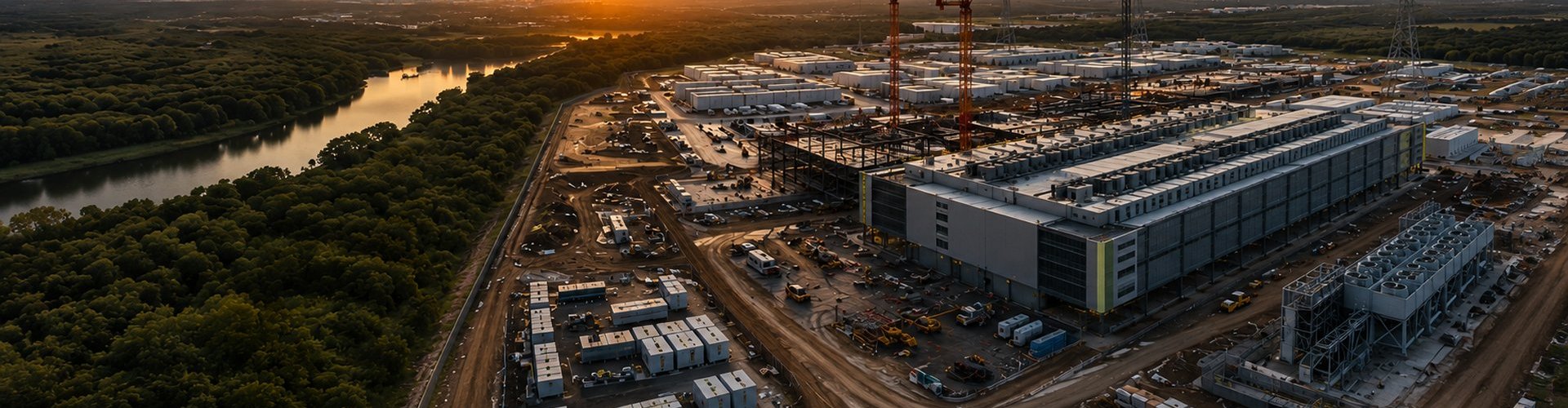
Federal agencies, the State of Texas, Austin-area counties and cities, anchor corporations and their suppliers all put capital into the same Austin regional buildout over the same window, 2022-2026. Each source covers a gap the others leave. A CHIPS Act grant does not build a fab without state incentives, county roads and corporate capital. A Texas Semiconductor Innovation Fund award does not anchor a research fab without a DARPA program and corporate partners. County road bonds do not open new subdivisions without TxDOT (Texas Department of Transportation) highway work and developer capital.
The 2022-2026 Coordination Window
Austin's semiconductor base dates to the 1980s Sematech and MCC (Microelectronics and Computer Technology Corporation) consortia and to Dell and Samsung Austin Semiconductor (operating since 1996). The public funding structure that now backs the buildout came together between 2022 and 2026:
- August 9, 2022: the federal CHIPS and Science Act is signed.
- June 9, 2023: the Texas CHIPS Act (HB 5174) is signed, creating the Texas Semiconductor Innovation Fund (TSIF) and the Texas Semiconductor Innovation Consortium.
- July 2024: DARPA (the Defense Advanced Research Projects Agency) awards $840 million under its Next Generation Microelectronics Manufacturing (NGMM) program to the Texas Institute for Electronics (TIE) at UT Austin.
- June 2025: the Texas Legislature appropriates another $250 million to TSIF, bringing total TSIF appropriations to about $948 million.
- September 2025: TSIF awards $250 million to Samsung for the Taylor fab.
The Capital Sources
| Capital Source | Main Programs and Funders | Role in the Buildout | Approximate Scale Through 2026 |
|---|---|---|---|
| Federal Strategic Capital to Austin | CHIPS Act grants and loans; DARPA NGMM; NSF (National Science Foundation) research grants; DOD (Department of Defense) and DOE (Department of Energy) research; NASA contracts | Largest single-source public layer; anchors site selection and requires state and local matching | About $5.6 billion-plus to Austin-region recipients, led by $4.745B in CHIPS Act funding to Samsung Taylor and $840M in DARPA NGMM funding to TIE |
| Texas State Strategic Capital to Austin | TSIF; Texas Enterprise Fund (TEF, deal-closing job grants); JETI Act (Jobs, Energy, Technology and Innovation Act, a property tax incentive); the $552M legislative appropriation to TIE; university endowments | Matching capital that federal programs require; funds projects below federal scale | About $1.5 billion across TSIF, TEF and the TIE appropriation |
| County and Municipal Strategic Capital to Austin | Williamson County road and parks bonds; Travis, Hays and Bastrop county infrastructure; City of Austin bonds; municipal utility districts | Voter-approved roads, water and utilities that sites and new housing depend on | More than $1.3 billion in Williamson County bonds alone (2019 and 2023) |
| Austin Region Strategic Private Capital | Samsung, Tesla, Apple, Oracle, AMD, NVIDIA, Arm, Silicon Labs, Texas Instruments, Dell; strategic venture and sovereign wealth funds | Largest layer by dollars; builds and runs the plants that public capital helped site | Tens of billions, led by Samsung's $44 billion-plus Taylor and Austin commitment |
| Austin Region Supply Chain Capital Investment | Equipment makers (Applied Materials, Tokyo Electron, Lam Research, KLA, ASML); specialty chemicals, gases and photomasks; parts cleaning (KoMiCo); electronics manufacturing services (Flex) | Supplier capital pulled into the region by Samsung and Tesla | Multi-billion and growing as anchor programs ramp |
Federal and State Semiconductor Awards by Recipient
Federal and Texas semiconductor awards in the Austin region cover leading-edge fabrication, prototyping, specialty devices, photomask supply and technician training:
| Recipient | Federal Commitment | State Commitment | What It Funds |
|---|---|---|---|
| Samsung Taylor | $4.745B CHIPS Act | $250M TSIF (September 2025) | Leading-edge 2nm logic fabrication for AI, 5G and high-performance computing |
| Texas Institute for Electronics (TIE), UT Austin | $840M DARPA NGMM (July 2024) | $552M Texas Legislature appropriation | Prototyping fab for 3D heterogeneous integration, advanced packaging and defense electronics |
| Silicon Laboratories | Federal supplemental research grants | $23.3M TSIF | $80M AI and wireless R&D lab |
| SpaceX (Bastrop) | NASA contracts and DOD programs | $17.3M TSIF | Aerospace-grade and orbital semiconductor capacity |
| Tekscend Photomask (Round Rock) | None listed | $15.2M TSIF | Photomask supply |
| Coherent Corp. | None listed | $14.1M TSIF | Specialty semiconductor materials and components |
| Austin Community College | CHIPS Act workforce programs | $3.6M for an advanced manufacturing lab; $3.75M from TIE for a Semiconductor Training Center partnership | Semiconductor technician training |
How Public and Private Capital Combine
Austin-region projects combine funding in recurring patterns:
- Federal award with state match: Samsung Taylor combines $4.745B in CHIPS Act funding, $250M from TSIF, and county and municipal infrastructure under a $44 billion-plus corporate commitment.
- State award with federal supplement: Silicon Labs pairs a $23.3M TSIF award for its $80M AI and wireless lab with federal research grants.
- County bond with private developer: Williamson, Travis, Hays and Bastrop county road bonds combine with federal Highway Infrastructure Program (HIP) funds, TxDOT projects, city contributions and developer capital to open land for housing and mixed-use growth.
- Federal program that draws partners: TIE combines $840M from DARPA and $552M from the Texas Legislature with 32 defense and commercial semiconductor industry partners and 18 academic institutions, for a total project investment of $1.4 billion.
- Corporate anchor that draws suppliers: Samsung Taylor pulled Tokyo Electron, Applied Materials, ENF, Sachem and photomask suppliers into the Williamson County corridor.
Capital by County
Williamson, Travis, Hays and Bastrop counties host the main commitments; Bell, Burnet and Caldwell counties see secondary growth.
| County | Major Anchor Commitments | Voter-Approved and Public Capital |
|---|---|---|
| Williamson County | Samsung Taylor ($44B-plus, the largest foreign direct investment in Texas history); the Apple Austin campus expansion on the Travis County line; the Round Rock cluster of Dell, Tekscend Photomask and NXP; growth in Liberty Hill, Leander, Cedar Park, Georgetown, Hutto and Taylor | $1.3 billion-plus: 2019 road bond ($412M), 2019 parks bond ($35M), 2023 road bond ($825M), 2023 parks bond ($59M) |
| Travis County | Tesla Giga Texas (opened April 2022); UT Austin and TIE; most of the Apple Austin campus; the Oracle East Riverside campus; corporate offices in the City of Austin core | Travis County and City of Austin bonds for transportation, water and utilities; the $7.1 billion Project Connect transit program, approved in 2020 and under construction |
| Hays County | Residential growth in Buda, Kyle, San Marcos and Dripping Springs; semiconductor supply chain sites; Texas State University as a workforce source | County and municipal infrastructure across the southern metro corridor |
| Bastrop County | The Musk Bastrop Complex (SpaceX, X Corp. and The Boring Company); residential and commercial growth in Bastrop and Elgin | County infrastructure coordinated with state highway projects |
Related Coverage: The Austin Supercluster | UT Austin Nexus | Austin Startup Nexus | Texas Energy Nexus | Texas AI & Hyperscalar Data Centers | The Texas Nexus