AustinIO > Austin as the Model 5IR City
Austin as the Model 5IR City
Austin is becoming one of the most concentrated technology and industrial regions in the United States. What makes it different is not any single company or sector. It's the combination of six systems operating in parallel and increasingly coordinating with each other: an industrial manufacturing base, a university research and federal coordination layer, a startup ecosystem, large-scale public and private capital, a surrounding regional system, and a state-level energy and trade infrastructure.
Most US tech regions have one or two of these at scale. A few have three. Austin has all six in the same place, with active connections between them.
This is not a claim that Austin is the only region where this is happening. Similar concentrations exist globally. But in the United States, Austin is the clearest current example, and that combination is the subject of this page.
Austin combines six concentration nexuses at one location: Giga Austin, UT Austin, Austin Startups, Austin CapEx, Texas Triangle, and Texas Energy. Each operates at scale on its own. Together they produce something no single nexus could.
The Six Nexuses
Each nexus has its own pillar page with the full coverage. The summaries below explain what each one is and why it matters as part of the larger picture.
Giga Austin Nexus — Tesla's four-program campus
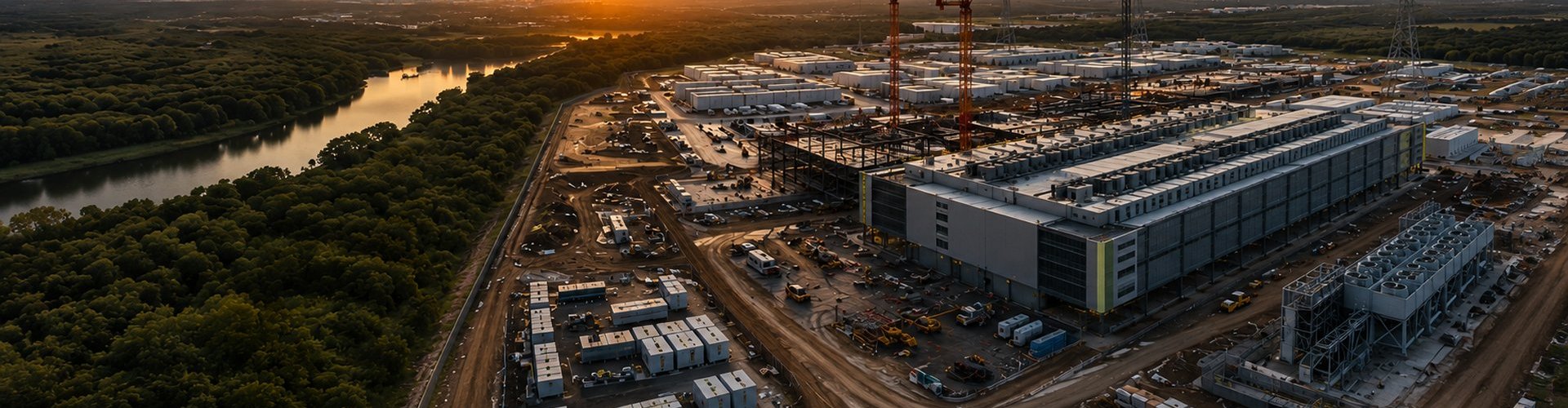
Tesla runs four different programs at one site east of Austin: vehicle production, AI training compute (Cortex 2.0), humanoid robot manufacturing (Optimus), and a research fab (Terafab). Most industrial campuses run one program. A few run two. Tesla runs four.
Three more Tesla operations extend the footprint across Texas: a lithium refinery in Corpus Christi, a Megapack factory in Houston, and a Starlink terminal factory in Austin. Together they form a vertically integrated system that covers silicon, energy storage, vehicles, robotics, and AI compute.
No other Tesla site runs more than two programs. Tesla Shanghai is vehicle-only. Berlin-Brandenburg is vehicles plus cells. Lathrop is energy storage only. No other US industrial campus from any operator runs four frontier programs at one address.
UT Austin Nexus — university, federal, and defense coordination
The University of Texas at Austin is the research anchor for the region. What sits at one institution:
- Texas Institute for Electronics (TIE) — $840M from DARPA plus $500M+ in state support for semiconductor prototyping
- Texas Advanced Computing Center (TACC) — one of the largest US academic supercomputing facilities
- Cockrell School of Engineering — engineering education and research backbone
- Computer Science and AI programs — research with industry partnerships
- Microelectronics Manufacturing Center — federal-state advanced packaging research
- Army Futures Command — headquartered in Austin, with active UT collaboration
Beyond the research itself, UT functions as a coordination layer where federal program offices, state economic development, and private industry partnerships all interact. Samsung, Tesla, Apple, Intel, IBM, and others have working relationships with UT research groups. Most US tech regions have a strong university. Few have one operating at this depth across federal, defense, academic, and industry channels at once.
Austin Startup Nexus — founders, capital, and commercialization
Austin was named the #1 US city to start a business in the 2025 USA Today study of 46 major US cities.
7,000+ business births with a net of 1,629 new businesses. 13.5% business entry rate. 13.2% of households reporting self-employment income — the highest among the 46 cities studied. GDP growth of 14.3% during 2021-2022, the largest among major US cities except El Paso.
The institutions behind the numbers:
- Capital Factory — main private accelerator and coworking space
- Austin Technology Incubator (ATI) — UT-anchored incubator running since 1989
- McCombs Harkey Institute for Entrepreneurial Studies — graduate-level entrepreneurship
- MSTC Program — Master of Science in Technology Commercialization, the first US program of its kind
- Austin VC community — venture firms, angels, and growth capital
- SXSW — annual founder and investor convergence event
This isn't a recent phenomenon. Austin's startup density traces back to the 1960s, when McCombs Dean George Kozmetsky started building what he called Silicon Hills. Today's numbers are the compounding result of six decades of deliberate ecosystem building. More than 20 unicorn companies have been founded in Austin in the past two decades, including Bumble, Indeed, and CrowdStrike. The ecosystem valuation exceeds $89 billion. Austin-based startups received approximately $4 billion in venture funding in 2024.
The MSTC program produced founders including Jeff Cardenas, whose company Apptronik now builds humanoid robots. Apptronik operates at scales that connect directly to Tesla's Optimus factory across town — a concrete example of one nexus feeding another.
Austin CapEx Nexus — public and private capital coordination
Roughly $6.4 billion or more in committed federal and state semiconductor capital has flowed into the Austin cluster as of April 2026. The aggregate is less interesting than what it builds.
Samsung Taylor: $4.745B federal CHIPS plus $250M TSIF.
UT TIE: $840M DARPA plus $500M+ state support.
Arm: $4.1M TSIF for Austin campus expansion.
Silicon Labs: $23M+ TSIF for $80M R&D lab.
Austin Community College: $3.6M for advanced manufacturing workforce training.
Tekscend Photomask: $15.2M TSIF for Round Rock photomask operations.
The capital is building a complete semiconductor stack at one regional location: fabrication, prototyping, IP and design, specialized devices, workforce, and photomask supply. Other clusters get federal support or state support. Few get both at this depth, coordinated around the same buildout.
The pattern extends beyond semiconductors. Williamson County's voter-approved $412M 2019 Road Bond funds the corridor expansion that supports the residential and commercial buildout. Texas Enterprise Fund grants flow alongside municipal incentives. Strategic private capital — sovereign wealth, growth-stage VC, corporate strategic investment — moves in the same direction.
Texas Triangle — the regional system
Austin sits at the center of a larger system: Dallas-Fort Worth, Houston, San Antonio, the Gulf Coast, Starbase, and the Mexico border. Austin's growth velocity exceeds the other Triangle metros. Capital inflows lead the region. UT Austin anchors the academic side at a depth other Triangle cities don't match. State government sits in Austin. The other cities provide industrial capacity, logistics, ports, and additional scale.
The buildout absorbs incoming capital and population through master-planned community development:
- Wolf Ranch (Georgetown) — $1.1 billion in residential development on 1,120 acres held by the Wolf family for 65 years before the 2014 Hillwood acquisition
- Sun City Texas (Georgetown) — approximately $15.7 billion in concentrated household wealth across 15,700 residents
- Williamson County corridor overall — 40+ master-planned communities representing $7-10 billion in residential capital deployment
The Hero Way / RM 2243 expansion is converting a rural two-lane road between Leander and Georgetown into a divided controlled-access highway. $132M total project. $100M in right-of-way acquired from approximately 60 landowners. Funded primarily through Williamson County's voter-approved $412M 2019 Road Bond. Adjacent commercial development includes the $2B District 2243 mixed-use urban village. Texas builds infrastructure at speeds most US states can't match.
Texas Energy Nexus — grid, generation, and trade
Texas runs the only US state grid that is largely independent of the federal interconnections. ERCOT operates under state regulation, which produces different economics, planning timelines, and risk profiles than other US grids.
The generation mix is unusually diverse:
- US leader in wind generation
- US leader in solar deployment growth
- Substantial gas-fired peaking capacity
- Nuclear baseload at Comanche Peak and South Texas Project
- BESS deployment at scales that exceed many states' total storage
- Permian Basin and Eagle Ford Shale at the largest US hydrocarbon scales
- Houston ship channel petrochemical concentration
- LNG export terminals on the Gulf Coast
Beyond energy itself, Gulf Coast ports at Houston, Corpus Christi, Galveston, Port Arthur, Beaumont, and Brownsville move substantial US energy exports plus general cargo. The Mexico border at Laredo, El Paso, McAllen, and Brownsville integrates Texas with North American manufacturing supply chains.
No other state combines grid independence, generation diversity, hydrocarbon production at the largest US scales, petrochemical concentration, BESS leadership, port access, and border trade. Without this substrate, the AI compute, fabs, and datacenter buildout in the rest of the cluster cannot operate at scale.
Why the Combination Matters
Each nexus is valuable on its own. The advantage comes from how they connect.
UT Austin produces graduates and research that feed both the startup ecosystem and Giga Austin's hiring. Strategic capital flows through TIE at UT, building research substrate that semiconductor operators across the cluster draw from. Texas Energy provides the power that Giga Austin's compute, Samsung Taylor's fabs, and the broader datacenter buildout require. The Texas Triangle absorbs the population growth and provides the logistics, ports, and border trade.
Take Texas Energy out and Giga Austin's AI compute can't scale. Take UT Austin out and the founder pipeline weakens. Take strategic capital coordination out and Samsung Taylor and TIE wouldn't exist as they do. Each nexus depends on the others. That's what makes the cluster harder to replicate than any single nexus would be.
It's also what makes the cluster more durable than a single-anchor cluster would be. If any one nexus weakens, the others continue. The structural advantage doesn't depend on any single program working out.
Austin Compared
Other regions are stronger in specific areas. The point of comparison is not to argue Austin is best at any one thing — it isn't — but to show what each peer cluster does best and what Austin combines that they don't.
| Peer Cluster | What it leads in | What Austin combines that it doesn't |
|---|---|---|
| Phoenix | TSMC at substantial scale; leading-edge logic foundry capacity | Energy autonomy; university-federal-defense coordination at TIE depth; startup density |
| Hsinchu Science Park | Global anchor of advanced semiconductor manufacturing; supplier ecosystem unmatched | Multi-domain breadth — energy, AI compute, vertically integrated EV and robotics |
| Pyeongtaek | Samsung leading-edge logic and memory; Korean industrial coordination at scale | Startup density and broader academic anchor |
| Shenzhen / Pearl River Delta | Hardware manufacturing density; rapid prototyping; multi-program concentration distributed across nearby sites | Federal-academic-defense coordination patterns (China's coordination runs through different channels) |
| Bangalore | Indian software and semiconductor design at scales exceeding US single-cluster software | Semiconductor manufacturing buildout and energy substrate |
| Bay Area | Largest US startup ecosystem by absolute capital and exit value | Cost basis and infrastructure buildout headroom (relative; narrowing) |
| Boston | Academic depth (MIT, Harvard, broader Cambridge research); biotech leadership | Commercial scale in venture funding; multi-domain industrial substrate |
| Pittsburgh | Carnegie Mellon AI and robotics depth; autonomous systems leadership | Overall ecosystem scale; capital depth; multi-nexus convergence |
| Singapore | Sovereign-capital-backed infrastructure investment; Southeast Asian regional anchor | US federal-state coordination; multi-domain industrial concentration at one focal point |
Peer clusters match Austin in one or two dimensions but not in the combination. Hsinchu has more semiconductor scale. Bay Area has more startup capital. Boston has more academic depth. Shenzhen has more hardware density. Austin combines six things at one place that no peer cluster combines together. That's the distinctive feature — not winning any single category.
Constraints
The cluster has real constraints that the substrate advantage doesn't eliminate. None are fatal individually, but they shape how fast the buildout can keep scaling.
| Constraint | What it means |
|---|---|
| Water stress | Texas water resources are limited and increasingly stressed by industrial water demand from fabs, datacenters, and population growth. Aquifer depletion in central Texas continues. Surface water allocation is fully committed and contested. Harder to fix with capital than energy is. |
| Infrastructure absorption pace | Right-of-way acquisition for major projects takes years. Future corridor expansions face rising land cost and community resistance as residential density grows. Current execution speed may not be sustainable indefinitely. |
| Single-entity exposure | Several nexuses depend heavily on one entity. Giga Austin depends on Tesla. Samsung Taylor depends on Samsung. TIE depends on continued DARPA funding. Cross-nexus redundancy helps, but within-nexus concentration is real. |
| Governance volatility | Texas state-level coordination has been favorable under recent administrations. Future administrations may pursue different priorities. Federal CHIPS Act allocation depended on a specific political coalition. Capital coordination is more dependent on policy continuity than physical infrastructure is. |
| Cost of living | Austin's cost of living has risen rapidly during the buildout. The relative-cost advantage that drove migration from Bay Area is narrowing. Workforce substrate depends partly on continuing affordability that may not persist. |
| Demographic stratification | Wealth concentration patterns produce stratification with social and political implications. The buildout is not affordable to the broader Texas population. Long-term absorption capacity depends on managing those effects. |
What Comes Next
The convergence is in active build-out. Three of the six nexuses are mature in their core function: Texas Energy, Texas Triangle, and Austin Startups. The other three are still ramping:
- Giga Austin — vehicle production is mature; Optimus, Terafab, and Cybercab are ramping
- UT Austin — TIE construction is operational; first wafer-out timing not yet disclosed
- Austin CapEx — actively coordinating federal, state, and local capital across multiple announced and pending programs
The 2026-2030 window will determine whether the six-nexus combination reaches operational maturity at the scales currently announced or whether one or more nexuses falls short of what regional capital and infrastructure commitments imply.
Bull case — all six nexuses reach maturity together, the supplier and workforce ecosystem matures around the combination, and the Austin cluster becomes a reference template for multi-nexus industrial co-location at frontier scale.
Bear case — one or more nexuses underperforms (most exposed: Cybercab adoption, Optimus end-market, Terafab process maturity, water allocation, governance shifts), and the regional ecosystem absorbs the underperformance.
Either outcome will show up in regional substrate signals: supplier siting decisions, master-planned community absorption, engineering hiring, infrastructure capacity at ERCOT and LCRA, and the broader corridor commercial buildout pace. AustinIO continues to track the substrate as the cluster evolves.
Related Coverage
UT Austin Nexus | Austin Startup Nexus | Austin Strategic CapEx Nexus | Texas Energy Nexus | The Austin Supercluster | Mapping the Convergence | Giga Austin Nexus | Texas Triangle Cluster