AustinIO > The Texas Nexus > Texas Triangle Cluster
Texas Triangle Cluster
Densest AI-Industrial Concentration Within Texas
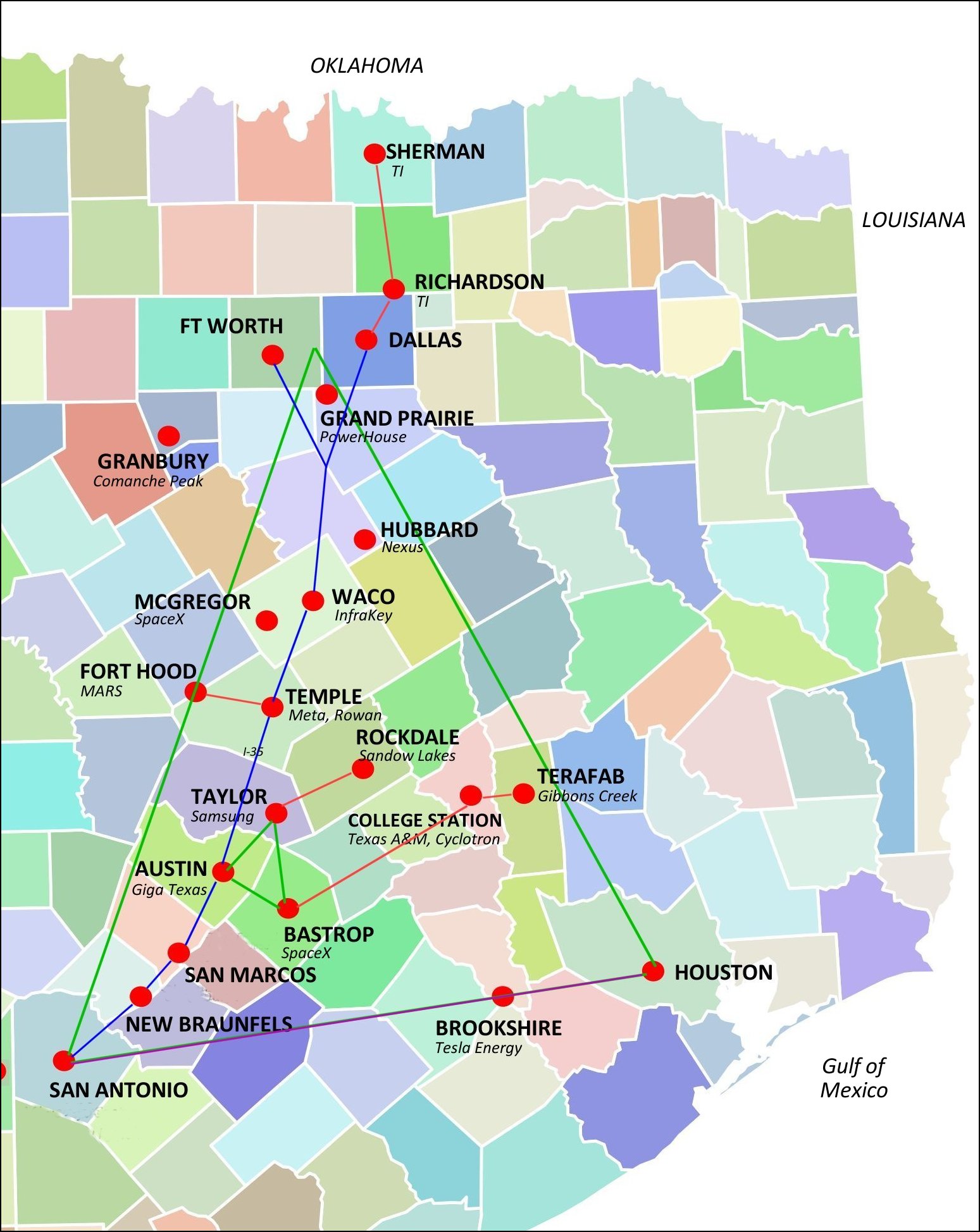
The Texas Triangle is the four-metro core — Austin, Dallas-Fort Worth, Houston, San Antonio — holding roughly 80 percent of Texas's population and GDP density. Within the broader Texas Nexus state-level frame, the Triangle is the densest sub-region but not the outer frame; anchors in the Panhandle, Trans-Pecos, Rio Grande Valley, and Gulf Coast sit outside it. The Triangle is where most of the AI-Industrial convergence concentrates, and where the named corridors covered on AustinIO operate.
The four metros are integrated through shared labor markets, ERCOT grid, intermodal rail, Gulf Coast logistics, and state-level coordination. Tesla's Texas footprint distributes across Austin, Houston (Brookshire Megapack), and Corpus Christi (Robstown Lithium) within a single operational network. Engineers commute and relocate between metros. Tier 1 and Tier 2 suppliers serve customers across the Triangle. The Triangle is one industrial system, not four separable economies.
The Four Metros
| Metro | Population | Anchor Roles |
|---|---|---|
| Austin | ~2.5M | AI-Industrial focal point: Tesla Giga Texas, Samsung Taylor, Apple Austin, Dell Round Rock, Starlink Factory at Bastrop, TIE NGMM, broader semiconductor design cluster |
| Dallas-Fort Worth | ~8.1M | Defense-industrial spine: Lockheed Fort Worth, Raytheon McKinney, Northrop Allen, Bell Textron; TI HQ; corporate finance; logistics |
| Houston | ~7.5M | Energy industry HQ; Houston Ship Channel petrochemical complex; Brookshire Megapack; Port of Houston; LNG export gateway |
| San Antonio | ~2.7M | Cybersecurity and military intelligence (Joint Base San Antonio, NSA Texas); Toyota San Antonio; Mexico border trade gateway |
Forward-looking metro candidate: Starbase at Boca Chica is on a trajectory to become the Triangle's fifth metro within the next 4-5 years. The 2025 incorporation as a city, the Cameron County land swap with U.S. Fish & Wildlife Service, the Starship V3 and V4 program scaling, and the broader SpaceX vertical-stack expansion across Cameron, McLennan, and Bastrop counties together imply substantial physical and demographic buildout that current metro classifications do not yet capture.
The Six Corridors
The Triangle's industrial and residential geography organizes around six named corridors. Each connects multiple cities or counties along a transportation spine and carries a distinct combination of industrial specialization and growth dynamics. Corridor pages cover each in depth.
| Corridor | Geography | Specialization |
|---|---|---|
| U.S. Highway 79 Corridor | Round Rock → Hutto → Taylor → Rockdale → College Station (17mi dense, 97mi extended) | Manufacturing supplier ring and advanced fab; densest semiconductor specialty supplier concentration in the Triangle |
| Austin-Taylor Manufacturing Axis (SH 130) | Travis County (Giga Texas) → Williamson County (Samsung Taylor), ~30mi | Tesla-Samsung captive supply chain spine; operational embodiment of the captive-fab arrangement |
| Georgetown-Hutto-Taylor Datacenter Corridor | Williamson County DC cluster (sub-corridor within Highway 79) | Datacenter concentration: Sabey, Switch, Skybox/Prologis, Blueprint, Colovore |
| Austin-Waco I-35 / I-14 Defense-Industrial Spine | Austin → Temple → Killeen-Fort Cavazos → Waco, ~130mi | Defense contractors, SpaceX McGregor engine production, Heroes MAKE America workforce pipeline; residential absorption along I-35 north |
| U.S. 183 N Austin / Space Corridor | Austin → Cedar Park → Leander → Liberty Hill → Georgetown | Firefly Aerospace, prospective Blue Origin, emerging space anchor concentration; in active full-corridor commercial-and-residential buildout |
| Austin-San Antonio Corridor (I-35 South) | Austin → San Marcos → New Braunfels → San Antonio, ~80mi | Two-metro connection spine; San Marcos-New Braunfels sub-corridor in full residential, commercial, and light-industrial buildout; absorption substrate for Austin-area industrial workforce |
Why the Corridor Architecture Matters
The Triangle's industrial geography is not legible at metro level alone. Samsung Taylor sits in Taylor, but its supplier ring extends through Round Rock, Hutto, Georgetown, and Killeen — across multiple cities along the U.S. Highway 79 and Austin-Taylor axes. Tesla Giga Texas is in Travis County, but its operational integration includes Brookshire (Megapack), Robstown (lithium refining), and Bastrop (Starlink and advanced packaging) — none of which are within Austin metro proper. The corridor architecture is what makes these distributed industrial systems visible as integrated wholes rather than disconnected facilities.
Each corridor combines an AI-Industrial role with a residential and commercial buildout dynamic. The U.S. 183 N Austin / Space Corridor carries Firefly's space anchor identity alongside the largest sustained suburban growth in the Triangle outside the I-35 South corridor. The Austin-San Antonio Corridor carries the two-metro connection spine alongside the San Marcos-New Braunfels sub-corridor that is itself one of the fastest-growing regions in the United States. The corridors are not separable from the master-planned community absorption that runs alongside the industrial buildout — both are part of the same regional system. The corridor pages cover each in this combined frame.
Related Coverage
Brazos Valley Semiconductor Concentration | Gulf Coast Nexus | Trans-Pecos & West Texas Nexus | Rio Grande Valley Nexus | Golden Dome Texas Corridor