AustinIO > Texas Energy Nexus > Comanche Peak Nuclear Power Plant
Comanche Peak Nuclear Power Plant
Texas Baseload Anchor and First Hyperscaler-Coupled Nuclear Site in ERCOT
Vistra's Comanche Peak Nuclear Power Plant in Somervell County is a 2,400 MW two-unit pressurized water reactor facility located approximately 40 miles southwest of Fort Worth and 60 miles southwest of Dallas. The plant is one of the most strategically important baseload generation assets in ERCOT and the structural anchor of Texas's existing nuclear fleet alongside the four-unit South Texas Project complex on the Gulf Coast. Operated by Luminant Generation, a subsidiary of Vistra Corp, Comanche Peak employs approximately 1,300 people and is the largest taxpayer in Somervell County, contributing more than $30 million annually in state and local taxes. The Nuclear Regulatory Commission approved 20-year license extensions in July 2024, allowing Unit 1 to operate through 2050 and Unit 2 through 2053.
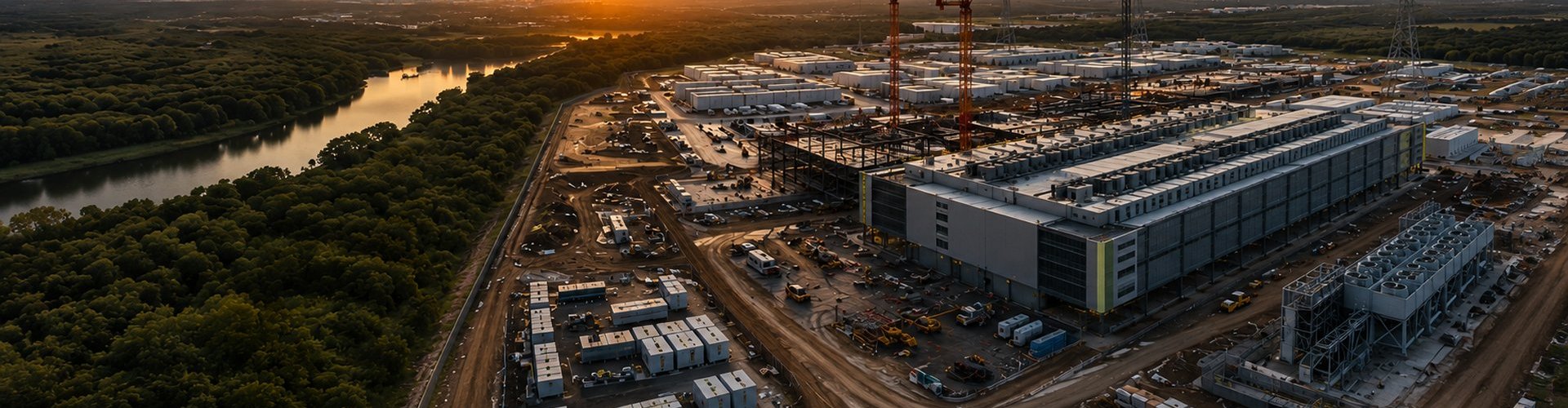
What distinguishes Comanche Peak at the Texas Nexus level is its emerging role as the first hyperscaler-coupled nuclear site in ERCOT. In September 2025, Vistra announced a 20-year power purchase agreement to supply 1,200 MW of carbon-free power from Comanche Peak to a large investment-grade customer, with delivery beginning in late 2027 and reaching full capacity by 2032. In March 2026, Amazon's plans for a large-scale data center campus on Vistra-owned property directly adjacent to the Comanche Peak plant became public — up to 18 two-story buildings across approximately 435 acres with $5 billion in projected investment, with construction potentially commencing in 2027. Amazon is also working with Hood County officials on the adjacent Project Spectrum, expanding the data center concentration around the Comanche Peak nuclear baseload to a multi-county scale.
Plant Operations and License Status
Comanche Peak entered commercial operation in stages — Unit 1 (1,259 MW gross) commenced commercial operation on August 13, 1990, after construction beginning in 1974, and Unit 2 (1,150 MW gross) followed on August 3, 1993. Both units are Westinghouse pressurized water reactors with 4-loop steam generators, drawing cooling water from the nearby Squaw Creek Reservoir. Total electric capacity is 2,400 MW, generating sufficient electricity to power approximately 1.2 million homes at full output. The plant has operated reliably for more than three decades with capacity factors consistently above 90 percent.
The July 2024 NRC license extension approval represents the third of Vistra's four nuclear plants to receive 20-year extensions beyond the original 40-year operating licenses. The extensions allow continued Comanche Peak operation through 2050 and 2053 respectively, providing 20+ years of additional carbon-free baseload generation that ERCOT's continued load growth — particularly from data centers and oil-and-gas electrification — increasingly depends on. The license extension required Vistra to demonstrate continued plant safety, reliability, and integrity through the extended operating period; the approval validates the plant's structural condition and operational practices.
Squaw Creek Reservoir functions as both cooling water source and recreation area, with the Comanche Peak Steam Electric Station Operating Company managing the reservoir under federal license. The reservoir's role in plant cooling provides the structural enabler for continued operation; water availability constraints that affect other Texas industrial operations are not a binding constraint at Comanche Peak given the dedicated reservoir capacity.
The Hyperscaler PPA and Amazon Adjacent Campus
The 20-year power purchase agreement Vistra announced in September 2025 represents the first major hyperscaler-coupled nuclear deal in ERCOT. The PPA structure delivers 1,200 MW of carbon-free power to an undisclosed investment-grade customer, with options to extend up to an additional 20 years beyond the initial agreement. Power delivery begins in Q4 2027 and ramps to full capacity by 2032. The customer was not publicly named at the time of the September 2025 announcement; subsequent reporting through early 2026 has speculated about Meta and Amazon as candidate counterparties given both companies' broader Texas data center investments and their parallel hyperscaler-coupled nuclear deals at other Vistra plants in the PJM region.
Amazon's plans for the adjacent data center campus became public in March 2026 through Hood County and Somervell County tax abatement filings. The proposed campus on Vistra-owned property would total up to 18 two-story buildings across approximately 435 acres at $5 billion in projected investment. Construction could commence in 2027 — aligned with the late-2027 power delivery commencement under the September 2025 PPA. Amazon is concurrently working with Hood County officials on Project Spectrum, a separate adjacent data center development that would extend the Comanche Peak hyperscaler concentration into multi-county scale.
The hyperscaler-coupled nuclear pattern at Comanche Peak is structurally distinctive within ERCOT for several reasons. ERCOT operates one of the fastest interconnection processes in the country, with transmission and distribution utilities and ERCOT itself working together to expedite large load interconnection. The speed-to-market advantage that ERCOT provides over PJM and other regional grids has been substantively important to Vistra's hyperscaler discussions. Texas's regulatory environment for co-location of generation and load is also more permissive than the disputes that have constrained co-located arrangements in PJM. The combination of speed-to-market, regulatory environment, and existing nuclear baseload at scale makes Comanche Peak structurally attractive for hyperscaler customers seeking carbon-free baseload to anchor multi-gigawatt AI compute deployments.
SMR Exploration and Plant Expansion
Vistra is exploring deployment of Small Modular Reactors at Comanche Peak and other existing nuclear sites in its portfolio. The structural advantage at existing nuclear sites is that the necessary transmission infrastructure, water access, regulatory framework, and workforce continuity are already in place — substantially reducing the development timeline and capital expenditure compared to greenfield SMR siting. SMR deployment at Comanche Peak is currently in early-stage exploration; specific reactor technology selection, capacity, and timeline have not been publicly committed.
The site has 7,950 acres of total reserve, providing land capacity for substantial expansion beyond the existing two-unit footprint. Original plans during the 1970s development phase included potential expansion to four units; only the two units were built. Recent regulatory and policy developments supporting nuclear deployment — federal critical-infrastructure designation, ERCOT load growth, hyperscaler customer demand for carbon-free baseload — could revive the broader expansion case in different reactor configurations including SMR or potentially additional large pressurized water units depending on regulatory and market conditions through the late 2020s and 2030s.
Cross-Anchor Position
Comanche Peak's most operationally significant cross-anchor relationship is with the broader Texas Energy Nexus baseload fleet. South Texas Project (Bay City, four units, 2,700 MW) operates as the Gulf Coast nuclear complement to Comanche Peak's North Texas position. Together the two plants supply approximately 5,100 MW of Texas nuclear baseload — substantial relative to ERCOT's broader generation mix but small relative to projected continued load growth from AI compute, oil-and-gas electrification, and broader manufacturing buildout. Project Matador's planned nuclear deployment at Fermi America's HyperGrid Campus in the Panhandle, with up to 4.7 GW of nuclear capacity from AP1000 reactors targeted for grid synchronization in 2031-2032, would substantially expand Texas's nuclear baseload but operates on a longer development timeline than Comanche Peak's existing fleet.
The relationship with the broader DFW industrial concentration is structural. Lockheed Martin Fort Worth's F-35 production, Bell Textron's vertical-lift platforms, Texas Instruments' Sherman SM1 fab, MP Materials Fort Worth's magnet manufacturing, and the broader DFW corporate-and-industrial economy all benefit from Comanche Peak's reliable carbon-free baseload supply through ERCOT. The plant's geographic position approximately 60 miles from downtown Dallas places it within direct grid-supply distance of the metro's industrial and residential load while operating in a rural Somervell County setting that the plant operations require.
The Amazon adjacent campus and Project Spectrum represent the first integration of Texas nuclear baseload directly with hyperscaler AI compute infrastructure on a co-located basis. The architectural pattern parallels Project Matador's coupled nuclear-and-AI design, but at much larger near-term scale given Comanche Peak's existing operational status. If the Amazon adjacent campus reaches full development, the Comanche Peak concentration becomes Texas's first operational hyperscaler-coupled nuclear cluster, with broader implications for how ERCOT's continued load growth and nuclear baseload coordination develops through the late 2020s and 2030s.
Why Glen Rose
The Comanche Peak siting in Somervell County reflected the structural fits that drove 1970s-era U.S. nuclear plant siting. Land availability at scales that the DFW metro could not provide — Somervell County's rural geography supported the multi-thousand-acre footprint that nuclear plant operations require including reactor units, switchyard, cooling reservoir, exclusion area, and emergency planning zones. Cooling water access through the dedicated Squaw Creek Reservoir provided the closed-loop water system that minimizes external water dependencies. Distance from major population centers (40 miles from Fort Worth, 60 miles from Dallas) supported emergency planning requirements while remaining within direct grid-supply distance of the major metro load. Texas state-level regulatory environment supported the development trajectory through the long construction period (1974 ground-breaking, 1990 Unit 1 commercial operation).
The continued investment trajectory has compounded over five decades. Original construction completion in the 1990s, decades of stable operation through 2020s, license extensions in 2024, the 2025 PPA, and the 2026 Amazon adjacent campus announcement collectively reflect sustained operator and customer commitment to the Comanche Peak site as a long-horizon strategic asset. Each subsequent commitment makes the next more rational. The Squaw Creek Reservoir, transmission infrastructure, workforce continuity, and regulatory framework are sunk-cost advantages that no greenfield siting could replicate at comparable timeline or cost.
Constraints and Considerations
Capacity expansion is the most material consideration shaping the site's continued role. Comanche Peak's current 2,400 MW nameplate capacity is fixed under existing operational configuration; meaningful expansion requires either uprates (incremental capacity increases at existing units) or new unit construction (whether AP1000-class large reactors or SMR deployment). Uprate authorization through NRC review processes is feasible but yields modest capacity increases (typically 100-200 MW per unit). New unit construction at Comanche Peak would parallel Project Matador's AP1000 deployment timeline at Carson County, with first concrete pour through first grid synchronization spanning 4-7 years under aggressive execution. The expansion case depends on continued hyperscaler and broader ERCOT customer demand at scales justifying the multi-billion-dollar investment.
Hyperscaler PPA execution is the secondary consideration. The September 2025 PPA's 1,200 MW commitment represents half of Comanche Peak's total capacity. Power delivery commencement in late 2027 and full capacity ramp by 2032 require continued plant reliability, NRC license compliance, and customer-side data center buildout proceeding on the customer's announced timeline. The Amazon adjacent campus's 2027 construction commencement and subsequent multi-building buildout represents one of the largest data center developments in Texas history; execution risk on the customer side affects load realization timing for the PPA.
Workforce and supplier continuity is the third consideration. Comanche Peak's 1,300-person workforce includes specialized nuclear operations, maintenance, and engineering personnel that take years to develop. License extension through 2053 requires sustained workforce build-up across operator generations, with retirements of original commissioning-era personnel offset by new training pipelines. The broader Texas nuclear workforce concentration is small relative to other US states with multiple operating plants; cross-plant workforce mobility supports continuity but creates broader labor market constraints if Texas adds new nuclear capacity at Project Matador or elsewhere.
Watching Items
September 2025 PPA power delivery commencement in Q4 2027 is the highest-impact near-term operational milestone, validating Comanche Peak's role as the first hyperscaler-coupled nuclear site in ERCOT. Amazon adjacent campus construction commencement in 2027 and subsequent multi-building development through the late 2020s validates the co-location pattern. PPA customer identity disclosure through subsequent SEC filings or public announcements clarifies the hyperscaler relationship. SMR deployment exploration progressing toward technology selection and commercial commitment shapes the long-horizon expansion trajectory. Adjacent watching items include any additional hyperscaler PPAs from Vistra's Texas plants, NRC review progress on potential capacity uprates, and Project Matador AP1000 deployment milestones at Fermi America that affect the broader Texas nuclear baseload trajectory.
Related Coverage
South Texas Nuclear Station | ERCOT Large Load Interconnection | Behind-the-Meter Power | Aalo Atomics | ERCOT Energy Sovereignty | Water & Cooling in Large Facilities