AustinIO > Texas AI & Hyperscalar Data Centers > AI Data Center Exemplars > Fermi America — Project Matador
Fermi America — Project Matador
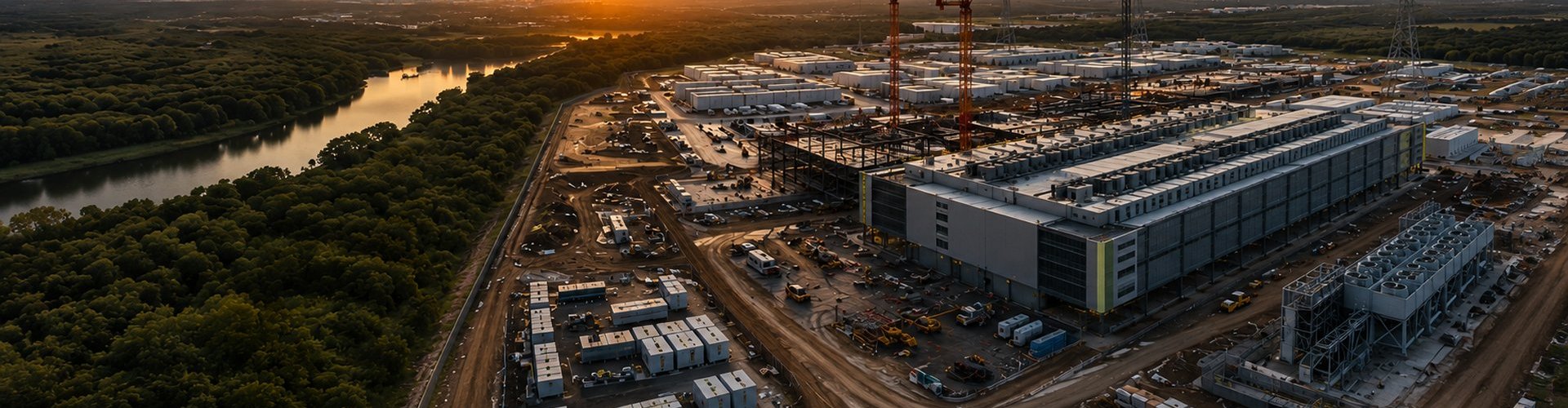
Fermi America's Project Matador is the most ambitious behind-the-meter campus in the country: a private-grid complex at Amarillo pairing AI data centers with nuclear, gas, solar, and storage toward 11 GW, next to the Pantex nuclear weapons plant. It is the exemplar of the nuclear-anchored model — and the only one selling firm power to multiple tenants rather than serving a single operator.
| Attribute | Detail |
|---|---|
| Operator | Fermi America (Nasdaq: FRMI); Texas Tech University System partner |
| Location | ~12 mi NE of Amarillo, Carson County, TX (Panhandle), adjacent to Pantex |
| Distance from Austin | ~500 mi NW |
| Campus | 5,800 acres, 18M sq ft of data centers, 99-year lease |
| Power model | Behind-the-meter private grid (HyperGrid), multi-tenant |
| Generation | 11 GW target: ~6 GW gas + 4.4 GW nuclear (4 Westinghouse AP1000) + SMR + solar/storage; up to 17 GW potential |
| Cooling | Water via 2+ mi large-diameter pipeline (installed) |
| Workload | AI training + inference; also targets fabs, defense, government |
| Compute chip | Tenant-supplied; anchor tenant TensorWave deploys AMD Instinct GPUs |
| Anchor tenant | TensorWave (neocloud) — 15-yr lease, 222 MW phase 1 (to 650+ MW), ~$6.5B, signed Aug 10 2026 |
| Investment | $1.5B+ invested to date; IPO'd on Nasdaq/LSE 2026 (FRMI) |
| Permitting | ~6 GW of the planned 17 GW permitted; AP1000s in NRC review |
| Timeline | First 1 GW targeted year-end 2026; TensorWave phase 1 delivers late Q3/Q4 2027; nuclear later |
| Status | Under construction (gas), permitting (nuclear); first anchor tenant signed |
Why it exists here
Project Matador sits on a 5,800-acre, 99-year lease from the Texas Tech University System about 12 miles northeast of Amarillo, immediately adjacent to the Department of Energy's Pantex plant — the nation's primary nuclear weapons facility, which employs roughly 4,600 skilled nuclear professionals. That adjacency is the strategy: Fermi is betting that proximity to Pantex gives it a ready nuclear workforce, a security envelope including a no-fly zone, and credibility with the regulators whose approval its reactors need. Co-founded by former Energy Secretary Rick Perry, Fermi took the company public on Nasdaq under the ticker FRMI in 2026.
The power model
Fermi brands its approach "HyperGrid" — a private, behind-the-meter grid built to serve multiple gigawatt-class tenants, each with a customizable mix of dedicated gas, nuclear, and solar. The target is 11 GW: roughly 6 GW of natural gas as the near-term bridge, 4.4 GW of nuclear anchored by four Westinghouse AP1000 reactors, additional small modular reactors, and solar with storage. Fermi has publicly floated expansion toward 17 GW with added land and permits.
This is the multi-tenant variant of behind-the-meter power. Where Meitner and GW Ranch build generation for a single operator, Matador is a merchant private utility: it develops the firm power and leases it, alongside the data center shells, to hyperscalers, fabs, and government tenants that need multi-gigawatt capacity faster than the public grid can deliver it.
The nuclear timeline
The gas is real and moving; the nuclear is the long pole. TCEQ granted a Clean Air Permit for the first 6 GW of gas generation in February 2026, and Fermi filed for an incremental 5 GW gas permit in March 2026 — enough, if approved, to reach the full 11 GW on gas alone, independent of the reactor schedule. On the nuclear side, the four AP1000s are working through Nuclear Regulatory Commission review, with Hyundai E&C and Doosan Enerbility signed as construction and equipment partners. Near-term, Fermi targets three 500,000 sq ft data center buildings and 1 GW of operational power by year-end 2026 — that first gigawatt is gas.
What runs here
Matador is a multi-tenant campus, so its compute is tenant-supplied — but it now has a named anchor. On August 10, 2026, Fermi signed its first binding customer lease with TensorWave, a neocloud provider, chosen after discussions with roughly a dozen prospective customers. The 15-year turnkey lease covers 222 MW in phase one, expandable above 650 MW across three phases, for approximately $6.5 billion in contracted revenue, with first delivery in late Q3 or early Q4 2027.
TensorWave deploys AMD Instinct GPUs exclusively, so Matador's first workloads are AMD-based AI training and inference sold as cloud capacity — the neocloud pattern that also defines Beacon Point and IREN, where the tenant is a compute reseller rather than a lab or hyperscaler. Fermi has said it expects the lease to be guaranteed by "one of the global leaders in AI." That guarantor is unnamed; market speculation centers on AMD, whose venture arm is a TensorWave investor, but Fermi has not confirmed it. What runs here beyond TensorWave stays open — the campus is designed for many tenants, and only the first is signed.
Suppliers and Co-Located Infrastructure
| Supplier | Proximity |
|---|---|
| ABB Switchgear Production | International |
| AMD Instinct MI300X/MI325X Production | Domestic |
| Arista Networks Switch Production | Domestic |
| Caterpillar Generator Production | Domestic |
| City of Amarillo Water Supply Agreement | Adjacent |
| Coherent Optical Transceiver Production | Domestic |
| CoolIT Systems Direct-to-Chip Cooling | International |
| Cummins Power Generation | Domestic |
| Doosan Enerbility Reactor Pressure Vessels | International |
| Doosan Enerbility Steam Generator Production | International |
| Eaton Power Distribution | International |
| Energy Transfer Firm Gas Supply + Pipeline Interconnect | Adjacent |
| Foxconn AI Server Production | International |
| Hitachi Energy Transformer Operations | International |
| Industrial Water Supply (Carson County / Ogallala) | Regional |
| Keystone National Group HV Equipment Facility | Domestic |
| Micron HBM Production | Domestic |
| NVIDIA H100/H200/B200 Production (TSMC) | International |
| NVIDIA Spectrum-X / InfiniBand Production | Domestic |
| On-Site Battery Energy Storage | Onsite |
| On-Site Solar PV Installation | Onsite |
| On-Site Wind Generation | Onsite |
| ONEOK Pipeline Operations | Domestic |
| Permian Basin Natural Gas Pipeline Network | Texas |
| Primoris Energy Services - Phase One Balance of Plant | Texas |
| Quanta Cloud Technology AI Server Production | International |
| Samsung HBM Production | International |
| Schneider Electric Datacenter Solutions | Domestic |
| Siemens Energy Control Systems | International |
| Siemens Energy Generator Production | International |
| Siemens Energy SGT-800 Gas Turbines (Phase One) | International |
| Siemens Energy SGT6-5000F Gas Turbines (Phase Two) | Domestic |
| Siemens Energy Steam Turbine Production | International |
| SK Hynix HBM Production | International |
| SPX Cooling Tower Production | Domestic |
| Supermicro AI Server Manufacturing | Domestic |
| Targa Resources Gas Processing | Texas |
| Titan Production Equipment Fuel Gas Letdown Stations | Texas |
| Trane Chiller Production | Domestic |
| Vertiv Liquid Cooling Production | Domestic |
| Westinghouse AP1000 Reactor Production | Domestic |
| Westinghouse Nuclear Fuel Production | Domestic |
| Wiwynn AI Server Manufacturing | International |
| Xcel Energy / Southwestern Public Service Grid Service | Adjacent |
Where it fits
Matador is the nuclear-anchored exemplar and the most ambitious of the set. Where GW Ranch and Pecos anchor on gas and Meitner on renewables, Matador is the only Texas campus building gigawatt-scale nuclear into the mix, and the only one structured as a merchant private grid serving many tenants across AI, semiconductors, and defense. It is the fullest expression of the buildout's core move — if the grid cannot deliver the power, build your own, at the scale of a national utility.
Capacity is target/permitted generation, not operational or IT load; nuclear is in NRC review. First anchor tenant (TensorWave, 222 MW phase 1) signed Aug 2026; lease guarantor unnamed. First 1 GW (gas) targeted year-end 2026. Status: gas under construction, nuclear permitting.
Constraints and Considerations
Schedule risk is the most material constraint on Project Matador's announced trajectory. AP1000 deployment timelines have historically slipped at every US installation; first reactor grid-synchronization in 2031-2032 assumes an aggressive permitting and construction schedule that has not been demonstrated at greenfield US sites. If the nuclear timeline slips by 2-4 years, the campus continues operating on gas-and-solar with delayed nuclear baseload, but the strategic premise of nuclear-and-datacenter coupled architecture loses some of its differentiating force. The earlier milestones (Phase 1 commissioning late 2026, datacenter first occupancy 2026-2027, first AP1000 first concrete pour 2027-2028) are the leading indicators that validate or rebase the trajectory.
Related: Behind-the-Meter Power · Water & Cooling · ERCOT Large Load Interconnection · Brownfield Inheritance · AI Data Center Exemplars
Related Coverage
Meitner Energy Center | AWS GW Ranch | Sailfish Comanche Circle | Nexus Hubbard | Stargate Abilene (Campus 1) | Crusoe Abilene Microsoft (Campus 2) | Texas Panhandle Nexus