AustinIO > UT Austin Nexus > Texas Advanced Computing Center
Texas Advanced Computing Center
NSF Leadership-Class Computing Facility
The Texas Advanced Computing Center at UT Austin is the largest academic supercomputing center in the United States and was selected by the National Science Foundation in 2024 as the home of the new NSF Leadership-Class Computing Facility — the federal designation that anchors US academic computing for the next decade. TACC celebrates its 25th anniversary in 2026, with a continuous lineage of supercomputers running since 2001 that has put computational capability into the hands of US scientific researchers across physics, climate, medicine, materials, energy, and increasingly AI. The facility's role as both a working scientific instrument and a workforce-and-research substrate distinguishes it from the commercial AI compute operations covered elsewhere on AustinIO.
What makes TACC distinctive at the Giga Austin Nexus level is the combination of operational scale, federal designation, and physical expansion into a second facility. The flagship Horizon supercomputer entering production in spring 2026 delivers 300 petaflops of simulation performance and a hundredfold AI improvement over the previous-generation Frontera system. Horizon is being installed not on the UT Austin campus but at Sabey Data Centers' new Round Rock facility (SDC Austin), making TACC a two-site operation spanning Travis County (legacy systems) and Williamson County (Horizon flagship). The off-campus expansion ties TACC operationally into the broader Williamson County datacenter corridor that hosts Sabey, Switch, Skybox, and other commercial datacenter operators.
Multiple Supercomputer Generations
TACC operates a portfolio of supercomputers reflecting different architectural generations and use cases, with each generation supporting different research workloads while older systems continue running until decommissioning.
| System | Status | Architecture | Role |
|---|---|---|---|
| Frontera | Operational since 2019 | Intel Xeon CPU, 8,368 nodes, 38.75 petaflops | Current NSF leadership-class system; one of the largest all-CPU machines in the world; transitioning workloads to Horizon through 2026 |
| Stampede3 | Operational | Intel-based | Workhorse system for general scientific computing across the open science community |
| Lonestar6 | Operational | AMD-based | Mid-scale system for Texas-based researchers and broader US scientific community |
| Vista | Operational since 2024 | NVIDIA Grace Hopper and Grace Superchips, ARM-based, 44.9 petaflops aggregate | AI-centric bridge system between Frontera and Horizon; 40.8 petaflops GPU performance for AI workloads; first ARM-architecture deployment at TACC |
| Horizon | Installation underway; production spring 2026 | NVIDIA Grace Blackwell, Dell PowerEdge servers, more than 1 million cores, approximately 4,000 GPUs, 300 petaflops simulation performance | Flagship NSF Leadership-Class Computing Facility system; tenfold simulation improvement and hundredfold AI improvement over Frontera; hosted at Sabey Round Rock |
The architectural diversity is itself a feature. Vista marked TACC's departure from x86-based architecture toward ARM-based compute; Horizon continues that direction with the Grace-Blackwell platform. Researchers using TACC systems gain experience across Intel, AMD, ARM, and NVIDIA architectures, providing the workforce and research insight that no single-architecture commercial datacenter operation could replicate. The portfolio approach also supports NSF's open-science mission by ensuring that researchers with different code optimizations can find suitable systems within the TACC portfolio.
The Sabey Round Rock Expansion
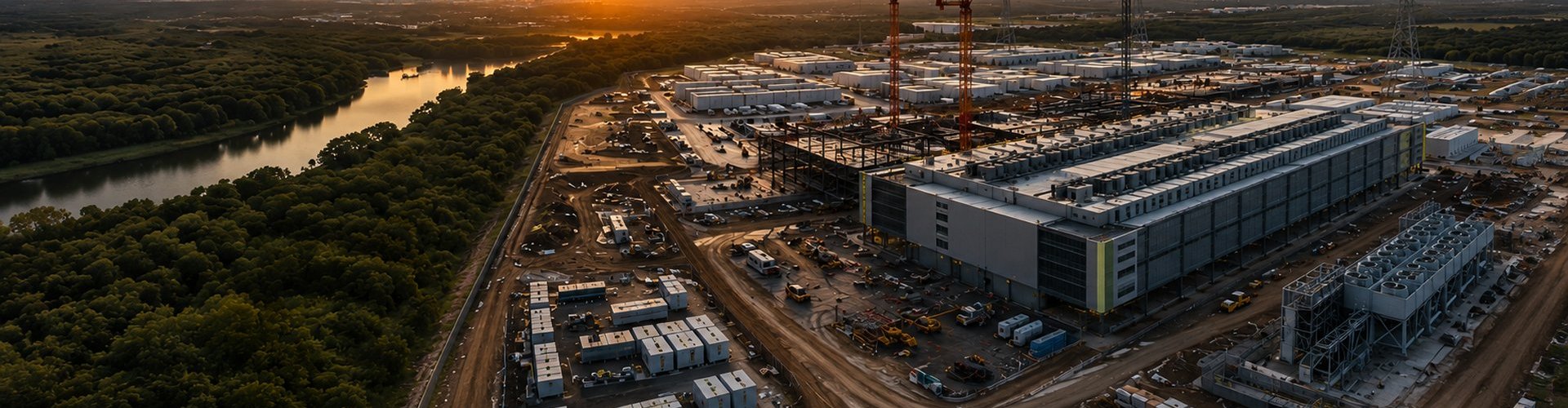
Horizon's installation at Sabey Data Centers' new Austin facility in Round Rock represents a structural shift for TACC. Previous TACC supercomputers have been hosted on the UT Austin campus in TACC's own facility space; Horizon is hosted off-campus at a commercial datacenter operator's facility under colocation arrangement. The Sabey site was the former Sears Teleserve building, demolished in 2024 to make way for the new datacenter complex specifically designed to support Horizon-scale operations.
The colocation model reflects practical operational realities. Horizon's power, cooling, and physical infrastructure requirements exceed what UT campus facilities can support without substantial dedicated facility expansion. Sabey's commercial datacenter operations provide the power density, liquid cooling capability, and facility infrastructure that the Grace-Blackwell platform requires at production scale. The arrangement also positions TACC operationally within the Williamson County datacenter corridor, alongside other commercial operators serving hyperscaler and enterprise customers; the proximity allows future TACC systems to potentially extend into the same operational geography rather than requiring on-campus expansion.
The Horizon partner stack reflects the system's hybrid academic-and-industrial character. Dell Technologies provides the PowerEdge server platform and Integrated Rack Scalable Systems integration. NVIDIA provides Grace CPU and Blackwell GPU silicon. VAST Data provides the all-flash storage platform — 400 petabytes of capacity with more than 10 terabytes per second read-write bandwidth, layered with multi-tenancy security. Spectra Logic and Versity provide the Ranch exabyte-scale archival system. Sabey Data Centers hosts the physical operation. The partnership structure mirrors how leading-edge commercial AI infrastructure is built and is itself a workforce-and-research substrate that flows back to Austin's broader AI compute ecosystem.
Cross-Anchor Position
TACC's most direct cross-anchor relationship is with the broader Austin AI compute concentration. Tesla Cortex 1 and 2 at Giga Texas runs in-house training compute on Tesla custom silicon and NVIDIA hardware; TACC Horizon runs open-science compute on the same NVIDIA Grace-Blackwell platform. Apple Austin's silicon design operations and AMD Austin's design and consumer-AI work both benefit from the broader Austin computing-and-AI workforce that TACC trains. UT Austin's TIE NGMM Center for advanced packaging research and TACC's supercomputing operations are both UT Austin federal-anchor research facilities, with workforce and research collaboration flowing between them across the Cockrell School of Engineering and adjacent UT departments.
TACC's relationship with the broader Williamson County industrial and datacenter buildout is increasingly important as Horizon goes operational at Sabey Round Rock. The corridor concentration that already includes Tesla Terafab supplier ring (Tokyo Electron, Tekscend, Entegris), Samsung Taylor's broader Williamson County supplier integration, and the Georgetown-Hutto-Taylor commercial datacenter cluster now also includes TACC's flagship academic supercomputer. The corridor is becoming a multi-purpose computing-and-manufacturing geography rather than a single-category cluster, with academic, captive corporate, hyperscaler, and semiconductor manufacturing operations all concentrating within the same Williamson County footprint.
The federal-coordination dimension matters operationally. TACC's NSF Leadership-Class Computing Facility designation makes it the academic complement to federally-coordinated commercial AI infrastructure including Project Matador (DOE-coordinated coupled architecture in the Panhandle), Stargate program sites (federal-aligned hyperscale buildout), and the broader US AI Research Resource pilot through NAIRR. TACC's role in NAIRR provides academic and government researchers with access to AI compute infrastructure that complements rather than competes with commercial AI training operations.
Why UT Austin and Round Rock
TACC's home at UT Austin reflects the university's research infrastructure substrate, the Cockrell School of Engineering's computing-and-AI research depth, and the state-of-Texas commitment to UT system as the flagship research university. UT Austin's research funding ranking (number one in NSF-funded research among US universities in recent rankings) provides the researcher demand that TACC's systems are sized to serve. The 25-year continuity of TACC operations under leadership including Dan Stanzione (TACC executive director and principal investigator for the Leadership-Class Computing Facility) reflects sustained institutional commitment that newer academic computing centers cannot replicate.
The Sabey Round Rock siting reflects four structural fits. Sabey's operational expertise hosting hyperscaler-grade datacenter facilities provides the physical infrastructure that Horizon-scale operations require. Round Rock's position within the Austin metro and the broader Williamson County industrial corridor places Horizon within commuting distance of UT Austin researchers and the broader Austin AI workforce. ERCOT grid capacity at Round Rock supports the multi-megawatt continuous load that 4,000+ Grace-Blackwell GPUs require. The Texas regulatory environment and Round Rock municipal coordination provide the permitting and infrastructure-development environment that Sabey's facility expansion required.
Constraints and Considerations
The five-year operational horizon for Horizon is the most material consideration for TACC's continued role. Horizon's $457 million NSF investment funds construction and initial operation; sustained operation through approximately 2030 depends on continued NSF funding plus the Leadership-Class Computing Facility's broader programmatic support. Each successive supercomputer generation requires new funding cycles, new architecture decisions, and new partner arrangements; the long-cycle nature of academic supercomputing budgets contrasts with the faster commercial AI infrastructure cycles where capital reallocation can happen quarterly.
Workforce and research-pipeline dependence is the secondary consideration. TACC's effectiveness depends on continued researcher demand from US scientific community plus continued workforce supply for facility operations. The broader US scientific research environment (NSF funding levels, university research support, federal R&D priorities) shapes TACC's operational scope in ways that commercial AI compute operations are insulated from. Federal R&D policy shifts could affect TACC's role as the academic counterpart to commercial AI infrastructure even if Horizon and successor systems are funded.
Watching Items
Horizon production launch in spring 2026 is the highest-impact near-term milestone, validating the NSF Leadership-Class Computing Facility's flagship system at production scale. Subsequent watching items include first AI-and-simulation hybrid workload demonstrations at Horizon scale, NAIRR pilot project expansion using Horizon allocations, and Frontera decommissioning as Horizon takes over leadership-class workloads. Adjacent watching items include Texas Tech and other Texas-system computing buildouts following the TACC model, and broader NSF Leadership-Class Computing Facility programmatic decisions about post-Horizon successor planning over a 5-10 year horizon.
Related Coverage
UT Austin CompSci & AI Programs | UT Austin TIE NGMM Center | UT Austin Cockrell School of Engineering | UT Austin Federal Program Coordination | UT Austin Industry-Academic Partnerships