AustinIO > Texas Nexus > Texas Triangle Cluster > Austin Metro Directory > Georgetown-Hutto-Taylor Datacenter Corridor
Georgetown-Hutto-Taylor Datacenter Corridor
Williamson County AI Compute Spine Anchored by Samsung Taylor
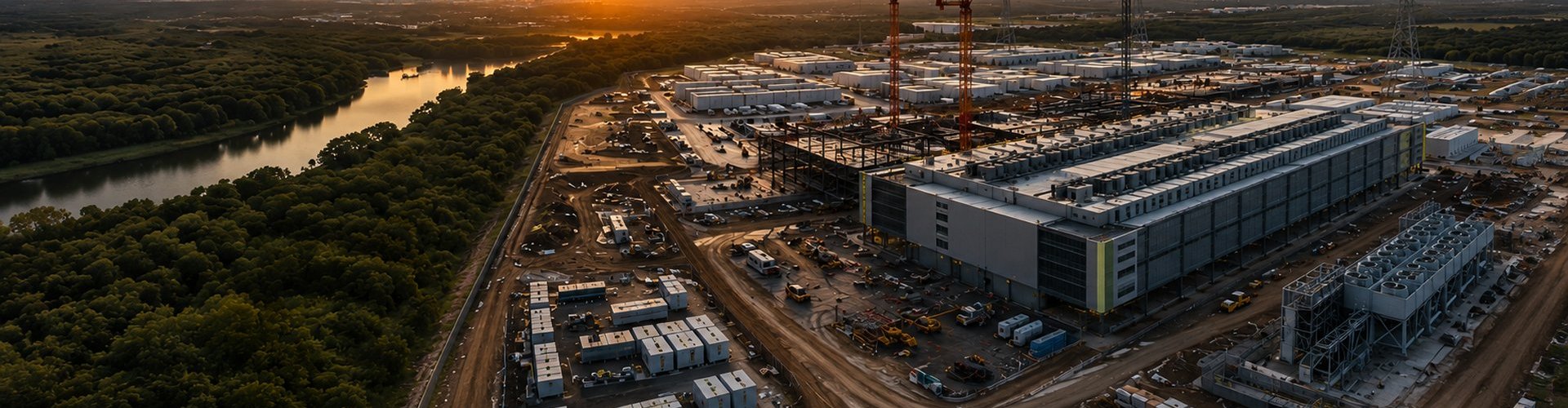
The Georgetown-Hutto-Taylor Datacenter Corridor extends approximately 30 miles across northeastern Williamson County from Georgetown through Hutto to Taylor, anchoring one of the most active US AI compute infrastructure buildouts of 2025-2026. Samsung Taylor's $40 billion semiconductor manufacturing campus operates as the corridor's primary anchor, with the broader fab plus the Oncor Electric Delivery Co. transmission infrastructure built to serve Samsung effectively opening the door for the data center concentration that has followed. Skybox Datacenters and Prologis Inc.'s 159-acre Hutto Megasite (potentially up to 4 million sqft and 600 MW capacity at $10B+ capital expenditure), Blueprint Data Centers' two-campus greater Austin platform (Taylor 60 MW plus Georgetown 25 MW totaling 85 MW combined), Colovore's $500 million Hutto AI-and-HPC campus, plus GAF Energy's Georgetown solar shingle manufacturing facility (450,000 sqft, 300 MW annual production, world's largest solar roofing producer) collectively reflect the corridor's combined data center plus advanced cleantech manufacturing concentration.
What distinguishes the Georgetown-Hutto-Taylor corridor at the Texas Nexus level is the structural integration of semiconductor manufacturing, AI compute infrastructure, and cleantech manufacturing within the AI-Industrial convergence thesis: every corridor anchor advances at least one of the four mutually-reinforcing pillars of the broader Texas AI-Industrial buildout (AI compute, semiconductor supply, autonomous systems, cleantech infrastructure). Samsung Taylor supplies advanced-node semiconductor capacity that AI training and inference workloads depend on. Skybox / Prologis, Blueprint, and Colovore supply the AI compute infrastructure that hyperscaler customers and AI-specific operators (Cerebras, Lambda Cloud, Cirrascale) require. GAF Energy supplies the distributed solar generation that the broader Texas Energy Nexus depends on as ERCOT scales to support AI compute load growth. The corridor sits at the intersection of multiple Williamson County corridors — US 183 N to the west supporting aerospace concentration, IH-35 to the southwest supporting the broader Texas Triangle corporate-and-industrial axis, SH 130 toll road supporting the east Austin manufacturing axis — supporting continued workforce flow plus shared utility infrastructure across multiple corridor anchors simultaneously.
Corridor Anchors
| Anchor | Corridor Location | Category | Coverage |
|---|---|---|---|
| Samsung Taylor | Taylor (corridor's eastern terminus) | Semiconductor manufacturing | Primary corridor anchor; $40B Samsung Foundry advanced node manufacturing campus; full treatment at Samsung Taylor spotlight |
| Skybox Datacenters / Prologis Hutto Megasite | Hutto Megasite — 159 acres (primary campus); ~140 acres second campus westward | Data center / AI compute | Largest single project on the corridor; potentially up to 4 million sqft across multiple buildings, ~600 MW capacity (powers approximately 450,000 homes equivalent), $10B+ capital expenditure; Hutto development agreement May 2024 plus Chapter 312 tax abatement; Round Rock zoning change request late 2025 to expand westward; two Samsung suppliers reportedly evaluating ~70 acres on the megasite; candidate Tier 1B spotlight; for forward coverage see Skybox/Prologis Hutto Megasite (forthcoming) |
| Blueprint Data Centers Taylor | Taylor — 1601 Martin Luther King Jr. Drive, 52 acres | Data center / AI compute | Up to $1B investment over 10 years across three construction phases; 135,000 sqft, 60 MW capacity; Taylor City Council unanimous approval July 2024; Oncor power agreement for initial 30 MW with full letters of intent at full capacity; minutes from Samsung Taylor; AI, semiconductor-adjacent, cloud, and enterprise workloads with liquid-cooling-ready designs; 50% property tax rebate for 10 years on each phase plus 50% rebate on local sales-and-use tax on construction materials |
| Colovore Hutto | Hutto — 2351 Innovation Blvd, Ironwood Tract (30 acres) | Data center / AI compute | $500M, 180,000 sqft data center plus 13,000 sqft office complex; Hutto City Council approval December 2024; construction commencement early 2026; California-headquartered Colovore specializes in liquid-cooled, high-density colocation for AI and HPC; customer base includes Cerebras, Lambda Cloud, and Cirrascale; sits within 1 million sqft Velocis / Ironwood Realty Partners / MBK Industrial Properties industrial park |
| Blueprint Data Centers Georgetown | Georgetown — Westinghouse Road, 10 acres | Data center / AI compute | $160M investment; 45,000 sqft, 25 MW power capacity; Georgetown City Council approval September 2024; Phase I operational late 2026, full completion early 2027; structurally integrated with Blueprint Taylor sister campus via dense regional fiber for low-latency dual-site or distributed customer architectures; Northampton Capital Partners backing; 10-year 50% property tax abatement |
| GAF Energy Georgetown | Georgetown | Cleantech / advanced manufacturing | 450,000 sqft Timberline Solar manufacturing facility; world's largest solar roofing producer at 300 MW annual production; 240+ employees at full capacity; Standard Industries subsidiary; world's first nailable solar shingle (Timberline Solar Energy Shingle); facility opened May 2024, second GAF Energy facility globally complementing San Jose CA R&D operations |
The anchor mix reflects the corridor's data-center-first identity (one semiconductor anchor plus four operational or under-construction data center campuses representing nearly 800 MW of combined planned capacity) integrated with adjacent advanced cleantech manufacturing (GAF Energy). The combined Skybox / Prologis Hutto Megasite (potential 600 MW), Blueprint Taylor + Georgetown (85 MW combined), and Colovore Hutto (180,000 sqft AI/HPC) capacity positions the corridor as one of the most concentrated US data center buildouts of 2025-2026. The Williamson County Economic Development Partnership tracks 70+ projects across the broader Central Texas data center corridor between Temple and San Antonio per Cushman & Wakefield data, with Williamson County capturing a disproportionate share due to power infrastructure, fiber connectivity, and available land — the corridor anchors the eastern edge of the Williamson County concentration.
The Samsung Oncor Effect
The corridor's emergence as a data center concentration traces directly to Samsung Austin Semiconductor's $17 billion Taylor fabrication plant and the cascading utility infrastructure investment it triggered. The Samsung Taylor power requirements brought Oncor Electric Delivery Co. — the fifth-largest electric utility in the United States — into eastern Williamson County with major transmission infrastructure that Oncor would not otherwise have developed at comparable scale or schedule. The transmission capacity built to serve Samsung effectively opened the door for data center operators that need reliable, large-scale electricity access at multi-hundred-megawatt scale.
The Oncor effect is structurally distinctive at the Texas Nexus level. Most Texas data center buildouts compete with each other for ERCOT interconnection queue capacity at sites where transmission infrastructure must be developed alongside the data center itself. The corridor anchors operate within transmission infrastructure that Samsung's fab requirements pre-justified — Blueprint Taylor's specific Oncor power agreement for an initial 30 MW (with letters of intent at full 60 MW capacity) reflects the structural advantage. Both Hutto and Georgetown sit on dense regional fiber corridors with multiple Tier 1 and regional network operators providing diverse paths, supporting low-latency interconnection between corridor anchors that geographically distributed sites cannot match.
Powered land in US data center markets trades at premiums of 1.6x to 2.5x over conventional industrial parcels (and materially higher in power-constrained markets) per Colliers' 2026 Data Center Marketplace report. The Williamson County concentration captures this premium because the Oncor infrastructure plus continued ERCOT capacity development plus Williamson County Economic Development Partnership coordination supports continued operator attraction at scales that other Texas counties cannot match without comparable preceding utility investment.
Corridor Geography
Georgetown (corridor's western terminus) — multi-corridor intersection of US 183 N (Austin/Space Corridor), IH-35 (Williamson County north-south spine), SH 130 (east Austin manufacturing axis), US 79 (corridor's primary spine), and SH 29 (east-west). Blueprint Data Centers Georgetown and GAF Energy Georgetown anchor the corridor's western entry. Georgetown anchors live in the (forthcoming) Georgetown city directory.
Hutto — corridor's central data center concentration along US 79 / SH 130. Skybox / Prologis Hutto Megasite plus Colovore Ironwood Tract plus broader Hutto industrial buildout. Hutto City of approximately 31,000 population has positioned itself aggressively along the US 79 corridor, which site selection experts rank among the most desirable US stretches for data center development. Hutto anchors live in the (forthcoming) Hutto city directory.
Taylor (corridor's eastern terminus) — Samsung Taylor $40 billion semiconductor manufacturing campus plus Blueprint Data Centers Taylor 52-acre campus plus broader Taylor industrial buildout. Taylor's emerging role as the corridor's primary semiconductor-plus-data-center concentration positions the city as a structurally significant Williamson County industrial hub. Taylor anchors live in the (forthcoming) Taylor city directory; Samsung Taylor cross-reference remains at the corridor level given the operator's structural significance to corridor identity.
Cross-corridor mobility infrastructure — US 79 (Georgetown-Hutto-Taylor primary spine), SH 95 (north-south Hutto-to-Taylor), SH 130 toll road (east Austin manufacturing axis with intersection at Hutto and Pflugerville), IH-35 (Williamson County north-south spine intersecting at Georgetown), US 183 N (aerospace corridor intersecting at Georgetown), CR 366 / Inner Loop in Georgetown, FM 1660 connecting Hutto to Taylor.
Prospective Additions
Multiple prospective data center additions are tracking through 2026-2030:
Skybox / Prologis Hutto Megasite scaling — Skybox is in planning stages for a second campus of approximately 140 acres just west of the primary 159-acre Hutto site. The late 2025 zoning change request to expand into Round Rock plus the two Samsung suppliers reportedly evaluating ~70 acres of the original megasite reflects the broader scale-out trajectory. The combined Skybox Hutto operations could substantially exceed the initial 4 million sqft and 600 MW projections at full buildout. Continued execution through 2026-2030 validates the corridor's largest single project. Substantive enough to merit dedicated Tier 1B spotlight treatment; for forward coverage see Skybox/Prologis Hutto Megasite (forthcoming).
Williamson County broader data center pipeline — the Cushman & Wakefield data tracking shows the broader Austin-San Antonio data center corridor with 7,823 MW of planned capacity compared to just 1,154 MW currently operating, with 615 MW under construction and 96 percent already pre-leased. Williamson County captures a disproportionate share of the planned capacity. Specific operator announcements through 2026 will continue scaling the corridor's data center concentration. Cushman & Wakefield, Cushman, Colliers, Jones Lang LaSalle, and Texas A&M Real Estate Research Center all track the broader concentration.
Continued Samsung Taylor capacity scaling — Samsung Taylor's continued ramp through 2026-2027 plus prospective subsequent fab capacity expansion continues to support the corridor's primary anchor. Samsung-driven data center demand plus broader semiconductor cluster supplier ring positioning supports continued corridor anchor attraction. Two Samsung suppliers' interest in ~70 acres of the Skybox Hutto Megasite reflects the structural pattern of semiconductor supplier ring concentration around the broader Samsung Taylor campus.
Cross-Anchor Position
The Georgetown-Hutto-Taylor Datacenter Corridor's most operationally significant cross-anchor relationship is with the broader Texas data center ecosystem. Stargate Abilene represents the largest US data center buildout at gigawatt scale within the broader $500 billion OpenAI / SoftBank / Oracle nationwide AI venture. Permian Basin Energy behind-the-meter gas-fired data center concentration represents the West Texas counterpoint to Williamson County's grid-supplied AI compute concentration. Project Matador / Fermi America HyperGrid in the Texas Panhandle (proposed 11 GW campus near Amarillo), Vantage's 1.4 GW Frontier campus in Shackelford County, and the 2 GW Tract Caldwell County Park between Austin and San Antonio collectively reflect the broader Texas state-level data center concentration of which the GHT corridor is one of the most metropolitan-proximate components.
The relationship with ERCOT Energy Sovereignty is foundational. The GHT corridor data center buildout operates within ERCOT's 233-410 GW interconnection queue plus Senate Bill 6 implementation framework plus Interconnection and Grid Analysis organization redesign. The corridor's structural advantage is the Oncor transmission infrastructure pre-built for Samsung — Blueprint's specific positioning around "time-to-power" (securing committed utility paths plus expedited timelines plus supply-chain alignment ahead of broader market availability) reflects the structural advantage that the Oncor effect provides corridor operators relative to data center sites without comparable preceding utility investment. The broader Texas BESS Concentration plus Texas renewable buildout plus continued ERCOT capacity expansion supports the data center buildout the corridor depends on.
The connection to Samsung Taylor is structurally direct beyond the Oncor effect. Blueprint Taylor's specific siting "minutes from Samsung's advanced semiconductor complex" plus Samsung suppliers' interest in the Skybox Hutto Megasite reflects the broader pattern in which data center operators co-locate near major semiconductor manufacturing for low-latency AI workload integration plus shared workforce attraction plus semiconductor-supplier ring proximity. The combined semiconductor-plus-data-center vertical integration that Samsung Taylor anchors represents one of the most distinctive Williamson County industrial concentrations and directly advances the AI-Industrial convergence thesis.
The relationship with parallel Williamson County data center concentrations is structurally significant. Round Rock's mature data center ecosystem (Sabey Data Centers, Switch, prospective Skybox Round Rock, prospective Amazon PUD) sits along the IH-35 / SH 45 axis rather than the US 79 / SH 95 GHT spine but represents parallel Williamson County concentration. Round Rock data center coverage lives in the (forthcoming) Round Rock city directory. The combined Williamson County data center buildout across both Round Rock and the GHT corridor reflects the broader county-level concentration.
The relationship with the parallel US 183 N Austin/Space Corridor at Georgetown plus the (forthcoming) Austin-Taylor Manufacturing Axis (SH 130) and Austin-Waco I-35 / I-14 Defense-Industrial Spine at Georgetown reflects the multi-corridor Williamson County industrial concentration. Workforce flow plus shared utility infrastructure plus broader Williamson County Economic Development Partnership coordination supports continued operator attraction across corridors simultaneously.
Related Coverage
Austin Metro Directory | Texas Triangle Cluster | Texas Nexus | Samsung Taylor | ERCOT Energy Sovereignty | Stargate Abilene | US 183 N Austin/Space Corridor | Spotlights Hub