AustinIO > The Austin Supercluster > Giga Austin Nexus > Tesla Giga Texas Complex
Tesla Giga Texas Complex
The Multi-Program Anchor of the Austin Convergence
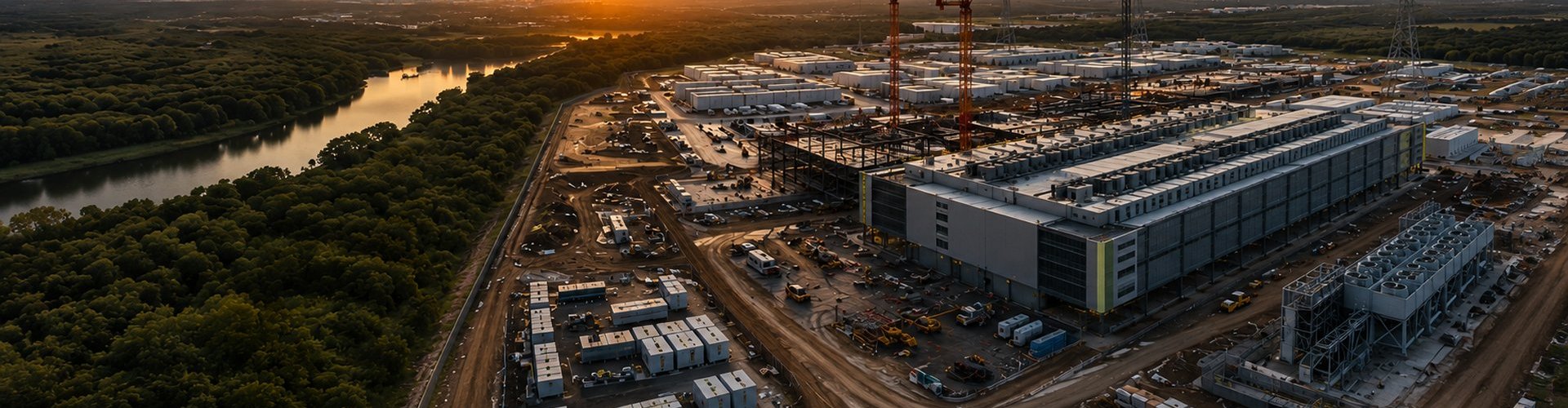
Tesla Giga Texas is the gravitational center of the AI-Industrial convergence covered across AustinIO. Vehicle production at Model Y volume scale plus Cybertruck at structural-stainless-steel scale. Humanoid production through the Optimus actuator and drive lines, with in-house Optimus deployment in factory operations. AI training compute through Cortex 1 and Cortex 2 clusters running model training for FSD autonomy and humanoid policy. Semiconductor research through the Terafab Research Fab developing Tesla's next-generation silicon process IP. Four operationally-distinct frontier programs at one campus address. No other facility in the United States combines this program breadth at one location.
The campus sits on roughly 2,500 acres on the eastern edge of Austin in Travis County, along Highway 130 between SH 45 and the Colorado River. Tesla broke ground in 2020 with a $13.9M Travis County tax rebate; the factory opened in April 2022 and has since produced over 500,000 vehicles, surpassed 100 million 4680 battery cells, and become Austin Water's third-largest customer at 556 million gallons annually. Direct employment exceeds 20,000, with thousands more in supplier and construction roles. The campus is one of the largest single industrial operations in Texas history, and continues to expand through 2026-2027 with the Terafab North Campus buildout and the supporting infrastructure that the multi-program scope requires.
The thesis in one line:
Tesla's vertical integration strategy concentrates four frontier programs at one campus, and the resulting gravitational pull on suppliers, captive arrangements, federal coordination, and supplier-ring formation is what makes Tesla Giga Texas the structural anchor of the broader Austin metro convergence.
The Four Programs
Each program operates with its own production line, its own supply chain, and its own strategic narrative. Together they constitute Tesla's vertical integration thesis made physical — the operational substrate on which the rest of the Tesla Texas footprint (Megapack at Brookshire, lithium refining at Robstown, future Megablock scaling) compounds.
| Program | Operational Status | Strategic Distinctiveness |
|---|---|---|
| Vehicle Production (Model Y, Cybertruck, Cybercab) | Volume operational; over 500,000 vehicles produced through 2025 | Integrated 4680 cell production on-campus; structural-stainless-steel Cybertruck demonstration; Cybercab autonomy-platform pivot underway; integrated CAM precursor processing tying the vehicle line to the Tesla Robstown lithium operations |
| Optimus Humanoid Production | Actuator and drive lines installed; in-house factory deployment in select assembly tasks | Tesla's bet on humanoid as next category-defining product after the vehicle; vertical integration into actuators and harmonic drives; first-of-its-kind in-house humanoid deployment in factory operations at scale |
| Cortex 1 and 2 AI Training Compute | Operational; ongoing capacity expansion through 2026 | On-campus training infrastructure for FSD autonomy and humanoid policy work; Dell PowerEdge XE9680-class server hardware; integrated with xAI training infrastructure post-merger; consumes silicon supplied through Samsung Taylor captive arrangement |
| Terafab Research Fab | Construction phase; first wafer through line targeted 2027-2028 | Tesla in-house semiconductor process IP development with Intel engineering services support; AI6 and AI7 silicon roadmap including radiation-tolerant orbital compute variants; seed of prospective Super Trusted Foundry positioning for dual-use commercial-and-defense silicon supply chain |
Each child page covers one program in standalone depth — the operational details, the supplier integration, the strategic narrative, and the cross-anchor relationships specific to that program. The multi-program concentration at one campus is itself the structural observation that the Tesla Giga Texas Complex page surfaces; the children pages are where each program's individual narrative lives.
Why the Multi-Program Concentration Matters
Most giga-scale industrial operators concentrate on a single product category at a single site. A vehicle plant makes vehicles. A foundry fab makes silicon. A satellite factory makes satellites. Tesla Giga Texas is structurally different. The four programs are not a portfolio of separate operations that happen to share infrastructure — they are an integrated stack where each program reinforces the others.
The integration shows at multiple operational layers:
Shared supplier ring. The Williamson County co-located supplier ring serving the Terafab program (Tokyo Electron at Round Rock, Tekscend Photomask at Round Rock, Entegris at Round Rock, Seoyon E-Hwa at Hutto for Cybertruck pillars) overlaps with the broader Tesla Texas supplier base in ways that compound across programs. Linde, Air Liquide, and Air Products serve multiple Tesla operations across Texas. The Quanta Services, DPR, and Rogers-O'Brien construction ecosystem builds for vehicle, humanoid, Cortex, and Terafab simultaneously. Supplier-ring efficiency increases as more programs concentrate at one site; it is one of the structural reasons Tesla chose to build all four programs at the same address rather than distribute them.
Shared workforce. Engineers move between programs as project priorities shift. Manufacturing engineers who built out the 4680 cell line transition to Optimus actuator production. Software engineers who developed FSD compute integration work on Cortex training infrastructure. Mechanical engineers move between vehicle, humanoid, and fab build-out as construction priorities evolve. Workforce mobility within Tesla's Texas operations is a structural advantage that distributed-program operators cannot replicate; it accelerates each program's scale-up and reduces the per-program workforce requirement that distributed operators must sustain.
Shared infrastructure. The Oncor Giga TX substation that serves the campus carries load for all four programs. The Tesla on-site 30 MW rooftop solar array and on-site Megapack storage provide behind-the-meter resilience that any single program would have to fund alone. The Austin Water service connection and the Travis County water authority service for the portion of campus outside Austin Water boundary serves all four programs. Infrastructure-sharing across programs is what makes giga-scale concentration economically rational; the second program at the same site costs less to support than the first program at a separate site.
Shared captive arrangements. Samsung Taylor's captive-equivalent foundry relationship with Tesla covers AI silicon across all four programs — vehicle FSD compute (AI4 to AI5 to AI6), Optimus on-board inference (same AI silicon family), Cortex training accelerators (Tesla custom silicon at training scale), and Terafab process IP development (Tesla learning from Samsung's process operations while Samsung produces Tesla-designed silicon). The captive arrangement scales with Tesla's silicon demand, which is itself the sum of demand across all four programs. A single-program Tesla operation could not justify the captive arrangement at this depth; the multi-program concentration does.
Cross-Anchor Position Within the Convergence
Tesla Giga Texas Complex anchors a network of cross-anchor relationships that constitute the broader convergence covered on AustinIO.
Tesla Robstown Lithium Refinery on the Gulf Coast feeds CAM precursor and lithium hydroxide to Tesla Giga Texas's 4680 cell line. The vertical integration into raw battery materials is enabled by Tesla's choice to operate at giga-scale; smaller operators cannot justify dedicated refinery capacity.
Tesla Megapack and Megablock at Brookshire feeds energy storage hardware to grid-scale deployments and increasingly back to Tesla operations. The Brookshire-to-Giga Texas connection runs through Tesla's vertical integration into grid-OEM, with Megapack storage at Giga Texas providing on-site behind-the-meter resilience.
Samsung Taylor operates as Tesla's captive-equivalent foundry under multi-year arrangements covering AI silicon across all four Giga Texas programs. The Samsung Taylor spotlight page covers this captive relationship in detail; from Tesla Giga Texas's perspective, Samsung Taylor is the silicon supplier that makes the AI compute substrate of Cortex, Optimus, and vehicle FSD operationally feasible.
SpaceX Bastrop's advanced packaging facility performs radiation-tolerant packaging for Tesla AI silicon variants destined for orbital compute applications (Starlink, Starshield, prospective Golden Dome SBI). The Tesla design → Samsung Taylor or Terafab fabrication → SpaceX Bastrop packaging → orbital deployment supply chain integrates Tesla Giga Texas into a vertically-integrated commercial-and-defense silicon supply chain that is structurally distinctive on US soil.
UT Austin's TIE NGMM Center provides the federally-anchored advanced packaging research substrate that surrounds Tesla's silicon ambitions. The DARPA-coordinated $840M+ NGMM 3DHI program and the broader UT Austin research and workforce-training capability create the regional substrate that enables Terafab's research operations and the broader Texas advanced-packaging buildout.
The Williamson County industrial corridor (running roughly along U.S. Highway 79 from Round Rock through Taylor) hosts the supplier ring that serves Samsung Taylor primarily but extends to Tesla Terafab and the broader Tesla Texas operations. Tokyo Electron, Tekscend Photomask, Valex precision piping, Linde Taylor, MGC Pure Chemicals at Killeen, and Soulbrain at Williamson County form a co-located AI-Industrial specialty supplier ring at one of the densest concentrations in the United States outside Silicon Valley.
Each of these cross-anchor relationships is covered in detail on the relevant counterpart pages. From Tesla Giga Texas's perspective, the relationships compound — every cross-anchor connection deepens the Giga Texas campus's gravitational pull on additional supplier capacity, additional captive arrangements, and additional federal strategic-infrastructure designations.
Suppliers and Co-Located Infrastructure
Note: Optimus Factory and Terafab Research Fab are under construction.
| Supplier | Sector |
|---|---|
| Air Liquide Texas Operations | Campus |
| Air Products Texas Operations | Campus |
| Austin Water Service to Giga Texas | Campus |
| Caterpillar Generator Production | Campus |
| ERCOT Interconnection | Campus |
| Hitachi Energy Transformer Operations | Campus |
| Industrial Chiller and Cooling Tower Plant | Campus |
| Linde Texas Operations | Campus |
| Oncor Giga TX Substation | Campus |
| Quanta Services Substation Construction | Campus |
| Rogers-O'Brien Construction Austin | Campus |
| Schneider Electric Texas Operations | Campus |
| TCEQ Wastewater Discharge Permit Oversight | Campus |
| Tesla Brookshire Megapack / Megablock Factory | Campus |
| Tesla Giga TX 30 MW Rooftop Solar Array | Campus |
| Tesla Giga TX On-Site Megapack Storage | Campus |
| Travis County Water Service Boundary | Campus |
| Arista Networks Switch Production | Cortex AI Training |
| Coherent Optical Transceiver Production | Cortex AI Training |
| Cortex 1 Training Cluster | Cortex AI Training |
| Cortex 2 Training Cluster | Cortex AI Training |
| Cortex On-Site Megapack Storage | Cortex AI Training |
| NVIDIA H100/H200 GPU Production (TSMC) | Cortex AI Training |
| Samsung Taylor (AI5/AI6 captive partner) | Cortex AI Training |
| SK Hynix HBM Production | Cortex AI Training |
| Supermicro AI Server Manufacturing | Cortex AI Training |
| TSMC Arizona Fab 21 (AI5 second source) | Cortex AI Training |
| Vertiv Cooling and Power Systems | Cortex AI Training |
| ABB Robotics | EV & Robotaxi |
| Adient US Seating Plants | EV & Robotaxi |
| AGC Automotive Glass | EV & Robotaxi |
| Albemarle Kings Mountain Lithium Operations | EV & Robotaxi |
| Asahi Kasei Separator Production | EV & Robotaxi |
| Battery Dry Room Desiccant Dehumidification Systems | EV & Robotaxi |
| BYD Shenzhen Battery Operations | EV & Robotaxi |
| CATL Ningde Cell Production | EV & Robotaxi |
| Cybercab Test Track | EV & Robotaxi |
| Durr Group Paint Shop Systems | EV & Robotaxi |
| FANUC Industrial Robots | EV & Robotaxi |
| Giga Texas Main Factory | EV & Robotaxi |
| Goodyear Akron Tire Production | EV & Robotaxi |
| Group14 BAM-2 Anode Plant | EV & Robotaxi |
| IDRA OL 6100 / OL 9000 Press | EV & Robotaxi |
| KUKA Industrial Robots | EV & Robotaxi |
| Lear Corporation Seating Operations | EV & Robotaxi |
| LG Chem Tennessee CAM Plant | EV & Robotaxi |
| Michelin Texas Distribution | EV & Robotaxi |
| MP Materials Fort Worth Magnet Plant | EV & Robotaxi |
| Omron Factory Automation | EV & Robotaxi |
| onsemi East Fishkill SiC Fab | EV & Robotaxi |
| Outokumpu Calvert Stainless Mill | EV & Robotaxi |
| Panasonic De Soto Battery Plant | EV & Robotaxi |
| Rockwell Automation Allen-Bradley Controls | EV & Robotaxi |
| Saint-Gobain Sekurit Glass Production | EV & Robotaxi |
| Seoyon E-Hwa Hutto Plant | EV & Robotaxi |
| Sila Moses Lake Anode Plant | EV & Robotaxi |
| STMicroelectronics Catania SiC Fab | EV & Robotaxi |
| Tesla Giga TX 4680 Cell Line | EV & Robotaxi |
| Tesla Robstown CAM Plant | EV & Robotaxi |
| Tesla Robstown Lithium Refinery | EV & Robotaxi |
| Toray Industries Separator Operations | EV & Robotaxi |
| Wolfspeed Mohawk Valley SiC Fab | EV & Robotaxi |
| Yaskawa Motoman Robots | EV & Robotaxi |
| Harmonic Drive Systems | Optimus |
| Optimus Battery and Power Electronics | Optimus |
| Optimus Factory Giga Texas | Optimus |
| Optimus Precision Component Supply | Optimus |
| Sony Semiconductor Image Sensor Production | Optimus |
| Tesla Giga TX Optimus Actuator Line (planned) | Optimus |
| Tesla Giga TX Optimus Drive Production (planned) | Optimus |
| Applied Materials Austin Operations | Terafab |
| ASML Veldhoven EUV Production | Terafab |
| Cadence Design Systems | Terafab |
| Entegris Texas Operations | Terafab |
| GlobalWafers Sherman 300mm Plant | Terafab |
| KLA Corporation Texas Service Operations | Terafab |
| Lam Research Tualatin Operations | Terafab |
| Synopsys EDA Austin Operations | Terafab |
| Tekscend Photomask Round Rock | Terafab |
| Terafab Research Fab (Giga Texas North Campus) | Terafab |
| Tokyo Electron Round Rock Service Center | Terafab |
A dozen or so suppliers are co-located in the Giga Texas Cluster complex, capturing the operationally co-located substrate at the Travis County campus. Cross-program supplier overlap is itself a structural feature: Linde's Texas operations serve every program; Williamson County specialty suppliers (Tokyo Electron, Tekscend, Entegris, Seoyon E-Hwa) serve both Terafab and vehicle programs; the Samsung Taylor captive-equivalent relationship serves AI Compute primarily but extends across the full Tesla AI silicon roadmap that touches every program.
The table shows a view of Tesla Giga Texas anchor relationships. Program-specific supplier views will be surfaced on the four program children pages - EV Production, Optimus, Cortex, and Terafab.
Operational Constraints and Considerations
The Tesla Giga Texas buildout is not unconstrained. Several structural pressures shape what the campus can scale to and at what pace.
Water at metro scale. Tesla's annual treated water consumption rose 68% from 2023 to 2025 to 556 million gallons, becoming Austin Water's third-largest customer. Property extends across multiple utility provider service boundaries; Travis County water authorities and possibly Colorado River sourcing supplement Austin Water. The Terafab North Campus expansion is expected to add 350-700 million gallons annually to the campus's water demand based on industry-typical fab water intensity. Water is the most constraining infrastructure factor on the campus's continued scale-up, and is one of the structural reasons Tesla used a 2024 Texas law to exempt the campus from Austin's water-quality regulations that would otherwise apply to industrial operations of this scale.
Grid resilience. ERCOT serves the campus through Oncor's substation interconnection at 138kV+. The on-site 30 MW rooftop solar plus on-site Megapack storage provide behind-the-meter resilience for non-process loads, but the leading-edge fab operations at Terafab will require power quality at fab-grade specifications that on-site generation cannot fully replace. Grid demand from the campus scales with each program's expansion; Cortex training compute alone draws power at scales comparable to mid-sized datacenters.
Workforce absorption. Direct employment exceeding 20,000 plus thousands of supplier and construction workers concentrates labor demand in the eastern Austin metro at a scale that strains housing, schools, and basic services. The broader convergence's growth across Tesla, Samsung Taylor, Apple Austin, and other operators compounds these pressures. Williamson and Travis Counties are absorbing population growth at rates that test infrastructure capacity in ways that the substrate-level analysis on the Texas Nexus page covers in further detail.
Regulatory and political continuity. Tesla's Texas operations have benefited from state and local incentive structures that depend on continued political alignment. The Chapter 313 tax abatement program that contributed to the original buildout has since been replaced by successor frameworks. The Travis County tax rebate that supported the initial construction is one of multiple incentive instruments that the campus's continued expansion has accumulated. Future political shifts at state or federal level could change the incentive landscape, though the campus's existing scale and supplier-ring integration mean operations would continue regardless of incentive changes; only the pace of further expansion would be affected.
Forward Trajectory
Tesla Giga Texas's trajectory through the next 3-5 years is shaped by several structural forces.
Terafab Production Fab announcement is the highest-impact pending event. The transition from Terafab Research Fab to production-scale capability requires operator structure disclosure (Tesla self-operated, Intel-operated joint venture, Samsung-foundry-extended, or other configuration). The announcement crystallizes the Super Trusted Foundry thesis and may eventually warrant the production fab's own Tier 1 spotlight separate from Tesla Giga Texas Complex. Targeted 2026-2027 announcement window per editorial analysis.
Tesla AI7 / D3 (Dojo 3) silicon production is calendar-critical for Golden Dome SBI 2028 initial capability target. Tape-out and first-silicon timing matters for the radiation-tolerant orbital compute supply chain that Tesla Giga Texas (silicon design) plus Terafab (or Samsung Taylor as bridge) plus SpaceX Bastrop (advanced packaging) plus SpaceX Starbase (deployment) collectively constitute. Tesla AI7 is one of the most strategically significant silicon products in the broader US national security space-defense supply chain.
Optimus production scaling from current actuator-and-drive build-out toward humanoid units at meaningful production volumes (tens of thousands per year, then hundreds of thousands). Each scale-up phase deepens Tesla Giga Texas's vertical integration and pulls more supplier capacity into the Williamson County and Travis County supplier ring.
Cybercab autonomy platform deployment at the vehicle production line. Cybercab represents Tesla's autonomy-first vehicle architecture, distinct from Model Y and Cybertruck driver-operated platforms. Production scaling at Cybercab volumes amplifies demand for AI silicon (FSD compute) which compounds the Samsung Taylor captive arrangement and the Terafab Production Fab utilization.
The prospective Tesla-SpaceX-xAI merger (anticipated early 2027 per editorial analysis) would consolidate Tesla Giga Texas Complex into the merged Musk entity's operations, with implications for capital allocation, supply chain integration, and federal-coordination reach. Tesla Giga Texas remains the gravitational center of the merged entity's manufacturing operations regardless of corporate structure.
Related Coverage
Musk Bastrop Complex | Samsung Taylor Fab | Terafab Gibbons Creek | Tesla Robstown Lithium Refinery