AustinIO > The Texas Nexus > Trans-Pecos & West Texas Nexus
Trans-Pecos & West Texas Nexus
The Trans-Pecos and West Texas concentration is the energy production substrate of the AI-Industrial convergence. The region holds the largest US oil-producing basin (Permian), the largest US wind concentration with sustained operational scale (Roscoe and adjacent), the only US heavy-rare-earth deposit at commercial scale (Round Top), and the easternmost edge of the largest single-program AI infrastructure announcement in US history (Stargate Abilene). The concentration is geographically vast — multiple counties across hundreds of miles — and its anchors are dispersed rather than co-located. The concentration's role in the convergence is substrate-providing rather than supplier-ring-forming: it generates the electrons, hydrocarbons, and critical materials that the Texas Triangle's manufacturing concentration consumes.
Unlike the Texas Triangle's metro-density model or the Panhandle's single-anchor coupled-infrastructure model, the Trans-Pecos and West Texas concentration operates as a regional production basin rather than as a clustered industrial system. Operators are dispersed; the geography is too broad for corridor identity in the AustinIO sense; the integration with the broader convergence runs through ERCOT grid flows, pipeline networks, and rail rather than through co-located supplier rings.
The Anchors
| Anchor | Operator | Role |
|---|---|---|
| Permian Basin | Multiple operators (ExxonMobil, Chevron, ConocoPhillips, Diamondback, Pioneer, Occidental, others) | World's largest oil-producing region; gas substrate increasingly feeding AI compute through gas turbine generation; emerging behind-the-meter datacenter siting at the gas wellhead |
| Round Top Heavy Rare Earths | USA Rare Earth | Only US heavy-REE deposit at commercial scale; critical for permanent magnets and specialty applications; commercial production target 2028 |
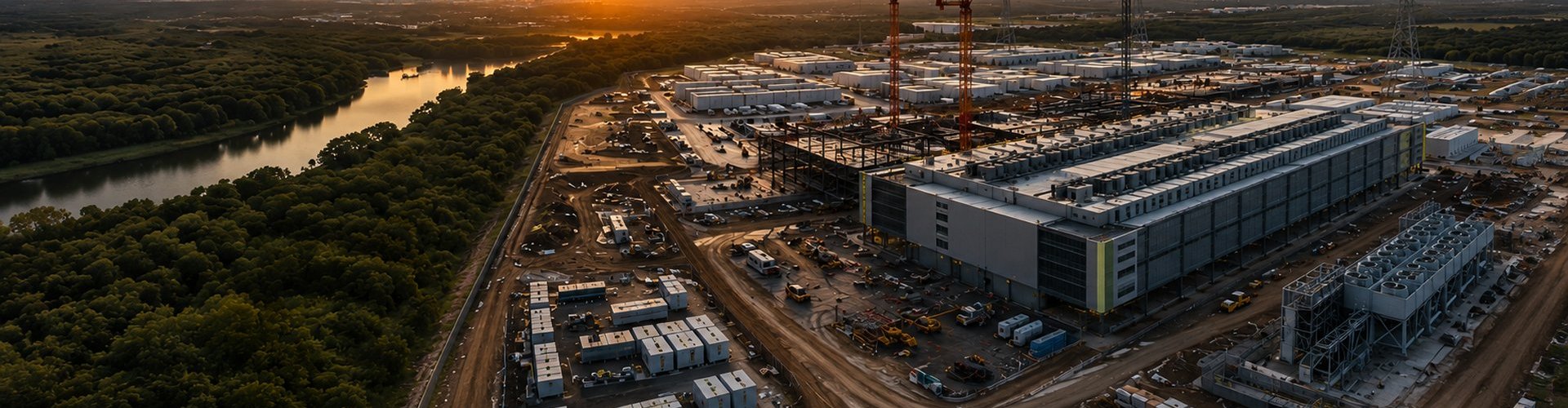
| Stargate Abilene | Microsoft / OpenAI / Oracle / SoftBank Stargate program | Largest single-program AI infrastructure announcement in US history; Taylor County campus on the eastern edge of the region; landmark federal-and-private capital alignment in West Texas |
| Roscoe and King Ranch Wind Cluster | Multiple operators (E.ON, NextEra, Pattern Energy, others) | Wind generation leg of the Texas energy-AI story; shared transmission infrastructure across multiple operators; foundational ERCOT renewable capacity |
Why Trans-Pecos and West Texas
The structural reasons the concentration sits where it does come down to geology and geography. The Permian Basin's hydrocarbon resource defines the region's economic role going back a century. The wind resource defines the region's renewable role over the past two decades. The heavy-REE deposit at Round Top is geological happenstance — there is no analog elsewhere in the United States. Stargate's siting at Abilene was driven by land availability, energy proximity, and the regulatory environment that the broader Texas substrate provides; Abilene sits on the eastern edge connecting back through the Texas Triangle's industrial system.
The concentration's role is increasingly important as the AI-Industrial buildout's energy demand scales. Permian gas is the dispatchable substrate that ERCOT operators, hyperscaler datacenters, and AI training campuses rely on for baseload and peaking capacity. Roscoe-class wind is the renewable substrate that complements the gas. The behind-the-meter siting of datacenters directly at Permian gas wellheads is an emerging architecture that bypasses ERCOT entirely for some loads. The concentration is structurally upstream of the rest of the convergence; the convergence's growth depends on the concentration's continued production capacity.
Why Not a Corridor
The Trans-Pecos and West Texas concentration is regional rather than corridor-shaped. The Permian Basin spans roughly 75,000 square miles across multiple Texas counties (and into New Mexico). Roscoe and adjacent wind operations distribute across hundreds of square miles. Round Top sits in remote Hudspeth County hundreds of miles from the other anchors. Stargate Abilene is on the eastern edge connecting back toward DFW. The anchors do not align along any single transportation spine that would justify a corridor identity in the AustinIO sense.
The concentration may eventually develop sub-corridors as buildout densifies — for instance, if Permian behind-the-meter datacenter siting concentrates along Interstate 20 between Midland-Odessa and the New Mexico border, that segment could earn a corridor designation. Currently the concentration is treated as a regional production basin rather than as a corridor system.
Watching Items Specific to the Region
Stargate Abilene first operational milestone (initial cluster online) is the highest-impact pending event. Round Top commercial production milestone (2028 target) crystallizes the heavy-REE supply chain story. Behind-the-meter datacenter siting concentration at Permian gas wellheads — multiple operators announcing such projects through 2026-2027 — would shift West Texas from a substrate-providing region to a co-located AI compute region. Texas SiC/GaN fab announcement (any operator) could plausibly land in West Texas if power supply and land availability are weighted heavily; alternatively could land in the Austin metro or Gulf Coast.
Related Coverage
Texas Triangle Cluster | Gulf Coast Nexus | Brazos Valley Semiconductor Concentration | Rio Grande Valley Nexus | Permian Basin Energy | Stargate Abilene (Campus 1)