AustinIO > Texas Energy Nexus > Permian Basin Energy
Permian Basin Energy
Largest US Oil and Gas Producer and Emerging Behind-the-Meter Data Center Power Hub
The Permian Basin spans approximately 75,000 square miles across West Texas and southeastern New Mexico, anchored on the Texas side around Midland and Odessa with operations extending across Ector, Midland, Andrews, Martin, Howard, Glasscock, Reagan, Reeves, Pecos, Ward, Winkler, Loving, and adjacent counties. The basin is the largest oil-producing region in the United States and one of the largest natural gas producers in the world, accounting for approximately 22 percent of marketed natural gas production in the U.S. in 2024 with year-over-year growth of 12 percent. The Texas Oil & Gas Association, Permian Basin Petroleum Association, and Texas Independent Producers & Royalty Owners Association collectively represent the operator base across the basin's hundreds of producers.
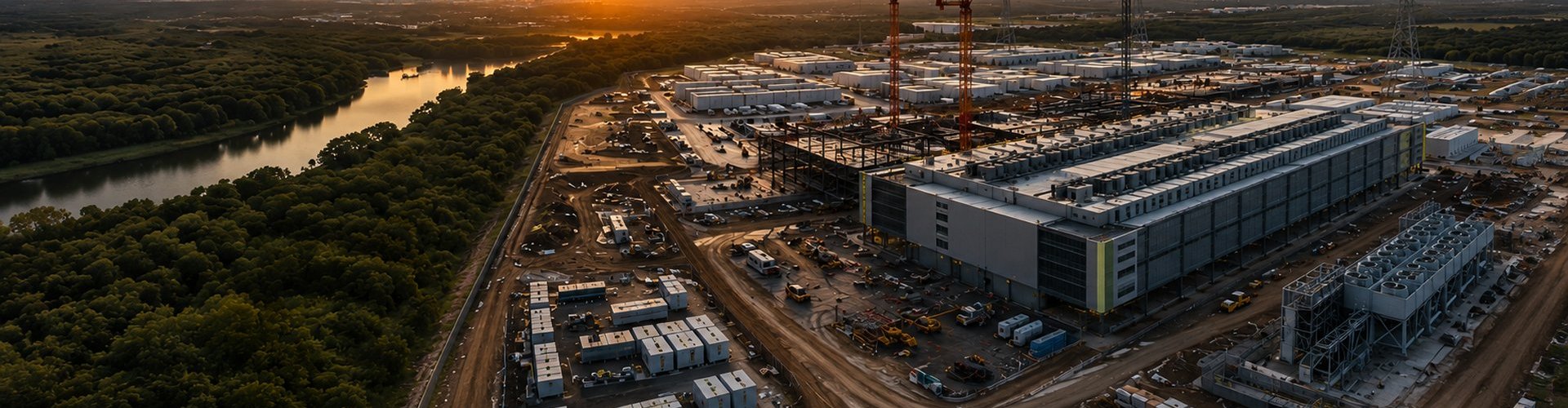
What distinguishes the Permian Basin at the Texas Nexus level in 2026 is the rapid emergence of behind-the-meter gas-fired data center power buildouts that are converting the basin's natural gas advantage from an export commodity into AI compute infrastructure. As of early 2026, multiple multi-gigawatt projects have been announced or are in development. Pacifico's GW Ranch received the largest air pollution permit ever issued in the U.S. in February 2026 for a planned 7.65 GW gas-and-data-center complex. Chevron announced a 2.5 GW initial gas-fired power plant for an AI data center in November 2025, expandable to 5 GW. FO Permian Partners outlined plans in March 2026 for more than 5 GW of off-grid natural gas power to data centers across a 3,200-acre platform in Midland County. The combination of behind-the-meter siting, Permian gas supply, and Texas regulatory environment is creating one of the largest concentrated AI infrastructure power buildouts in U.S. history.
Oil and Gas Production Foundation
The Permian Basin produces approximately 6 million barrels of oil per day at recent rates, accounting for roughly 40 percent of total U.S. crude oil production. Natural gas production exceeded 25 billion cubic feet per day in 2024 with continued growth driven by both crude-oil-associated gas production and dedicated natural gas operations. The basin's structural advantages include vast hydrocarbon reserves with multiple productive formations stacked vertically, established pipeline takeaway infrastructure that the Permian's three-decade-plus shale buildout has developed, and the workforce and supplier ring depth that supports rapid drilling and completion cadence.
The basin's electrification trajectory has been one of the most significant contributors to U.S. nationwide power demand growth in recent years. Approximately 4 GW of average demand has been added in the Permian since 2021, with upstream pad operations (electric submersible pumps, pad equipment) contributing approximately 2 GW, gas compression contributing roughly 1 GW, and direct electricity use at gas power plants and midstream facilities contributing another 1 GW. Residential and commercial sectors in West Texas have added approximately 2.5 GW of demand, with roughly 30 percent of that increase tied directly to oil and gas development. Peak energy demand in Permian oilfields can approach 10 GW — comparable to the power demand of the Houston metro area. This electrification trajectory continues regardless of the data center buildout, with substantial additional demand growth projected through 2030 and beyond.
The shift from natural gas as commodity export to natural gas as electricity feedstock for AI compute changes the basin's strategic position substantively. Permian gas has historically faced pipeline takeaway constraints, with associated gas production from oil wells sometimes flared rather than captured when pipeline capacity was unavailable. Behind-the-meter gas-fired power generation directly at the gas source converts gas output into electricity for AI compute, providing a new market for in-basin gas that solves takeaway constraints while generating substantially higher value-per-cubic-foot than commodity export.
The Behind-the-Meter Data Center Buildout
The behind-the-meter gas-fired data center pattern in the Permian represents a new architectural model for AI compute infrastructure deployment in the United States. The model combines large-scale natural gas-fired power generation co-located directly with data center facilities, bypassing ERCOT grid interconnection entirely and supplying electricity from generation to compute load via dedicated on-site infrastructure. The structural advantages include speed-to-market (months from agreement to operation rather than years for grid interconnection), regulatory simplification (avoiding ERCOT interconnection queue and transmission upgrade dependencies), and direct gas supply (eliminating pipeline takeaway risk for the gas producer and supply chain risk for the power consumer).
| Project | Operator | Scale | Location and Status |
|---|---|---|---|
| Pacifico GW Ranch | Pacifico Energy / data center partners | 7.65 GW at full operation; gas plants plus co-located AI data centers | Permian oilfield-adjacent siting; February 2026 received largest U.S. air pollution permit ever issued; could consume 1-2 Bcf/day of gas (4-7 percent of 2025 Permian gas production) |
| Chevron Permian Power Plant | Chevron Corporation | 2.5 GW initial gas-fired plant; expandable to 5 GW | Behind-the-meter to undisclosed AI data center customer; announced November 2025; leverages Chevron's interest in 1 of every 5 Permian wells; first Chevron move into electricity generation as direct supplier |
| FO Permian Partners | FO Permian Partners (Texas-based off-grid power developer) | More than 5 GW of off-grid natural gas power across a 3,200-acre platform; 320-acre initial parcel with 150 MW ready-now capacity | Midland County, Texas; outlined March 2026; positions to move data center developers from contract to commissioning in months |
| Texas Critical Data Centers | Texas Critical Data Centers | 250 MW initial gas-powered AI data center; potential to scale beyond 1 GW | 235 acres in Ector County; recent purchase |
| Vistra Permian Basin Power Plant | Vistra Corp | $25M expansion adding 860 MW; total capacity expanding from 325 MW to 1,185 MW | Existing Permian plant; final investment decision September 2025; meets growing West Texas data center growth and oilfield electrification demand |
| Diamondback Energy partnerships | Diamondback Energy | Active partner search | Permian Basin operations; announced February 2026 the company is seeking data center partners for behind-the-meter siting |
Per Oil and Gas Watch reporting in February 2026, there are 158 proposed gas power plant projects in Texas, many of them in the Permian and many tied to data center development. The aggregate capacity if all proposed projects are built would more than double Texas's current gas power generation capacity. The buildout reflects both the scale of AI compute power demand and the structural advantage that the Permian's gas supply, regulatory environment, and behind-the-meter speed-to-market provide.
Cross-Anchor Position
The Permian Basin's most operationally significant cross-anchor relationship is with the broader Texas AI compute infrastructure buildout. Stargate Abilene approximately 200 miles east of Midland operates on a similar gas-plus-grid model with the on-site 350 MW gas plant supplemented by Lancium's broader West Texas energy substrate. Project Matador in the Panhandle approximately 250 miles north of Midland operates on a different architectural model — coupled nuclear-and-gas-and-solar — but draws from the same broader West Texas energy resource base. Meta Temple in the Texas Triangle, Tesla Cortex at Giga Texas, and other Texas AI compute operations consume Permian gas indirectly through ERCOT generation; the behind-the-meter Permian buildout extends the gas-to-AI integration directly to the source.
The relationship with Texas oil and gas operators is the foundational substrate. Chevron, ExxonMobil, ConocoPhillips, Diamondback Energy, Pioneer Natural Resources (now part of ExxonMobil), Devon Energy, Permian Resources, and dozens of independent operators collectively produce the gas that the data center buildout consumes. Each major operator's strategic positioning — whether to enter the data center power business directly (Chevron's behind-the-meter model), partner with off-grid power developers (the Diamondback model), or simply continue selling gas via existing midstream relationships — shapes the basin's continued evolution. The basin's gas takeaway pipeline operators (Energy Transfer, Kinder Morgan, Targa Resources, Williams Companies) have ongoing buildout programs supplying both the long-haul export markets and the in-basin gas demand for power generation.
The connection to the broader Texas industrial-and-AI footprint runs through electricity supply chains. Permian-generated electricity supplies oilfield electrification, in-basin data centers, and incrementally feeds into ERCOT for downstream metro and industrial consumption. The integration of West Texas energy substrate into the broader Texas AI-Industrial buildout is increasingly tight; whether AI compute load is sited at Permian behind-the-meter or at metro-area hyperscaler datacenters consuming ERCOT-supplied power, the Permian's gas production is the structural fuel input across both deployment models.
Why the Permian
The Permian Basin's structural advantages for behind-the-meter data center development are substantive and stack together. Vast natural gas supply at scales no other U.S. region matches at comparable cost — Permian associated gas production from oil wells is essentially free input cost from the gas producer's perspective when pipeline takeaway capacity constrains export. Land availability at scales that metro-adjacent siting cannot provide, with thousand-plus-acre parcels available across multiple counties for under $5,000 per acre. Regulatory environment that Texas state-level coordination plus county-level cooperation supports rapid permit issuance — the GW Ranch's air pollution permit was issued at unprecedented scale and pace despite the project's environmental impact magnitude. Speed-to-market via behind-the-meter siting that bypasses ERCOT interconnection queue and transmission upgrade dependencies entirely.
The federal-policy environment under the Trump Administration prioritizes fossil fuel infrastructure development and AI infrastructure expansion simultaneously, with realigned federal policies and incentives supporting the Permian behind-the-meter buildout. The combination of state-level regulatory support, federal-policy alignment, and operator interest in directly capturing AI compute infrastructure value has accelerated the buildout pace beyond what any single factor alone would generate.
Workforce and supplier ring depth in the Permian supports rapid project execution. The basin has decades of experience with large-scale industrial development, with construction contractors, electrical contractors, mechanical contractors, and specialty trades all available at scales that other U.S. greenfield datacenter sitings cannot match. Permian Basin Petroleum Association and adjacent operator-organization coordination supports infrastructure development at multi-billion-dollar capital scales without the friction that less-developed industrial regions face.
Constraints and Considerations
Environmental and air quality considerations are the most material constraint on the behind-the-meter buildout's continued pace. Pacifico's GW Ranch air pollution permit at 7.65 GW received unprecedented permit volume reflecting the scale of operations; aggregate environmental impact across all 158 proposed Texas gas plant projects represents substantial emissions, water consumption, and broader environmental footprint expansion. Texas Commission on Environmental Quality permit decisions, EPA regulatory environment, and broader environmental review processes shape whether the announced buildout converts to operational facilities. Continued regulatory environment depends on continued federal-and-state alignment that the current policy environment supports but future administrations may approach differently.
Water availability is the secondary consideration. Permian Basin water supply is constrained even before adding multi-gigawatt cooling demand from data centers; oil and gas operations already consume substantial water through hydraulic fracturing and produced water management. Data center cooling at gigawatt scale either requires water-intensive cooling or significantly more expensive air-cooled architectures. Cooling water sourcing, produced water reuse for cooling, and broader water infrastructure development in the basin shape continued data center buildout feasibility.
Pipeline and gas supply economics are the third consideration. The behind-the-meter model converts associated gas (from oil wells) and dedicated gas production into electricity for AI compute. Permian gas pricing economics depend on overall U.S. gas demand including LNG export, broader power generation, residential heating, and industrial consumption. If gas prices rise materially, behind-the-meter data center economics tighten; if oil prices fall reducing associated gas production, gas supply tightens for both behind-the-meter and broader markets. The current policy environment supports continued gas production and infrastructure expansion, but commodity price cycles affect operator economics in ways that the AI infrastructure cycle alone does not determine.
Watching Items
Pacifico GW Ranch construction commencement and operational milestones validate the largest single behind-the-meter project in U.S. history. Chevron Permian Power Plant first operational milestones validate the major-oil-operator-as-power-supplier model. FO Permian Partners 320-acre initial buildout to 150 MW operational capacity validates the off-grid platform model. Vistra Permian Basin Power Plant 860 MW expansion through 2027-2028 validates the existing-grid-plant expansion model. Diamondback Energy data center partnership announcements track the broader Permian operator pivot toward direct AI infrastructure integration. Adjacent watching items include any additional behind-the-meter project announcements through 2026-2027, any environmental review or regulatory developments affecting the proposed projects, and any Permian operator vertical integration toward direct data center ownership beyond power supply alone.
Related Coverage
Behind-the-Meter Power | ERCOT Large Load Interconnection | Texas LNG Export Hub | Houston Ship Channel Petrochemical | Rodeo Ranch Energy Storage | AWS GW Ranch | Microsoft Pecos (Project Kilby)