AustinIO > The Texas Nexus > Texas Triangle Cluster > TI Sherman SM1 Fab
TI Sherman SM1 Fab
World's Largest 300mm Analog Fab and Anchor of the Sherman Cluster
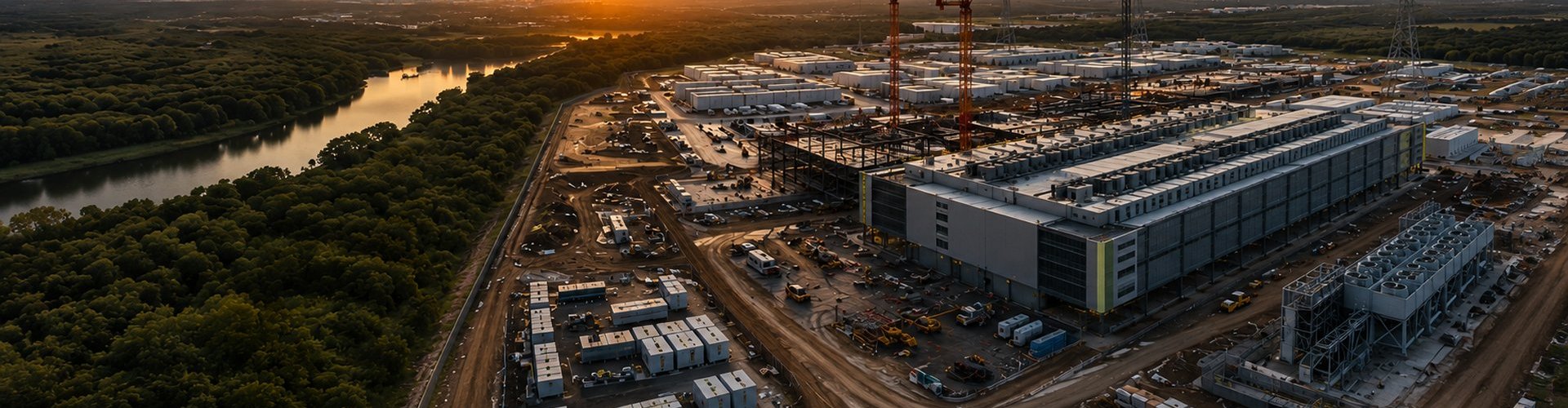
Texas Instruments' Sherman SM1 fab in Grayson County is the world's largest 300mm analog and embedded processing fab, commencing volume production in December 2025 as the first of four planned fabs at the Sherman campus. The campus is sized for up to $40 billion in cumulative capital investment across SM1 through SM4, with SM2's exterior shell already complete and cleanroom installation plus tool positioning scheduled to begin in 2026. SM3 and SM4 follow as market demand for analog, mixed-signal, and embedded processing silicon scales — driven by AI-Industrial demand for power management, automotive electrification silicon, humanoid robotics, and the broader analog-and-embedded silicon layer that supports AI compute deployment across every category.
What distinguishes TI Sherman at the Texas Nexus level is its complementary role to the Austin-Taylor leading-edge logic concentration. Samsung Taylor produces leading-edge logic at 2nm GAA. Tesla Terafab develops next-generation Tesla AI silicon. TI Sherman produces the analog, mixed-signal, and embedded processing silicon that the AI-Industrial buildout depends on as much as it depends on leading-edge logic — power management, motor control, sensor interface, automotive systems, industrial controls, embedded processors. The Texas semiconductor footprint is structurally complete because Austin-Taylor and Sherman together cover both the leading-edge logic axis and the analog-and-embedded axis. No other US state has both at this scale.
SM1 Production and SM2 Buildout
SM1 commenced volume production in December 2025 with capacity ramping through 2026 and beyond. The fab produces analog and embedded processing chips at 300mm wafer scale — daily output measured in tens of millions of chips at full capacity, supplying TI's automotive, industrial, personal electronics, and communications equipment customers globally. The 300mm wafer transition (from TI's legacy 200mm operations) provides approximately 2.3x output per wafer plus substantial cost-per-die reductions; SM1's volume scaling positions TI to meet the analog-and-embedded silicon demand growth that AI deployment, automotive electrification, and industrial automation are driving simultaneously.
SM2 is the second fab at the Sherman campus. Exterior shell completion is done; cleanroom installation and tool positioning begin in 2026, with first wafer production targeted in 2027. SM2 is being equipped through a phased ramp consistent with TI's broader capital deployment cadence. SM3 and SM4 are committed at the campus-planning level but specific equipping and ramp timelines depend on demand growth through the late 2020s. The full four-fab campus at maturity represents one of the largest concentrated semiconductor manufacturing operations in the United States, comparable in scale to Samsung Taylor's announced multi-fab phasing though at different process nodes and product categories.
The Sherman Cluster
The Sherman Cluster are three operationally-interdependent semiconductor anchors concentrate in Grayson County around the Sherman Economic Development Corporation's industrial geography. Texas Instruments' SM1 (operational) plus SM2 (commissioning 2026-2027) plus future SM3 and SM4 anchor the cluster as the fab-consumer side. GlobalWafers America's 300mm silicon wafer plant opened in May 2025 anchors the wafer-producer side; the facility is GlobalWafers' largest silicon wafer site globally, with $7.5 billion in committed investment after the May 2025 announcement of $4 billion in additional expansion (Phases 3 and 4 of the GWA campus). GlobiTech, GlobalWafers' wholly-owned epitaxy subsidiary in Sherman, manufactures silicon and silicon-carbide epitaxy wafers; under the CHIPS Act award structure GlobiTech is converting a portion of existing capacity to 150mm and 200mm SiC epitaxy production, adding power-and-EV-market specialty wafer capability to the cluster.
The cluster's operational interdependence is structurally tight. GlobalWafers America's 300mm silicon wafers are direct feedstock for TI Sherman SM1 production; the co-located wafer-and-fab operations eliminate the international shipping and supply-chain risk that has historically constrained US fab production through Asian wafer dependence. GlobiTech's specialty epitaxy serves both TI Sherman and other US fab customers, with the SiC epitaxy expansion positioning the cluster to participate in the broader US power semiconductor supply chain as SiC-and-GaN demand scales. Workforce pipeline through Sherman High School, Denison High School, Grayson College, and the broader North Texas technical college system supports the cluster's labor demand at scales that smaller individual operations could not justify.
The cluster's structural model is similar to the Phoenix-Chandler semiconductor concentration in Arizona, though at smaller scale and at different process and product categories. Phoenix-Chandler has TSMC plus Intel plus the broader supplier ring; Sherman has TI plus GlobalWafers plus GlobiTech with the supplier ring still forming as the campus phases scale. The Sherman Cluster is the DFW metro's semiconductor cluster, complementing the Austin-Taylor leading-edge cluster within the broader Texas Triangle.
Cross-Anchor Position
TI Sherman's most strategically significant cross-anchor relationship is its complementarity with the Samsung Taylor leading-edge logic concentration. Samsung Taylor produces the silicon for AI compute, autonomy, and humanoid systems; TI Sherman produces the silicon for power management, motor control, sensor interfaces, and embedded systems that surround the AI compute and autonomy hardware. Tesla's vehicle, Optimus, and Megapack programs all require both Samsung Taylor's leading-edge logic and TI's analog-and-embedded silicon; the two Texas operations together supply the silicon stack that no peer US region currently provides at this combined scale.
TI Sherman also connects to the broader US power-semiconductor supply chain through GlobiTech's SiC epitaxy expansion. Tesla's compound multi-program SiC demand (vehicle traction inverters, Megapack/Megablock power conversion, future Optimus and Cybercab applications) depends on US-based SiC supply that GlobiTech's expansion incrementally adds to. The Sherman Cluster's SiC epitaxy capability does not by itself solve the SiC bottleneck thesis covered elsewhere on AustinIO and across the SiliconPlans network, but it is one of the structural pieces of US-controlled SiC supply chain capacity that the bottleneck thesis points toward.
GlobalWafers America's 300mm wafer production positions Sherman as a feedstock supplier to the broader US fab buildout. TSMC Arizona, Samsung Taylor, Intel's Ohio and Arizona operations, and TI's own Sherman fabs all consume 300mm silicon wafers; GlobalWafers America's domestic supply reduces the dependence on Asian wafer imports that has historically been one of the most concentrated chokepoints in the US semiconductor supply chain. The cluster's role in this layer of supply chain resilience is structurally consequential beyond its direct economic footprint.
Why Sherman
Sherman's selection by both TI and GlobalWafers reflects four structural fits. Land availability at scale that the DFW metro's denser geography cannot match — Sherman's roughly 75-mile distance from downtown Dallas places it outside metro-pressure land and water competition while remaining within DFW commuting and supplier ring reach. Texas state-level incentive structures (Texas Enterprise Fund grants, Chapter 313 successor programs) plus Sherman Economic Development Corporation's local coordination provided the regulatory and financial environment that both operators required for multi-billion-dollar greenfield commitments. Workforce pipeline through Sherman ISD's electronics lab partnership, Grayson College's technical programs, and the broader North Texas community college system supplies the technician and engineering labor that the operations require. Federal CHIPS Act funding alignment — TI received CHIPS support and GlobalWafers America received $406 million through CHIPS — anchored the financial structure for both projects.
The Sherman concentration also benefits from the broader DFW metro's defense-industrial substrate. Lockheed Fort Worth, Raytheon McKinney, Northrop Allen, and Bell Textron operate within the same metro labor market; cross-operator workforce mobility (electrical engineers, mechanical engineers, manufacturing operations) deepens the metro-scale labor pool that Sherman's semiconductor operations draw from indirectly even though the immediate workforce pipeline is local-Sherman.
Constraints and Considerations
Demand-side scaling is the most material constraint on the SM2-through-SM4 phasing. TI's analog-and-embedded silicon demand is structurally tied to automotive electrification, industrial automation, and AI-deployment-adjacent power management; whether the demand growth materializes at the rates that justify the full four-fab campus depends on AI-Industrial buildout pacing through the late 2020s and into the 2030s. The campus is structurally sized for substantial demand growth; if growth slows, fabs can be brought online more slowly without abandoning the campus plan, but the announced phasing assumes continued growth.
Water and grid demand at full four-fab maturity will be substantial. Sherman's water and electrical infrastructure has been scaled up substantially to support TI and GlobalWafers operations, but full SM3 and SM4 commissioning will require additional municipal and regional capacity expansion. Grayson County's growth trajectory (population, housing, services) will need to keep pace with the cluster's labor demand to avoid workforce-absorption constraints similar to those covered on the Texas Nexus page.
Watching Items
SM2 first wafer production targeted 2027 is the next major milestone. SM3 and SM4 specific equipping commitments through 2027-2030 will validate or rebase the four-fab campus trajectory. GlobalWafers America Phase 3 and Phase 4 commissioning under the announced $4 billion expansion adds substantial 300mm wafer capacity to the cluster. GlobiTech SiC epitaxy expansion milestones contribute to the broader US power semiconductor supply chain story. Adjacent watching items include any TI announcement of additional analog-and-embedded capacity beyond the Sherman campus, and any further GlobalWafers expansion at Sherman or elsewhere in Texas.
Related Coverage
Dallas-Fort Worth Metro B2B Directory | Austin-Taylor Manufacturing Axis (SH 130) | MP Materials Magnets Fort Worth | US Hwy 79 Deep Tech Corridor | Samsung Taylor Fab | Dallas-Fort Worth Semiconductor