AustinIO > The Austin Supercluster > Giga Austin Nexus > Samsung Taylor Fab
Samsung Taylor Fab
Captive-Equivalent Foundry for Tesla AI Silicon
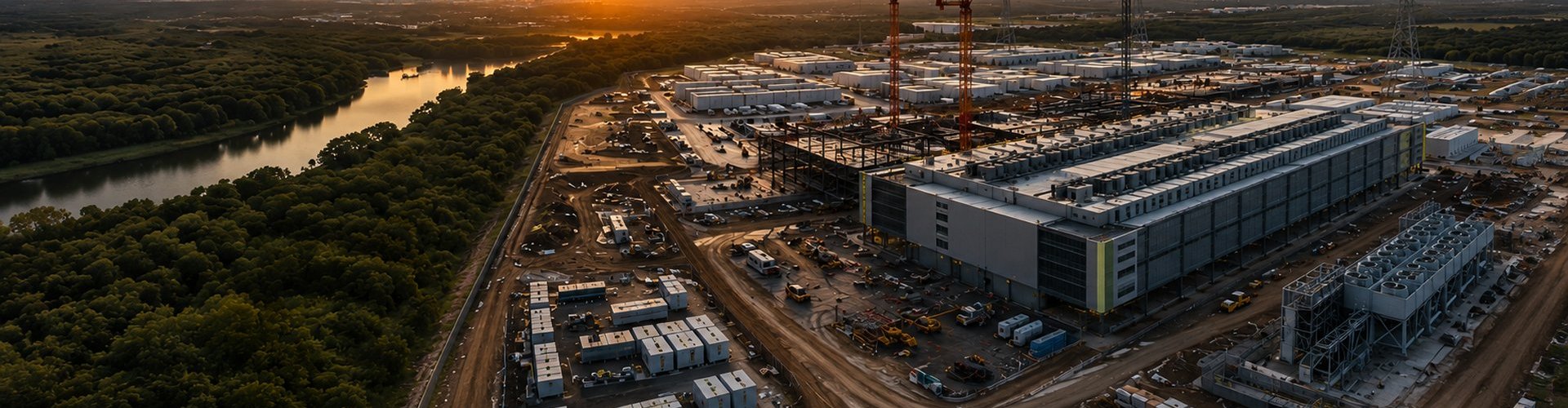
Samsung Taylor is the largest semiconductor capital commitment in Texas history. Samsung Foundry's 2nm GAA leading-edge logic fab in Williamson County represents over $45 billion in cumulative committed capital across announced phases, with Fab 1 ramping to volume production in 2027 and additional fabs optioned through Chapter 313 successor frameworks. The campus is on a trajectory that may eventually include 11 fabs at $192 billion in cumulative capital over decades, making Samsung Taylor not just a single fab but the foundation of a multi-fab complex at one site.
What distinguishes Samsung Taylor at the Giga Austin Nexus level is the captive-equivalent foundry arrangement with Tesla. Tesla AI silicon (AI5 currently in production, AI6 and AI7 forward-looking) is fabricated at Samsung Taylor under multi-year arrangements that approach captive operating conditions. Tesla engineers work on the Samsung Taylor floor; Samsung Foundry's leading-edge capacity at Taylor is operationally tied to Tesla's silicon roadmap across vehicle FSD, Optimus humanoid, Cortex training, and Terafab research programs. The arrangement has no precedent on US soil — no other foreign foundry-customer relationship operates at this depth of integration, and the captive-equivalent framing is what makes Samsung Taylor the critical second-anchor of the Giga Austin Nexus alongside Tesla Giga Texas itself.
The Korean Vertical Integration Pattern
Samsung Taylor exhibits a distinctive Korean vertical integration pattern that other foreign foundries on US soil do not replicate. Samsung Foundry operates the fab; Samsung E&C America (SECAI) is the lead general contractor and cleanroom EPC for the entire Taylor plant; EPCOR USA operates the on-site water utility infrastructure (Sandow Water Project pipeline from Carrizo-Wilcox Aquifer; Blue Sky Water Reclamation Facility on-site, 75% reuse target); Austin Industrial provides UPW and IWT operations on-Samsung-campus; Korean specialty chemicals suppliers (Soulbrain at Williamson County for phosphoric acid, plus broader supply ring) provide fab production inputs. The vertical integration depth is more characteristic of how Samsung operates at Pyeongtaek and Hwaseong domestically than how foreign foundries typically operate on US soil.
By comparison, TSMC Arizona uses Western contractors (Exyte for cleanroom EPC, multiple US GCs, conventional water sourcing through Phoenix municipal infrastructure). Samsung Taylor's Korean-vertical-integration pattern is editorially distinctive and worth surfacing as a structural feature: it means the Samsung Taylor cluster is more tightly Korean-controlled across the full physical infrastructure stack than peer foreign foundries, while simultaneously being more tightly Tesla-coupled at the customer relationship layer than peer foundries are with their customers. The dual integration (Samsung-internal + Tesla-captive) is what makes Samsung Taylor structurally singular.
Suppliers and Co-Located Infrastructure
| Supplier | Proximity |
|---|---|
| AGC Photomask Substrate Production | global |
| Air Liquide Texas Electronics | regional |
| Air Products Houston Operations | regional |
| Applied Materials Austin | local |
| ASM International ALD Production | global |
| ASML Hutto | local |
| ASML Veldhoven EUV Production | global |
| ASML Wilton | domestic |
| Austin Industrial Taylor Operations | onsite |
| Avantor High-Purity Chemicals | domestic |
| Cabot Microelectronics CMP Production | domestic |
| Cadence Design Systems Austin | local |
| Canon Lithography Equipment | global |
| Caterpillar Generator Production | domestic |
| Dai Nippon Printing Photomasks | global |
| Dongjin Semichem Texas (DST) | regional |
| DPR Construction Texas Operations | domestic |
| DuPont Electronic Solutions | domestic |
| Ebara CMP Production | global |
| EcoMicron Cedar Park | local |
| ENC Inc. Taylor | local |
| Entegris Round Rock Operations | local |
| EPCOR Blue Sky Water Reclamation Facility | onsite |
| EPCOR Sandow Water Project | regional |
| Exyte (M+W Group) Cleanroom Construction | global |
| Fine Semitech (FST) Hutto | local |
| Fujifilm Electronic Materials | global |
| GlobalWafers Sherman 300mm Plant | regional |
| Hanyang ENG USA North American HQ | local |
| Hitachi Energy Transformer Operations | domestic |
| Hitachi High-Tech Metrology Production | global |
| Hoya EUV Mask Blank Production | global |
| HTNS America Taylor | local |
| Ichor Systems Texas Operations | local |
| iMarket America / Gradiant Technology Park | local |
| JSR Photoresist Production | global |
| JX Nippon Sputtering Targets | global |
| KLA Corporation Texas Operations | local |
| KMG Electronic Chemicals (Cabot) | regional |
| KoMiCo Technology Round Rock | local |
| Lam Research Tualatin Operations | domestic |
| Lasertec EUV Mask Inspection | global |
| Linde Taylor ASU + Electrolyzer Plant | onsite |
| LS Electric Bastrop | regional |
| Materion Sputtering Target Production | domestic |
| MGC Pure Chemicals America Killeen | regional |
| MSS International Round Rock | local |
| Nikon Precision Lithography | global |
| Nissin Ion Equipment USA Austin | local |
| Nomura Micro Science UPW | global |
| Oncor Taylor Substation | onsite |
| Ovivo UPW Systems | global |
| Photronics Photomask Production | domestic |
| Quanta Services Substation Construction | regional |
| Samsung Austin Semiconductor Austin Campus | local |
| Samsung C&T Taylor Project | onsite |
| Samsung E&C America Taylor Project Office | onsite |
| Schneider Electric Texas Operations | domestic |
| SEMES America | local |
| Shin-Etsu Chemical Photoresist | global |
| Shin-Etsu Handotai 300mm Wafers | global |
| Siemens EDA Operations | domestic |
| Siltronic Wafer Production | global |
| Soulbrain TX | local |
| SUMCO Wafer Production | global |
| Synopsys EDA Austin Operations | local |
| Taiyo Nippon Sanso US Operations | domestic |
| Tekscend Photomask Round Rock | local |
| Tesla AI5/AI6 (Captive-Equivalent Customer) | local |
| TOK Photoresist Production | global |
| Tokyo Electron Round Rock Service Center | local |
| Tokyo Electron US Headquarters | local |
| Toppan Photomasks | global |
| Valex Georgetown Operations | local |
| Valex Round Rock Precision Piping | local |
| Veolia Water Operations Texas | global |
| Versum Materials (Merck Performance) | domestic |
| W.G. Yates & Sons Construction - Taylor Fab 1 | onsite |
| Wonik Materials North America | regional |
The supplier ring is the densest semiconductor specialty supplier concentration in the United States outside Silicon Valley. The U.S. Highway 79 Corridor and Austin-Taylor Manufacturing Axis both run through the Samsung Taylor Cluster's geographic footprint, surfacing the regional density at the corridor-page level. The supplier-ring concentration reinforces Samsung Taylor's position as a multi-fab complex — each subsequent fab phase benefits from the ring already in place, reducing capex marginal cost relative to greenfield siting.
Cross-Anchor Position
Samsung Taylor's relationship with Tesla Giga Texas is the most operationally significant cross-anchor relationship in the entire AustinIO dataset. The Samsung Taylor row in the Tesla Giga Texas supplier CSV (S058) and the Tesla AI5 captive customer row in the Samsung Taylor supplier CSV (S056) capture the bidirectional dependency. Tesla AI5 silicon (FSD compute) flows from Samsung Taylor to Tesla Giga Texas vehicle assembly. Tesla AI6 and AI7 forward-looking silicon will flow through the same captive arrangement. Tesla engineers working on the Samsung Taylor floor are an editorial fact distinguishing this relationship from arms-length foundry-customer arrangements.
Samsung Taylor's relationship with the broader Tesla-SpaceX silicon pipeline extends to SpaceX Bastrop's advanced packaging operations. AI silicon fabricated at Taylor is potentially packaged at Bastrop for orbital compute applications (Starlink V3+, Starshield, prospective Golden Dome SBI). The Texas-anchored end-to-end silicon supply chain — design at Tesla, fabrication at Samsung Taylor, packaging at SpaceX Bastrop, integration at SpaceX Starbase — is structurally distinctive on US soil; Samsung Taylor is the fabrication node in that chain.
Samsung Taylor's relationship with the federally-anchored research substrate at UT Austin's TIE NGMM Center (DARPA-coordinated 3DHI advanced packaging hub) and broader Austin silicon design cluster (Apple, AMD, Tesla in-house design) is workforce-and-research adjacent rather than directly operational. The supplier ring around Samsung Taylor indirectly serves these adjacent operations through shared specialty chemicals, gases, and equipment vendors.
Suppliers and Co-Located Infrastructure
Samsung Taylor's supplier-and-co-located-infrastructure includes 63 suppliers across the supply chain — Tier 1A fab production inputs (specialty gases, photomasks, precision piping, electronics-grade chemicals, captive customer relationships), Tier 1B fab co-located infrastructure (water utility, wastewater reclamation, on-site UPW operations, substation interconnection), and Tier 2 fab equipment and construction (lead general contractor, the Big-5 wafer fabrication equipment vendors, EDA tools, civil construction contractors).
Fifteen suppliers are part of the Samsung Taylor Cluster, which are facilities operationally co-located on the Samsung campus or within the dense Williamson County supplier ring serving the fab.
Constraints and Considerations
Water is the constraint most often discussed for Samsung Taylor. The EPCOR Sandow Water Project pipeline from the Carrizo-Wilcox Aquifer in Milam County is the primary industrial water supply, with the Blue Sky Water Reclamation Facility on-site reclaiming and recycling at 75% target. The arrangement is more sustainable than conventional fab water sourcing but the absolute water demand at multi-fab scale will continue to grow. The combined demand from Samsung Taylor plus Tesla Giga Texas plus broader Austin metro industrial buildout is one of the structural constraints on the convergence's continued scale-up that the Texas Nexus page covers in further detail.
Power supply is conventional ERCOT grid through Oncor's Taylor substation. Unlike Tesla Giga Texas, Samsung Taylor does not currently operate on-site DER, BESS, or microgrid architecture — the fab industry's power-quality requirements for leading-edge process tools are difficult to meet with on-site generation, so grid-tied with high-quality power conditioning is the industry norm. Future BESS for non-process loads may eventually be added without changing this basic architecture.
Watching Items
Samsung Taylor Fab 1 first wafer is targeted 2026 with volume production 2027. Fab 2 is committed and under construction with phasing approximately one year behind Fab 1. Fab 3 and beyond are optioned through regulatory filings but not formally committed. Apple-Samsung Taylor diversification (Apple selectively diversifying silicon production from TSMC-exclusive to include Samsung Taylor as second source for some product categories) is the highest-impact pending external event — would represent a major strategic shift for both Apple and Samsung. Tesla AI7 silicon production milestones are the highest-impact internal-to-the-relationship event, calendar-critical for Golden Dome SBI 2028 capability targets.
Related Coverage
Tesla Giga Texas Complex | Musk Bastrop Complex | Austin-Taylor Manufacturing Axis (SH 130) | Terafab Research Fab Giga Texas