AustinIO > The Austin Supercluster > Giga Austin Nexus > Musk Bastrop Complex > SpaceX Starlink Factory Bastrop
SpaceX Starlink Factory Bastrop
Starlink Terminal Manufacturing and Semiconductor Packaging
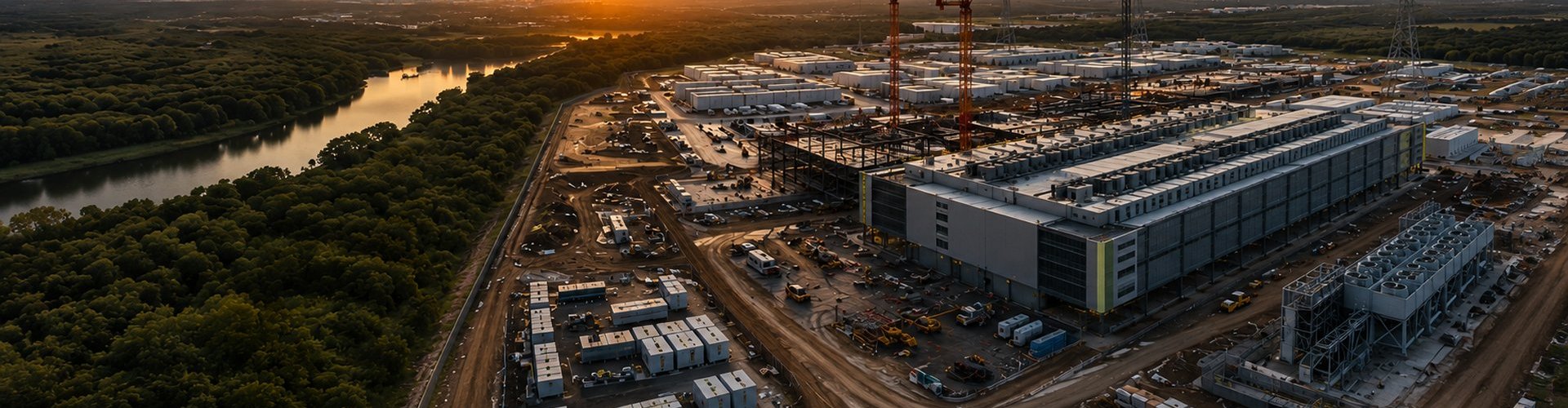
The SpaceX Starlink factory at 858 FM 1209 (Farm to Market Road 1209) in Bastrop County builds Starlink user terminals, the dish-and-router kits that connect subscribers to SpaceX's satellite internet constellation. It is the largest satellite-related manufacturing operation in North America by output volume. In March 2025 the Bastrop line produced about 15,000 dishes a day, and SpaceX's Starlink progress report for 2025 set a goal of doubling Bastrop kit production in 2026.
The factory is the founding operation of the Musk Bastrop Complex, about 30 miles east of Austin along FM 1209. The complex also holds the SpaceX Gigasat Factory (an 11-million-square-foot campus for AI1 orbital data center satellites, announced June 2026), the Bastrop Blades and Vanes Foundry, the X Corp. and Boring Company headquarters at Hyperloop Plaza, and the Snailbrook company town. Within the Giga Austin Nexus, Bastrop is the third manufacturing anchor alongside Tesla Giga Texas and Samsung Taylor.
A $280 million expansion announced on March 12, 2025 adds in-house printed circuit board (PCB) production, a semiconductor failure analysis lab and panel-level packaging (PLP), a method of packaging chips on large rectangular panels instead of round wafers. Governor Greg Abbott's office said the finished plant will be the largest PCB and PLP facility in North America. Packaging equipment began going in during April 2026, and SpaceX is targeting production by the end of 2026.
Facility Profile
| Attribute | Detail |
|---|---|
| Operator | SpaceX (Space Exploration Technologies Corp.) |
| Address | 858 FM 1209, Bastrop, Texas (Bastrop County) |
| Building area | About 1.1 million sq ft existing, rising to about 1.6 million sq ft after the current buildout (Austin Business Journal, March 2026) |
| Workforce | At least 1,000 workers (estimated, March 2026); 400+ more jobs committed under the 2025 expansion |
| Terminal output | About 15,000 dishes per day (March 2025); 2026 goal to double Bastrop kit production |
| 2025 expansion | $280M+ capital investment; about 1 million sq ft added over three years |
| State grant | $17.3M from the Texas Semiconductor Innovation Fund (TSIF), created by the 2023 Texas CHIPS Act |
| Packaging production target | End of 2026 |
What the Factory Produces
| Product Line | Description | Status |
|---|---|---|
| Starlink user terminals | Consumer and enterprise satellite internet terminals (dishes, routers, mounting hardware) for a subscriber base of 12 million+ active customers in 160+ countries and territories (June 2026) | Volume production; operational |
| Starlink component parts | Kit-level components and sub-assemblies for terminal production | Volume production; operational |
| Printed circuit boards (PCBs) | In-house PCB production for Starlink hardware, part of the $280M expansion | Being expanded; production targeting end of 2026 |
| Panel-level packaging (PLP) | Fan-out panel-level packaging of Starlink chips, starting with radio frequency (RF) chips now packaged by outside suppliers; planned as the largest PLP facility in North America | Equipment installation began April 2026; production targeting end of 2026 |
| Semiconductor failure analysis lab | In-house failure analysis for packaged silicon quality and reliability | Part of the $280M expansion |
The 2025 Semiconductor Expansion
On March 12, 2025, Governor Abbott announced a $17.3 million Texas Semiconductor Innovation Fund grant to SpaceX for the Bastrop expansion. SpaceX committed more than $280 million in capital investment and more than 400 new jobs, and the plant will add about 1 million square feet over three years. The work covers Starlink kits and their component parts, including advanced packaged silicon products.
SpaceX Starlink chips are packaged today by STMicroelectronics, with Innolux in Taiwan handling overflow orders, according to Digitimes reporting cited by Tom's Hardware in June 2025. The same reporting described the Bastrop packaging line as fan-out panel-level packaging (FOPLP) on 700 mm by 700 mm panels, which would be among the largest panel formats in the industry. Reuters reported on April 10, 2026 that SpaceX had begun installing equipment, that the first products will be the radio frequency chips used in Starlink hardware, and that the schedule has slipped somewhat but still targets production before the end of 2026.
Bringing PCBs and chip packaging in-house cuts SpaceX's dependence on outside suppliers for the electronics inside every Starlink kit. Tesla's Terafab Research Fab at Giga Texas applies the same approach to automotive and AI compute silicon. SpaceX President and COO (chief operating officer) Gwynne Shotwell said at the announcement: "This grant will help continue to expand Bastrop's manufacturing for Starlink to help connect even more people across the state and around the world with high-speed, low-latency internet."
The TSIF grant and the $280 million capital commitment are scoped to Starlink. As the adjacent Gigasat Factory ramps toward AI1 satellite production, the PCB and packaging lines built for Starlink may also serve AI satellite hardware.
Expansion Timeline
| Event | Date | Detail |
|---|---|---|
| Starlink R&D facility opened | Fall 2024 | Initial semiconductor research and development (R&D) facility and PCB plant at Bastrop |
| TSIF grant and expansion announced | March 12, 2025 | $17.3M Texas Semiconductor Innovation Fund grant; $280M+ committed capex; 400+ jobs; 1M sq ft expansion over three years |
| Terminal output reaches 15,000 dishes a day | March 2025 | About 5.5 million dishes a year at the Bastrop line |
| Project Echo office expansion | September 2025 | $8M, 80,000 sq ft office addition at 858 FM 1209; construction September 2025 to January 2026 (Texas Department of Licensing and Regulation filing) |
| Site clearing and vertical construction | February 2026 | Land cleared on both sides of the plant under the permit name "Project Echo Solar Warehouse"; a 50,000 sq ft parking garage for 250+ vehicles under way |
| Packaging equipment installation begins | April 2026 | Reuters reports equipment going into the chip packaging facility; first products are Starlink RF chips |
| PCB and PLP production target | End of 2026 | In-house PCB and panel-level packaging production operational |
Place in the SpaceX Texas Network
The Starlink factory connects to these SpaceX and Musk-affiliated sites in Texas:
- SpaceX Gigasat Factory (Bastrop County): the 11-million-square-foot AI1 satellite campus on the same FM 1209 corridor, announced June 2026. It shares site infrastructure and workforce with the terminal factory and may draw on the PCB and packaging lines built under the $280M expansion.
- SpaceX Starbase (Boca Chica, Cameron County): the Starship production and launch site about 350 miles south, which will launch AI1 satellites built at the Gigasat Factory.
- SpaceX McGregor Engine Factory (McLennan County): builds and tests the Raptor engines for Starship and tests Merlin engines for Falcon 9.
- Tesla Giga Texas (Travis County): designs Tesla AI silicon. As Bastrop brings packaging in-house, it becomes a step in a chain that runs from Tesla chip design through fabrication at Samsung Taylor or Terafab Gibbons Creek, packaging at Bastrop, and deployment in orbit.
- TIE NGMM Center at UT Austin (Travis County): the Texas Institute for Electronics Next-Generation Microelectronics Manufacturing center, funded by an $840 million DARPA (Defense Advanced Research Projects Agency) award, researches three-dimensional heterogeneous integration (3DHI) packaging, which stacks chips of different types and materials in a single package.
Why Bastrop
SpaceX chose Bastrop County for the original Starlink terminal factory for these reasons:
- Large tracts of available land at a low cost basis
- Proximity to the Austin metro for engineering talent and supplier access
- The Texas regulatory and labor environment, including state incentives such as the TSIF
The 2025 expansion stayed in Bastrop because the terminal factory already supplied the workforce, supplier relationships and operating base the packaging lines need. The June 2026 Gigasat announcement, on 1,000+ acres along the same FM 1209 corridor, made Bastrop SpaceX's main Texas manufacturing site for both ground hardware (terminals and gateways) and space hardware (AI satellites). Across the SpaceX Texas footprint, Starbase handles Starship production and launch, McGregor handles engine production and testing, and Bastrop handles terminals, electronics and satellites.
Related Coverage
SpaceX Gigasat Factory | Bastrop Blades & Vanes Foundry | SpaceX Starbase | Terafab Gibbons Creek
