AustinIO > Texas Energy Nexus > Behind-the-Meter Power
Behind-the-Meter Power
A meter is the point where a project's wires meet the grid's wires. Everything on the grid side — the substations, the transmission lines, the utility's power plants — is front of the meter. Everything on the project's side — the switchgear, the batteries, the on-site generators — is behind the meter. Behind-the-meter power is electricity generated on site and consumed directly, on the customer's side of that point, rather than drawn from the public grid.
The model went from niche to structural in about two years, and the reason is timing. Grid interconnection in major markets now runs three to ten years. Industrial buildout schedules cannot wait that long, so the largest new power consumers started bringing their own. One industry filing projects behind-the-meter penetration in new-build projects rising from 10-20% in 2025 to 50-60% by 2030 — a shift from temporary fix to primary enabler of growth.
Why operators bring their own power
The appeal is time before anything else. A dedicated on-site plant can be permitted and built faster than a grid interconnection can be approved, turning a multi-year queue wait into a phased energization schedule. Beyond speed, self-generation reduces exposure to volatile wholesale prices, sidesteps transmission and network cost allocations, and hands the operator direct control over its own reliability instead of a place in someone else's line.
In Texas specifically, it routes around three constraints at once: a 474 GW interconnection queue five times the grid's peak demand, the SB 6 mandatory-curtailment kill switch that applies to grid-connected large loads, and the August 2026 audit that froze new grid connections entirely. A facility that never enters the queue is not waiting in it, not subject to its curtailment, and not frozen by its pause.
The terms are not interchangeable
"Behind the meter," "off-grid," "islanded," "co-located," and "micro-grid" get used as synonyms, and they are not. The cleaner way to think about it is by how the site connects to the grid, from most isolated to least:
- Off-grid / islanded — no grid connection at all. The site's generation is its only power source, and reliability rests entirely on how well that plant is run. This is the purest form and the riskiest to operate.
- Co-located with new generation — a power plant built specifically for the facility, on or beside the site. It may keep a thin grid tie for backup, but its primary supply is the dedicated plant. Most flagship AI campuses use this configuration.
- Co-located with existing generation — the facility attaches to a plant that already served the grid, such as a nuclear station. Regulators treat this differently from new generation, because it can subtract capacity the public grid was already counting on.
- Export-only — the plant remains grid-connected and sells power, while the facility draws from it. Because the supply circuit ties into the plant's grid-connected system, the site still participates in grid frequency dynamics. This looks like off-grid but is not — it is connected through the plant.
The distinction matters legally as well as technically. Texas Utilities Code §39.169 governs co-locating a large load with an existing generation resource, and regulators can and do treat a brand-new plant differently from one that used to feed the grid.
What powers them
The generation behind the meter is whatever can be built fast and sized to a constant load. In practice that means, in rough order of current deployment: natural gas turbines and reciprocating engines, solar paired with battery storage, fuel cells, and — at the frontier — dedicated nuclear. Batteries are the piece that makes intermittent sources work: an industrial load is flat around the clock, solar and wind are not, and storage bridges the gap. Gas remains the workhorse because it is dispatchable and quick to permit relative to anything else at gigawatt scale. NuScale's small modular reactors are currently the only nuclear technology NRC-approved to operate behind the meter, which is why the nuclear entrants are watched closely.
The Industrial Triad is converging on one power model
Data centers, semiconductor fabs, and gigafactories — the three recursive machines of the AI-industrial base — are all adopting behind-the-meter power at the same moment, for the same reason. It is not three separate facility stories. It is one energy story with three load types on it.
Data centers
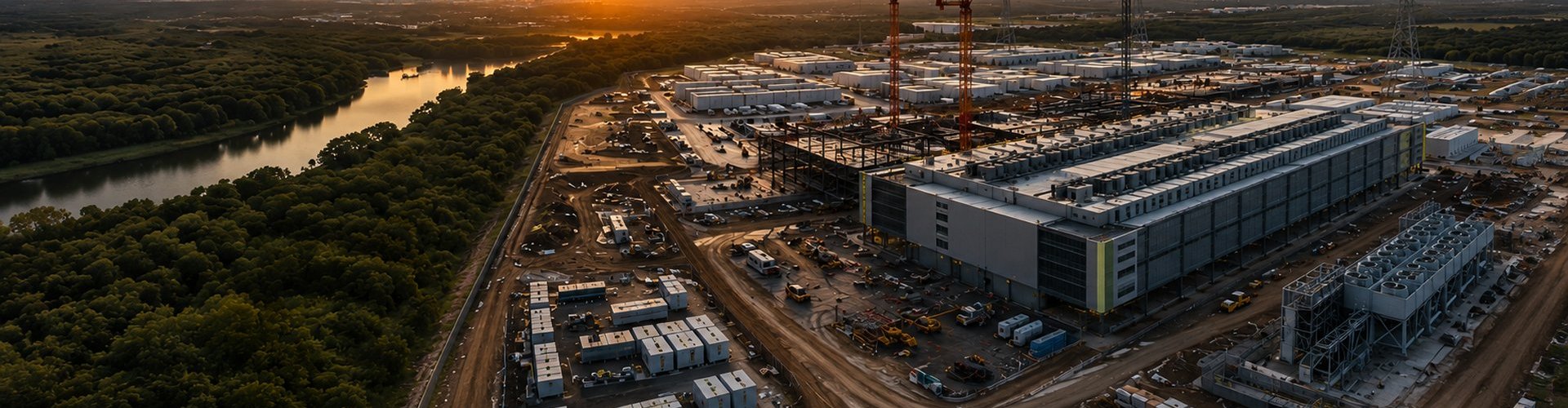
The loudest and largest case. A modern AI training campus draws more than a gigawatt of flat, around-the-clock load, and the grid queue cannot serve it on schedule. Every flagship Texas AI campus generates its own power: Fermi's Project Matador at Amarillo (on-site nuclear, gas, solar, and storage toward 11 GW), Google's Meitner Energy Center in the Panhandle (co-located wind, solar, and 3 GWh of storage with gas for firming), AWS at GW Ranch in Pecos County (up to 7.65 GW of on-site gas), Microsoft's Project Kilby (a 2.67 GW Chevron gas plant built for the campus), and Crusoe's Abilene site serving Microsoft. Microsoft alone signed more than 5 GW of behind-the-meter nameplate capacity in 2026.
Semiconductor fabs
Arguably a better fit than data centers, because a fab's power problem is quality as much as quantity. A momentary voltage sag can ruin a wafer lot mid-process and halt a production line, which makes fabs the most power-sensitive industrial assets in North America. For them, on-site firm generation is about continuity and clean power, not only queue-jumping. Project Matador markets to fabs explicitly alongside data centers, tying behind-the-meter supply to CHIPS Act onshoring. This is the power question underneath Terafab and Samsung's Taylor fab: as fab clusters scale, dedicated generation stops being optional.
Gigafactories
A gigafactory fits for sheer sustained draw. Battery cell production runs continuous electrochemical processes — drying, formation, calendering — that do not tolerate interruption, and a full plant pulls hundreds of megawatts around the clock. The logic mirrors a training campus: constant baseload, grid queue too slow, so bring your own power. As the Giga Texas footprint expands and adds on-site chip and compute load, the case for dedicated generation compounds.
Steel and hydrogen sit just outside the Triad but on the same curve. Electric arc furnaces and green-steel plants are enormous point loads already pairing with on-site solar and storage, and hydrogen production is the extreme case — the electrolysis is the load, so co-locating dedicated generation is the entire business model. Data City near Laredo, a 50,000-acre campus phasing toward green hydrogen from salt-dome storage, is a hydrogen hub and a behind-the-meter data center in one.
The catch
Behind the meter is not free of friction. On-site generation has to be permitted for emissions and air quality, and a gigawatt of gas turbines carries a real environmental footprint — GW Ranch is permitted for upward of 30 million metric tons of CO2 per year. The generation has to be sized, synchronized, and protected so it coexists with any grid tie, which is a genuine engineering burden. And incentives can cut against it: in some states, tax exemptions are conditional on grid interconnection, so a fully behind-the-meter facility forfeits them. Texas, so far, has leaned the other way — Governor Abbott has explicitly praised projects that provide their own power and water, which is why the model faces less policy resistance there than almost anywhere else.
Last updated September 11, 2026. Behind-the-meter capacity figures reflect nameplate generation, not facility load; the two differ substantially. See individual facility pages for detail.
Related: ERCOT Large Load Interconnection · Texas Data Center Moratorium · AI Data Center Exemplars · Giga Austin Nexus · Texas Energy Nexus
Related Coverage
ERCOT Large Load Interconnection | ERCOT Energy Sovereignty | Brownfield Inheritance | Texas BESS Concentration | Permian Basin Energy | Water & Cooling in Large Facilities | Bastrop Blades & Vanes Foundry