AustinIO > The Austin Supercluster > Giga Austin Nexus > Musk Bastrop Complex > Bastrop Blades & Vanes Foundry
Bastrop Blades & Vanes Foundry
Gas Turbine Blade and Vane Casting for AI Data Center Power
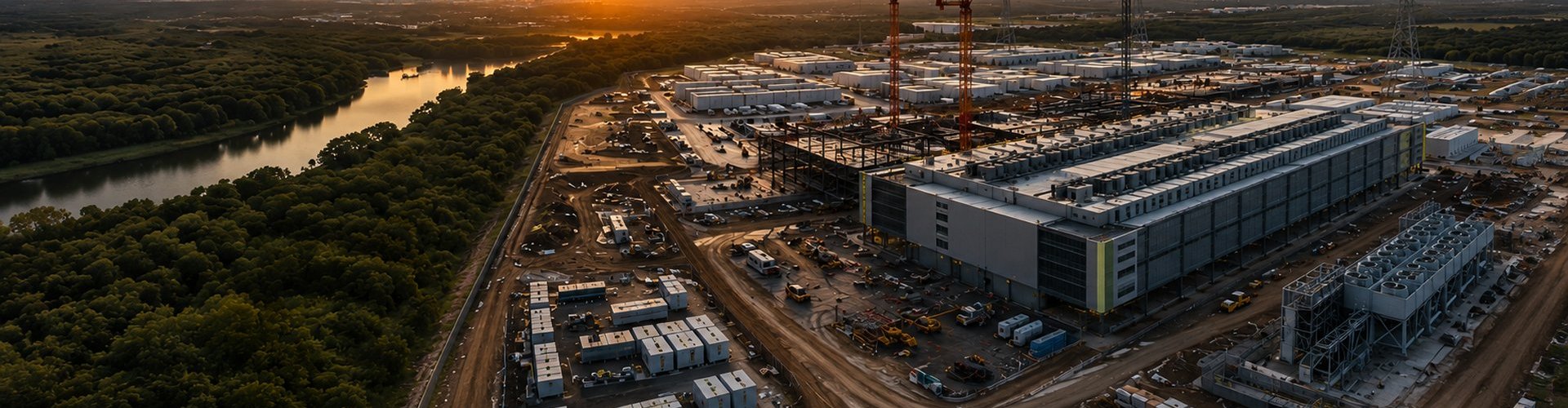
SpaceX is building a foundry at the Musk Bastrop Complex in Bastrop County, Texas, to cast gas turbine blades and vanes in-house. Blades and vanes for the hot section of a large gas turbine are the scarcest component in the gas power supply chain. The Information first reported the project in August 2026, and SpaceX CEO Elon Musk confirmed it on X (the social platform formerly called Twitter) on August 30, 2026: "The limiting factor for nat gas turbine production is casting the blades & vanes. By doing in-house casting at SpaceX, we can accelerate nat gas turbines coming online by up to 18 months, which is a profound game-changer."
The foundry sits on FM 1209 about 30 miles east of Austin, next to the Starlink terminal factory, the SpaceX Gigasat Factory (which builds the AI1 orbital data center satellite) and the SpaceX semiconductor advanced packaging plant. SpaceX bought roughly 830 acres near the Starlink factory between March and June 2026. Only three or four foundries worldwide can cast hot-section blades for large gas turbines, and their order books are reportedly full through 2029-2030. Every data center that depends on gas turbines for primary or backup power waits in that queue, including the SpaceX goal of 10 GW (gigawatts) of AI data center power by the end of 2027 (SpaceX now owns xAI, the AI developer behind the Grok models).
The Casting Bottleneck
Hot-section blades and vanes sit directly behind the combustor of a gas turbine, in combustion gas at 3,000-3,600°F (about 1,650-1,980°C). That gas is hundreds of degrees hotter than the melting point of the nickel superalloy the parts are made from. The parts survive for two reasons:
- Single-crystal structure: each blade is cast as one continuous crystal lattice with no grain boundaries, so cracks have no boundary to run along at high temperature.
- Internal cooling: compressed air from the turbine's compressor flows through ceramic-cored passages inside the blade and out through film-cooling holes fractions of a millimeter across, keeping the metal below its melting point.
The parts are made by investment casting with directional solidification: molten superalloy is poured into a ceramic shell mold and cooled from one end so the grains grow in one direction. A single-crystal casting adds a crystal selector, a spiral passage at the base of the mold that lets only one grain grow into the part. The tooling, vacuum furnaces, ceramic core technology and metallurgical skill this takes are concentrated in a few companies:
- Precision Castparts Corp. (owned by Berkshire Hathaway)
- Howmet Aerospace (formerly Arconic), the largest independent castings supplier
- Consolidated Precision Products (CPP) of Cleveland, Ohio, which GE Aerospace agreed on September 8, 2026 to buy for $11.75 billion
- A small number of European and Japanese specialists
Demand for turbines is rising because of AI data centers. A data center campus needs either grid power, which takes years to connect in most markets, or on-site generation, which today means gas turbines. GE Vernova is reported to be sold out of gas turbine production capacity through 2030. In the Austin area, Meta Temple, Rowan Temple, the US 79 Data Center Corridor through Georgetown, Hutto and Taylor, and the Cedar Creek Data Center Cluster in Bastrop County compete for the same turbine delivery slots, and for ERCOT large-load interconnection (ERCOT is the Electric Reliability Council of Texas, the state grid operator). The casting backlog turns a 24-month turbine delivery into a wait of 36-42 months.
The Foundry
SpaceX posted jobs for the Bastrop foundry in April 2026: Senior Operations Engineer, Senior Materials Engineer, Automation Engineer and Senior Tooling Engineer, each scoped to a "Blades and Vanes Foundry" on the Bastrop site. The Senior Operations Engineer posting covers "construction, buildout, and operational ramp-up of a new blades and vanes foundry." The Senior Materials Engineer posting covers "Ni-superalloy castings for power generation" (Ni is nickel).
| Detail | What's Known |
|---|---|
| Location | Bastrop, Texas, within the Musk Bastrop Complex on FM 1209, about 30 miles east of Austin |
| Land | About 830 acres bought near the Starlink factory between March and June 2026 |
| Product | Single-crystal nickel-superalloy blades and vanes for large gas turbines; possibly Raptor engine turbopump castings |
| Purpose | Avoid the global casting backlog running to 2029-2030 and bring gas turbines online up to 18 months sooner |
| Dual use | Morgan Stanley analyst Adam Jonas (August 16, 2026 research note): the plant could serve both data center gas turbines and Starship Raptor engine turbopumps |
| Hiring | Active since April 2026: materials, automation, operations and tooling engineers |
| Investment and jobs | Not disclosed |
| Permits | Environmental permits pending as of September 2026; no state filing reported |
| Operational date | Not announced; new single-crystal casting lines typically take years to qualify |
Musk tied the foundry to solar in the same August 30 post on X: "SpaceX and Tesla are each building 100GW/year of solar production capacity as fast as possible, but natural gas will still be needed to supplement and bootstrap solar for several years." He first raised the idea on a February 2026 podcast, saying SpaceX and Tesla may need to make turbine blades and impellers in-house to keep enough power flowing.
The foundry is part of a wider SpaceX move into on-site gas power for its data centers, which Musk calls "Bring Your Own Power":
- xAI, now part of SpaceX, has run gas turbines at its Colossus data centers in Memphis, Tennessee since 2024; SpaceX has said the temporary, unpermitted units will be fully removed by July 2027 and replaced with a permanent 1.2 GW gas plant.
- SpaceX is spending $2.8 billion on gas turbines for its AI data centers, WIRED reported in May 2026.
- Musk bought APR Energy, an operator of trailer-mounted gas turbines with more than 1 GW of fleet capacity, in a deal that surfaced in a Federal Trade Commission filing in July 2026.
Raptor Turbopump Castings
The metallurgy that produces gas turbine hot-section blades also produces Raptor engine turbopump parts. A Raptor turbopump runs at temperatures and rotational speeds comparable to a gas turbine hot section, and the two use similar superalloys, melting practice and casting processes. Adam Jonas of Morgan Stanley pointed to this overlap: one foundry can spread its cost over power generation parts and rocket engine parts, which helps justify a plant that a newcomer to the turbine market might not build for turbine blades alone.
Turbopump castings would put the foundry in the SpaceX propulsion supply chain. SpaceX designs Raptor in Hawthorne, California, builds and tests engines at SpaceX McGregor near Waco in McLennan County, and launches Starship from SpaceX Starbase at Boca Chica in Cameron County. A Bastrop casting source would add a Texas link to that chain:
- Design: Hawthorne, California
- Casting: Bastrop, Bastrop County
- Engine build and test: McGregor, McLennan County
- Launch: Starbase, Cameron County
The Foundry Within the Bastrop Complex
The Blades and Vanes Foundry is the newest plant at the Musk Bastrop Complex, a campus of more than 1,000 acres on FM 1209 owned or under contract by SpaceX and other Musk affiliates. SpaceX runs five manufacturing operations there:
| Facility | Function | Status |
|---|---|---|
| Gigasat Factory | AI1 orbital data center satellite manufacturing; 11 million sq ft, vertically integrated from solar ingots to finished spacecraft | Unveiled June 8, 2026 |
| 10 GW Solar Cell Factory | Solar ingots, wafers and cells on two floors of 5 GW each, supplying power systems for the AI1 constellation | Under construction |
| Semiconductor Advanced Packaging | Packaging of D3, the SpaceX custom radiation-tolerant chip, for orbital compute modules | Equipment installation began April 2026; production targeted for end of 2026 |
| Starlink Terminal Manufacturing | Starlink user terminal production | Operational |
| Blades and Vanes Foundry | Single-crystal nickel-superalloy casting for gas turbine blades and vanes, and possibly Raptor turbopump parts | Hiring since April 2026; buildout underway; permits pending |
SpaceX builds Starship and Super Heavy at Starbase. Bastrop makes most of what goes around the rocket: satellites, solar cells, chip packaging and now power generation parts, all feeding the AI1 orbital compute program and the company's ground data centers.
Three Texas Answers to Data Center Power Limits
The foundry is one of three projects in the Austin area aimed at the power limit on AI data centers:
| Response | Operator | Location | Mechanism |
|---|---|---|---|
| Move compute to orbit | SpaceX AI1 / Gigasat Factory | Bastrop County (manufacturing); low Earth orbit, or LEO (deployment) | Satellites run AI servers on solar power and reject heat through radiators, with no grid connection |
| Bring nuclear to the data center | Aalo Atomics | Austin headquarters; Georgetown (planned manufacturing); customer sites (deployment) | Aalo Pod: a 50 MWe (megawatts electric) plant built from factory-made, sodium-cooled modular reactors; no carbon emissions, no grid dependency |
| Clear the gas turbine backlog | SpaceX Blades and Vanes Foundry | Bastrop County | In-house casting of the scarcest turbine part, bringing gas turbines online up to 18 months sooner |
The three projects work on different timescales:
- Gas turbines, 2026-2030: the fastest source of behind-the-meter power (generation on the customer's side of the utility meter) once the hardware arrives. SpaceX needs 3-4 GW of gas power for the ground data centers it is building ahead of orbital compute.
- Modular nuclear, 2028 onward: around-the-clock power from Aalo Pods at 50 MWe each. The Aalo-X test reactor at Idaho National Laboratory reached criticality on July 4, 2026.
- Orbital compute, 2027 onward: AI1 satellites on continuous solar power, free of land, water, grid and permitting limits. SpaceX targets two AI1 prototype launches in early 2027.
Gas turbines are the first of these to deliver power, and blade and vane casting limits how fast turbine makers can ship them. The wider Texas gas, grid and storage picture is on the Texas Energy Nexus page.
Related Coverage
SpaceX Gigasat Factory | SpaceX Starlink Factory Bastrop | Behind-the-Meter Power