AustinIO > The Austin Supercluster > Giga Austin Nexus > Tesla Giga Texas Complex > Giga Texas Cortex Training Cluster
Giga Texas Cortex Training Cluster
Cortex is the Tesla AI training program at Tesla Giga Texas, the 2,500-acre campus along SH 130 in Travis County. Two GPU (graphics processing unit) clusters on the campus, Cortex 1 and Cortex 2, train the neural networks behind Full Self-Driving (FSD), the Tesla Robotaxi service and the Optimus humanoid robot. The same campus builds the vehicles and robots that run those networks, covered at Tesla Giga Texas Car Production and Optimus Factory at Tesla Giga Texas.
Tesla reports its onsite AI training capacity in Texas in megawatts (MW) of power. A chart in the Tesla Q2 2026 update shows about 115 MW at the end of 2025, about 135 MW at the end of Q1 2026 and about 260 MW at the end of Q2 2026, with most of the increase coming from Cortex 2. Tesla targets nearly 400 MW by the end of 2026.
Cluster Overview (End of Q2 2026)
| Cluster | Campus Location | GPU Count | Power | Primary Workload | Status |
|---|---|---|---|---|---|
| Cortex 1 | South end, next to the main vehicle factory | More than 100,000 H100e (mixed Nvidia H100 and H200) | About 130 MW | FSD and robotaxi training | In production since Q4 2024 |
| Cortex 2 | North end | More than 130,000 H100e | About 130 MW active; 500 MW design capacity | Vehicle and humanoid robot autonomy | Online April 2026; ramping |
| Combined | Giga Texas, Austin | More than 230,000 H100e | About 260 MW active; nearly 400 MW targeted by end of 2026 | FSD, robotaxi and Optimus training | Ramping |
H100e means H100-equivalent: Tesla counts its mixed population of Nvidia H100 and H200 GPUs in units of one H100. Tesla schedules work across both clusters as program needs shift. Cortex 2 was first planned as the Optimus cluster, but the Q2 2026 update says it "supports the development of both vehicle and humanoid robot autonomy software and will ramp further over the rest of the year to ensure we have sufficient compute resources."
Cortex 1: FSD and Robotaxi Training
Cortex 1 occupies a dedicated data center building on the south end of the Giga Texas property, next to the 10-million-square-foot main vehicle factory. It came online in Q4 2024 with 50,000 Nvidia H100 GPUs and grew through 2025 to about 100,000 H100 and H200 GPUs. Tesla's Q1 2026 Form 8-K filing lists the cluster at "over 100k H100e."
Cortex 1 trains the FSD neural network that runs on Tesla vehicle computers from Hardware 3 (HW3) through Hardware 4 (HW4, also called AI4). Tesla credits Cortex with a 5x increase in its training compute, which supported the move from FSD v11, built on modular hand-written C++ code, to FSD v12, a single end-to-end neural network that maps camera input directly to driving controls. Cortex 1 now trains the v14 release line and FSD v15.
| FSD Version | Architecture | Status (October 2026) |
|---|---|---|
| v11 | Modular C++ code | Superseded |
| v12 | End-to-end neural network, first trained at Cortex scale | Superseded |
| v14 | Current production release, about 1 billion parameters | Consumer vehicles on v14.3.x; FSD v14 Lite shipped to HW3 vehicles |
| v15 | Rebuilt architecture, about 10 billion parameters | Testing in the Tesla Robotaxi fleet; HW4 consumer release targeted for late 2026 or early 2027 |
FSD v15 grows the network from about 1 billion to about 10 billion parameters. On the Q1 2026 earnings call, Elon Musk confirmed that v15 will run on current HW4 computers with 16 GB of memory, so owners will not need the next-generation AI5 computer. Tesla told JPMorgan in August 2026 that v15 rests on seven core technologies, about 40% of them already running in the Austin robotaxi fleet. Tesla has tied round-the-clock robotaxi operation, targeted for around October 2026, to validation of v15. Unsupervised FSD will debut on a version of v14 or v15 where the law allows, and Tesla plans larger unsupervised deployments only after v15 training and validation are complete.
Tesla Robotaxi launched in Austin in June 2025 and has since expanded to Dallas, Houston, Miami (July 3, 2026), Orlando and Tampa (July 21, 2026) and the San Francisco Bay Area. The service logged 2.4 million cumulative paid miles through Q2 2026, about 900,000 of them in Q2. The Cybercab, a two-seat robotaxi with no steering wheel or pedals, launched in Austin on September 3, 2026, with public rides starting September 4. As of September 2, 2026, Tesla had 314 robotaxis registered in Texas, 45 of them Cybercabs, according to the FSD Database count of Texas Department of Motor Vehicles records. Texas Robotaxi Deployment covers the service city by city.
Cortex 1 draws about 130 MW at full capacity. Its cooling system uses six chilled-water pipes feeding the GPU racks, four water tanks on the building's second floor and large propeller-style fans on the roof, whose heat exhaust drone observers regularly film. Data Center and Fab Water Use and Cooling in Texas covers cooling across the state's large sites.
Cortex 2: Vehicle and Humanoid Autonomy
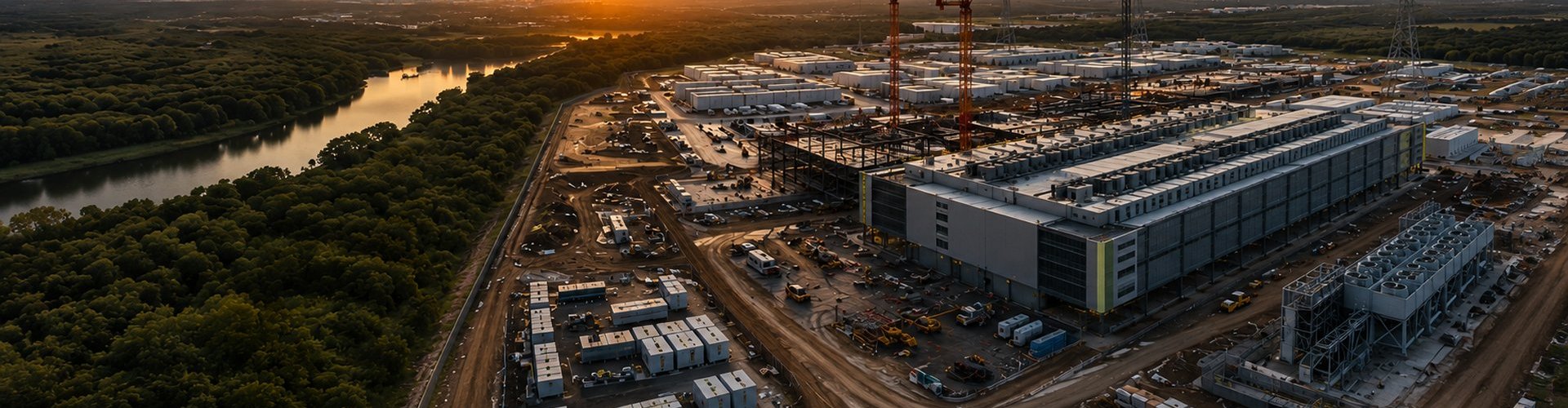
Cortex 2 sits on the north end of the campus, opposite Cortex 1, and is the larger cluster by GPU count and design power. Tesla first permitted the site as a "Central Campus Support Facility" and redesignated it in mid-2025 as a single large data center building. Cortex 2 came online in April 2026; the Tesla Q1 2026 shareholder deck listed it at "Early Ramp" with more than 130,000 H100e installed. Its first phase is rated at 250 MW and its full design at 500 MW. As of May 2026, Data Hall 5 was nearing completion and the count of Tesla Megapack units (Tesla's utility-scale battery storage product) at the site was rising from about 130 to about 250.
Cortex 2 runs the Optimus humanoid training pipeline alongside vehicle autonomy work. Its workload differs from Cortex 1 in data, network design, simulation and training method:
| Workload Type | Cortex 1 (FSD-Primary) | Cortex 2 (Vehicle and Humanoid) |
|---|---|---|
| Primary training data | Dashcam video at fleet scale | Fleet video, first-person video of human task demonstrations and Optimus unit telemetry |
| Network architecture | Single end-to-end driving network | Mixed perception, manipulation and planning networks |
| Simulation load | Modest synthetic augmentation | Heavy, from neural world simulator runs |
| Training method | Supervised and imitation learning | Supervised, imitation and reinforcement learning |
The neural world simulator is the heaviest Cortex 2 workload. Tesla AI vice president Ashok Elluswamy described it at ICCV 2025 (the International Conference on Computer Vision). The simulator is itself trained on fleet video and generates realistic training environments, a learned simulation in place of a hand-coded physics engine, producing thousands of synthetic training variations per day.
The FSD and Optimus Training Loops
Each cluster runs a closed training loop: data from deployed machines trains new models, and the new models return to the machines by over-the-air (OTA) software update. Both loops share Tesla's fleet-data ingestion and OTA distribution systems but produce model weights for different products.
FSD loop (Cortex 1):
- The global Tesla fleet of about 4 million vehicles uploads selected video clips and telemetry.
- Cortex 1 ingests the video, adds synthetic data and runs training cycles of about 70,000 GPU hours each.
- Tesla pushes the finished model weights to the fleet by OTA update.
- Vehicles run the new models on the road, and edge cases flow back to Cortex 1.
Optimus loop (Cortex 2):
- First-person video of human task demonstrations, repurposed fleet camera footage and telemetry from deployed Optimus units flow into Cortex 2.
- Cortex 2 trains on those inputs together with neural world simulator output.
- Tesla pushes updated model weights to Optimus units by OTA update.
- Optimus units at Tesla Fremont in California and at Giga Texas send sensor data and manipulation telemetry back to Cortex 2.
The loops also feed each other. Fleet video collected for FSD trains Optimus spatial understanding, and world simulator environments serve FSD training. Tesla calls this dual-loop setup its main competitive advantage in embodied AI (AI that controls physical machines).
Dojo Shutdown and the Move to Nvidia Training Hardware
Tesla disbanded the Dojo project in August 2025. Dojo was a four-year effort to build an AI training supercomputer on Tesla's own D1 chip. Musk called Dojo an "evolutionary dead end" for these causes:
- Tesla's chip development could not keep pace with Nvidia's release cadence.
- Dojo trailed Nvidia hardware on performance per watt.
- Custom training silicon tied up engineering resources Tesla needed elsewhere.
Tesla moved Dojo resources into the Nvidia-based Cortex clusters and focused its own chip design on inference, the running of trained models inside vehicles and robots. The AI5 chip, designed for both vehicles and Optimus, came out of that shift. Samsung will build AI5 at the Samsung Taylor Fab in Williamson County, and Musk has said AI5 will not reach volume production until mid-2027. Until then, Tesla vehicles, including the Cybercab, run on AI4 and AI4.5 computers. The Terafab Research Fab at Giga Texas develops Tesla process technology for later chip generations.
| Compute Tier | Silicon | Workload |
|---|---|---|
| Training (FSD-primary) | Nvidia H100 and H200 at Cortex 1 | Vehicle autonomy model training |
| Training (vehicle and humanoid) | Nvidia H100 and H200 at Cortex 2 | Vehicle and humanoid model training |
| Inference (vehicles) | Tesla AI4 and AI4.5 today; AI5 in volume from mid-2027 | On-board FSD inference |
| Inference (Optimus) | Tesla AI5, then AI6 (Terafab pipeline) | On-robot humanoid inference |
Power and Grid Exposure
The Cortex clusters are the largest electrical load on the Giga Texas campus and its most direct tie to the Texas grid run by ERCOT (the Electric Reliability Council of Texas), covered at Texas Energy Nexus. At the nearly 400 MW targeted for the end of 2026, AI training would draw more power than the vehicle factory at full production.
| Facility | Power |
|---|---|
| Cortex 1 | About 130 MW |
| Cortex 2 (active, end of Q2 2026) | About 130 MW of 500 MW design capacity |
| Combined active (end of Q2 2026) | About 260 MW |
| Target, end of 2026 | Nearly 400 MW |
| Full design capacity (Cortex 1 plus Cortex 2) | About 630 MW |
The campus supports this load with a 30 MW rooftop solar array and on-site Megapack storage growing from about 130 to about 250 units. Behind-the-Meter Power for Data Centers and Fabs covers on-site generation and storage at Texas sites, and ERCOT Large Load Interconnection covers how large loads connect to the grid.
On August 3, 2026, Governor Greg Abbott directed the Public Utility Commission of Texas (PUCT) and ERCOT to stop advancing data center projects through the ERCOT interconnection process until every pending project is verified and audited. Cortex 2 was already built and operating, which places it outside the scope of that pause. On September 21, 2026, Abbott ordered the Texas Commission on Environmental Quality (TCEQ) to halt permits sought by data centers statewide until the ERCOT audit is complete, expected in mid-December 2026; the order reaches projects that do not already hold air permits or related TCEQ authorizations. Texas Data Center Moratorium tracks both orders.
Outlook for 2026 and 2027
Cortex 2 continues its ramp toward 500 MW. Open questions for the program:
- Whether FSD v15, trained on Cortex 1, reaches HW4 consumer vehicles in late 2026 or early 2027 as Tesla projects.
- Whether Tesla Robotaxi reaches round-the-clock operation on v15.
- Whether combined vehicle and humanoid training on Cortex 2 keeps pace with robotaxi expansion and the Optimus factory ramp.
- Whether Tesla reaches nearly 400 MW by year-end on the ERCOT grid while the state's data center pauses hold back new projects.
- Whether the chilled-water cooling design scales without the bottlenecks that have slowed other large AI training deployments.
Slower training on either cluster would slow FSD and Optimus releases, and with them the vehicle and humanoid production plans at Giga Texas.
Related Coverage
Optimus Factory at Tesla Giga Texas | Tesla Giga Texas Car Production | Texas Robotaxi Deployment | Terafab Research Fab Giga Texas
