AustinIO > The Austin Supercluster > Giga Austin Nexus > Tesla Giga Texas Complex > Terafab Research Fab Giga Texas
Terafab Research Fab Giga Texas
The Terafab Research Fab is Tesla's semiconductor development line on the North Campus of Tesla Giga Texas in Austin, Travis County: the pilot fab for Terafab, the chip-manufacturing venture of Tesla, SpaceX and xAI, with Intel as foundry partner. Tesla broke ground on April 22, 2026, with a $3 billion initial commitment. The fab is sized at a few thousand wafer starts per month, enough to develop and qualify new process recipes for Tesla's AI6 and AI7 chips before volume production moves to the Terafab Production Fab in Grimes County. Within the Giga Austin Nexus, it is the fab of the Texas Industrial Triad (gigafactory, fab and datacenter) anchored at Giga Texas.
Elon Musk unveiled Terafab in Austin on March 21, 2026, as a vertically integrated semiconductor complex covering chip design, lithography mask production, logic fabrication, memory production, advanced packaging and testing under one roof. Intel joined as foundry partner on April 7, 2026. On Tesla's first-quarter 2026 earnings call on April 22, Musk said Terafab would use Intel 14A, Intel's next-generation process, and that Tesla would run the research fab while SpaceX handles high-volume manufacturing. Tesla's Q1 2026 Form 8-K names the Research Fab as the first concrete deliverable of the Terafab program and discloses that the final design of AI5, Tesla's next-generation inference processor, was completed in April 2026. In July 2026, xAI rebranded as SpaceXAI, the AI division of SpaceX.
The $3 billion is Tesla's initial cash commitment, not the cost of an equipped fab. AustinIO estimates a fully tooled 2nm-class research fab at $25-30 billion, based on comparable TSMC, Intel and Samsung facilities. Three to five extreme ultraviolet (EUV) lithography scanners at $200-350 million each would consume most of the $3 billion before any metrology, deposition, etch, chemical mechanical planarization (CMP), ion implantation, inspection or facilities cost. Intel's capital, tools and process knowledge cover much of that gap.
Research Fab and Production Fab
Terafab runs as two facilities in two counties: the Research Fab at Giga Texas and the Production Fab at the former Gibbons Creek coal plant site in Grimes County.
| Dimension | Research Fab | Production Fab |
|---|---|---|
| Location | Giga Texas North Campus, Travis County | Gibbons Creek Reservoir, Grimes County |
| Operator | Tesla, with Intel as foundry partner | SpaceX (filing entity TeraFab AI, LLC) |
| Scale | About 2 million sq ft of cleanroom; a few thousand wafer starts per month | More than 100 million sq ft, 2.5 miles long; 100,000 to 1 million wafer starts per month at full scale |
| Primary Role | Fast iteration of process recipes, transistor architectures and packaging variants | Volume manufacturing of validated designs: logic, memory, advanced packaging and testing under one roof |
| Capital | $3B Tesla initial; $25-30B AustinIO estimate for equipped cost | $16.8B initial phase; up to $119B across four phases |
| Status (October 2026) | Groundbreaking April 22, 2026; equipment ordered July 2026; steel erection under way October 2026 | Agreements signed August 2026; SpaceX in talks with TSMC (October 2026) |
SpaceX and Tesla confirmed the Grimes County site on August 6, 2026, with a $16.8 billion Phase 1 commitment, 3,000 permanent jobs and plans for a free electron laser (FEL) EUV light source. On October 3, 2026, Musk confirmed that SpaceX is in discussions with TSMC about the Grimes County project ("Just discussions, but something may come of it"). The Terafab Production Facility (Grimes County) page covers that site.
Why Tesla Built a Research Fab
Each iteration of a new process recipe at sub-2-nanometer nodes takes several weeks of wafer time, a full set of EUV lithography and metrology tools, and a fab line to validate it. A high-volume foundry cannot pull its lines out of revenue production to run experimental recipes, so chipmakers develop new process nodes at dedicated research and development (R&D) fabs.
| Operator | R&D Fab | Location |
|---|---|---|
| TSMC | Fab 12 | Hsinchu, Taiwan |
| Intel | D1X | Hillsboro, Oregon |
| Samsung | S1 | Giheung, South Korea |
| Tesla and Intel | Terafab Research Fab | Giga Texas North Campus, Austin |
A few thousand wafer starts per month is enough to qualify a new recipe and characterize its yield, but far too little to supply Cybercab, Optimus or Starlink at production volume. Validated recipes transfer to the Production Fab in Grimes County for volume manufacturing.
Intel's Role at the Research Fab
Intel's April 7, 2026 statement described its contribution as the ability to "design, fabricate, and package ultra-high-performance chips at scale." AustinIO expects that role to extend into the Research Fab itself, because Tesla has no in-house answer to two constraints on the announced timeline.
Tool Supply
Wafer fab equipment (WFE) for leading-edge nodes is allocated through multi-year queues. ASML, the only maker of EUV lithography systems, has historically run new fab customers through a multi-year technical readiness review; TSMC, Samsung and Intel each spent years in that process before receiving their first EUV systems. Intel has EUV systems installed in Arizona and Oregon and a position in the queue for High-NA (high numerical aperture) EUV scanners. Applied Materials, Lam Research, Tokyo Electron and KLA also give allocation priority to established fab operators. Musk said on Tesla's second-quarter 2026 earnings call on July 22 that Tesla had placed equipment orders for its development fab in Austin; suppliers and quantities were not disclosed.
Fab Operations Expertise
Tesla has not run a leading-edge fab. The Research Fab needs capabilities that fab operators build over decades:
- Process integration engineering
- Yield ramp methods
- Contamination control
- Statistical process control
- Tool installation and qualification protocols
Intel engineers on the floor, Intel process recipes as starting points for Tesla's experimental variants, and Intel-led tool qualification would supply them. Tesla keeps the chip-and-fab co-design work for AI6, AI7 and later silicon. Tesla's wider foundry strategy spans Samsung Taylor (AI5, and AI6 under a $16.5 billion contract through 2033), TSMC (AI5 and AI6) and Terafab (Tesla-owned process development and production for later generations). SemiconductorX covers the chips, process nodes and foundry choices in Tesla Terafab Supply Chain.
Chips the Research Fab Will Develop
AI5 has finished design and is headed to production at Samsung Taylor and TSMC Arizona; Musk said on the July 22, 2026 call that he hopes AI5 reaches volume production around mid-2027. The Research Fab works on the generations after it.
| Chip | Application | Optimization Priority | Manufacturing Path |
|---|---|---|---|
| AI5 | Vehicle inference (Hardware 5, or HW5) | Maximum TOPS (trillions of operations per second) at datacenter-class thermal design power (TDP) | Samsung Taylor (near-captive) and TSMC Arizona (second source) |
| AI6 | Low-power inference for Cybercab and Optimus | Maximum efficiency per watt within a compact thermal budget | Research Fab iteration, then Production Fab volume |
| AI7 | SpaceX orbital compute (Starlink and successors) | Radiation-tolerant continuous AI in low Earth orbit (LEO) | Research Fab process modifications, then Production Fab |
AI6 trades AI5's peak throughput for efficiency per watt, because Cybercab robotaxis and Optimus humanoids have small thermal budgets. AI7 needs process changes no commercial foundry will develop for a single customer:
- Radiation-hardened standard cell libraries
- Error-correcting code (ECC) on all memory
- Triple modular redundancy on safety-critical control paths
- Deep n-well guard rings
- Process parameters tolerant of total ionizing dose (TID)
Because Musk named Intel 14A as the Terafab process, AI7's radiation-tolerant variants may be developed alongside the 14A ramp at Grimes County, with the Research Fab qualifying recipes and transferring them. The Research Fab's own line has been expected to start on Intel 18A.
Tesla designs each chip together with the process variant it will run on, making optimization decisions in the circuit design and in the lithography at the same time. A chip designer buying from an outside foundry works from that foundry's fixed process design kit (PDK). Once the Research Fab has characterized yield on a recipe, the recipe moves to the Production Fab.
Construction Status
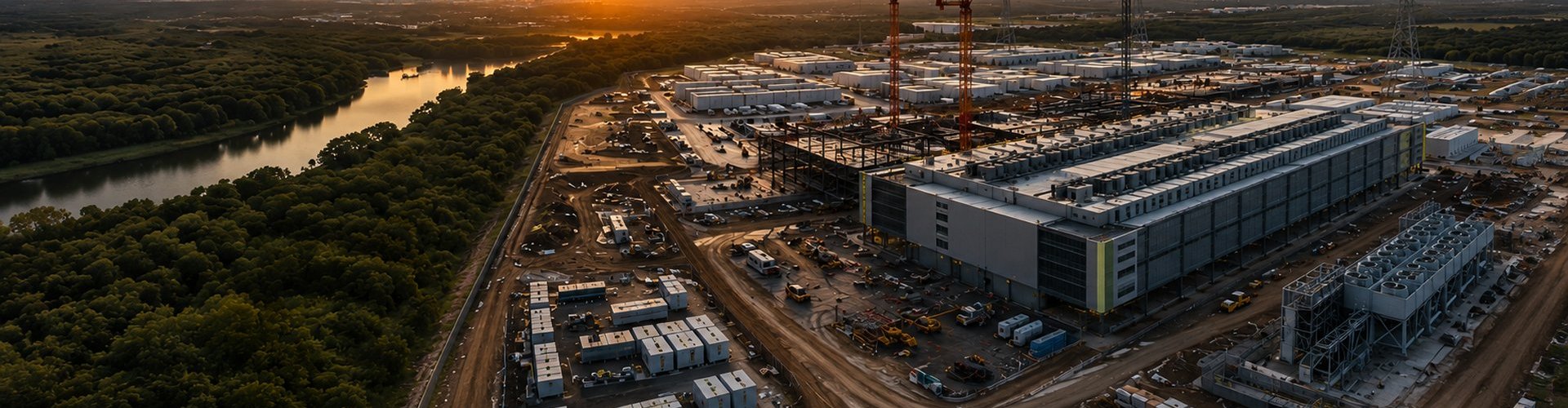
The Research Fab is part of Tesla's 5.2-million-square-foot North Campus expansion filed with Travis County in March 2026, a 50% increase to the Giga Texas footprint. The Research Fab accounts for about 2 million square feet of cleanroom. Lars Moravy, Tesla's vice president of vehicle engineering, confirmed the buildout on July 7, 2026, as part of the factory's "scaling effort." Tesla filed the fab building with the Texas Department of Licensing and Regulation (TDLR) as "North Campus Manufacturing," a semiconductor manufacturing plant at 1 Harold Green Road, with a scheduled completion date of December 31, 2029.
| Date | Milestone |
|---|---|
| November 2025 | Musk first proposes Terafab at the Tesla annual shareholder meeting |
| March 2026 | Tesla files the 5.2-million-square-foot North Campus expansion with Travis County |
| March 21, 2026 | Musk unveils Terafab in Austin |
| April 7, 2026 | Intel joins as foundry partner |
| April 13, 2026 | Drone footage by Joe Tegtmeyer shows earthwork: River Road extension, water retention and drainage, and workshops and trailers relocated off the footprint |
| April 22, 2026 | Groundbreaking and $3 billion Tesla commitment; Musk names Intel 14A on the Q1 earnings call |
| July 7, 2026 | Lars Moravy confirms the North Campus buildout |
| July 22, 2026 | Musk says equipment orders are placed for the Austin development fab |
| Late July 2026 | Four permits filed for a contractor trailer complex and temporary Tesla offices |
| August 7, 2026 | Tegtmeyer footage shows the foundation for the E Support Facility of the Advanced Technology Chip Fab, with GeoPier ground-improvement columns driven into softer soil |
| August 25, 2026 | "North Campus Manufacturing" semiconductor plant registered with TDLR |
| October 1, 2026 | First steel columns standing and seven large cranes on site; vertical construction begins |
Site work started less than five weeks after the March 21 announcement, so planning had begun well before Musk went public. Tesla's earlier targets called for tool installation in the third quarter of 2026 and first silicon in early 2027; at the start of October 2026 the main building was still at the steel-erection stage. Morgan Stanley projected in March 2026 that first output would come no earlier than mid-2028.
Capital Figures
Published Terafab capital figures range from $3 billion to several trillion dollars, because each measures a different scope.
| Figure | Source | What It Measures |
|---|---|---|
| $3 billion | Musk, April 22, 2026 | Tesla's initial cash commitment to start Research Fab construction |
| $20-25 billion | Musk, March 2026 | Musk's estimate for Terafab as first announced in Austin, before the Grimes County site |
| $25-30 billion | AustinIO estimate from TSMC, Intel and Samsung comparables | Equipped cost of a 2nm-class research fab |
| $16.8 billion | SpaceX and Tesla, August 6, 2026 | Confirmed Phase 1 commitment for the Grimes County Production Fab |
| $55-119 billion | SpaceX filing, May 2026 | Production Fab initial filing figure ($55B) and full four-phase buildout ($119B) |
| $5-13 trillion | Bernstein, 2026 | Capital spending needed to reach Musk's target of 1 terawatt (TW) of AI compute per year |
Capital equipment alone runs $8-12 billion at Research Fab scale, covering 15-20 EUV systems plus the full process tool set. Tesla's $3 billion likely covers the EUV lithography stack and part of the facilities cost, with the joint venture and Intel covering the rest. The global semiconductor industry spends $200-250 billion a year on capital equipment and facilities, so Bernstein's estimate equals about 20 to 65 years of current worldwide industry spending.
Campus Integration
The Research Fab places requirements on the Giga Texas campus that vehicle assembly does not:
- Ultra-pure water at semiconductor-grade specifications; AustinIO estimates the North Campus fab adds 350-700 million gallons a year to a campus that already used 556 million gallons in 2025 (see Data Center and Fab Water Use and Cooling in Texas)
- Power quality at the stability EUV tools require, delivered through ERCOT (the Electric Reliability Council of Texas)
- Vibration isolation from the adjacent vehicle factory
- Process and yield engineers drawn from the Austin Semiconductor Ecosystem, including Samsung Austin, Samsung Taylor and NXP
The Research Fab ties into the other Giga Texas programs in a closed loop:
- AI6 silicon developed at the Research Fab goes into Optimus humanoids built at the adjacent Optimus Factory.
- Optimus units in service generate operational data.
- That data trains models on the Cortex 2 training cluster on the same campus.
- Trained models return to vehicles and robots through over-the-air (OTA) software updates.
The same loop already runs for the vehicle lines at Tesla Giga Texas Car Production. The Research Fab adds chip process development to the campus, so Tesla designs the chip, develops its process, builds the product that carries it and trains the software that runs on it at one address in Travis County. Radiation-tolerant variants for orbit go to SpaceX's advanced packaging line at the Starlink factory in Bastrop.
Research Fab Snapshot (October 2026)
| Dimension | Detail |
|---|---|
| Location | North Campus, Giga Texas, 1 Harold Green Road, Austin, Travis County (part of the 5.2 million sq ft expansion) |
| Facility Scale | About 2 million sq ft of cleanroom |
| Operating Model | Tesla-run, with Intel as foundry partner; Intel's expected role covers wafer fab equipment procurement, process know-how, tool qualification and operating support |
| Tesla Initial Capital | $3 billion (announced April 22, 2026) |
| Estimated Equipped Cost | $25-30 billion fully tooled (AustinIO estimate for a 2nm-class research fab) |
| Output Scale | A few thousand wafer starts per month (development) |
| Primary Function | Fast iteration of process recipes, transistor architectures and packaging variants for AI6, AI7 and later Tesla silicon |
| Venture Partners | Tesla, SpaceX and xAI (rebranded SpaceXAI in July 2026); Intel as foundry partner (announced April 7, 2026) |
| Process Technology | Intel 14A named by Musk for Terafab (April 22, 2026); Research Fab line expected to start on Intel 18A (1.8nm-class, gate-all-around transistors, PowerVia backside power delivery, EMIB and Foveros packaging) |
| Construction Status | Foundations poured; steel erection under way with seven cranes (October 1, 2026); equipment ordered (July 2026); TDLR scheduled completion December 31, 2029 |
Related Coverage
Giga Texas Cortex Training Cluster | Optimus Factory at Tesla Giga Texas | Tesla Giga Texas Car Production | Terafab Gibbons Creek | Terafab: Global Case Study
