AustinIO > The Texas Nexus > Texas Triangle Cluster > Austin-San Antonio Mega-Metro
Austin-San Antonio Mega-Metro
The Austin-San Antonio Corridor extends approximately 80 miles south along Interstate 35 from Austin through San Marcos and New Braunfels to San Antonio, anchoring the structural spine of the emerging San Antonio-Austin mega-metro — a recognized 13-county region encompassing Greater Austin's 5 counties plus Greater San Antonio's 8 counties with a combined population of approximately 5.5 million. Approximately 3.9 million residents live along the I-35 corridor itself in Bexar, Comal, Hays, and Travis Counties, surpassing the Phoenix-Mesa-Chandler metro area and establishing the corridor's I-35-adjacent population among the top 10 most populous US metropolitan areas. By 2050, the mega-metro population is projected to surpass 8.3 million people, exceeding current populations of both Dallas-Fort Worth and Greater Houston metros. By 2100, the region is projected to rank among the three most populated metropolitan regions in the United States.
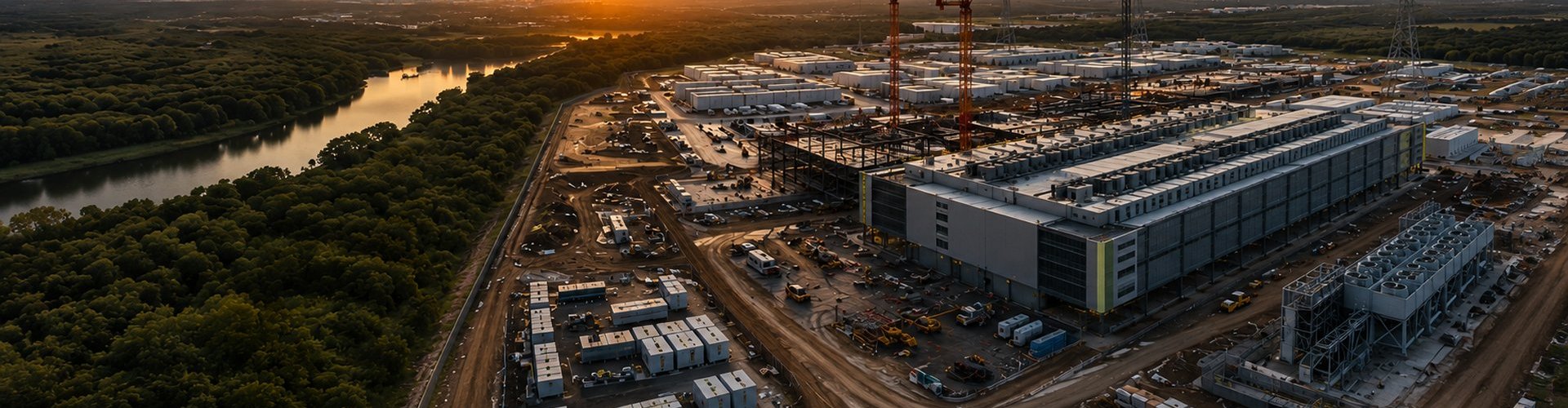
What distinguishes the Austin-San Antonio Corridor at the Texas Nexus level is its structural role as the mega-metro's industrial spine plus its emerging AI-Industrial concentration in its own right. The corridor advances the AI-Industrial buildout through multiple pillars: AI compute infrastructure (Tract Caldwell County 2 GW master-planned data center technology park, CloudBurst / Evolve San Marcos Data Center I 1.2 GW, plus broader Caldwell-Hays-Guadalupe County buildout collectively exceeding 3.2 GW master-planned capacity).
Corridor Anchors
| Anchor | Corridor Location | Category | Coverage |
|---|---|---|---|
| CFAN San Marcos | San Marcos, Hays County (1000 Technology Way) | Aerospace / advanced composites manufacturing | 50/50 joint venture between GE Aviation and Safran Aircraft Engines (formed 1991, San Marcos facility established 1993); 270,000 sqft facility (250,000 sqft shop floor); ~500 employees; world-leading composite jet engine fan blade manufacturer for the world's largest commercial aircraft engines including GE90 (Boeing 777), GE9X (Boeing 777X), GEnx (Boeing 787 and Boeing 747-8); Texas State University engineering pipeline supports continued workforce. |
| Tract Caldwell County Park | Caldwell County (1,515 acres near Uhland, between San Marcos and Lockhart) | Data center / AI compute | 2+ gigawatt master-planned data center technology park; six designated sites with provisions for on-site power generation; initial 360 MW grid energization 2028 via Blue Bonnet Electric Cooperative; targeted at hyperscaler, public cloud, AI training, and AI inferencing applications; sits at intersection of high-tension transmission, Kinder Morgan Permian Highway gas pipeline, and long-haul fiber; site previously evaluated by Micron Technology for multibillion-dollar semiconductor fab (selected New York instead 2022); Tract Capital Management backed by Berkshire Partners, PSP Partners, Permira, S2G Ventures, Columbia Capital; candidate Tier 1B spotlight; for forward coverage see Tract Caldwell County Park (forthcoming) |
| CloudBurst / Evolve San Marcos Data Center I | San Marcos / New Braunfels corridor (Hays and Guadalupe Counties) | Data center / AI compute | 1.2 gigawatt master-planned AI/HPC data center campus; Phase 1 50 MW targeted Q4 2026 go-live; broke ground November 2025; behind-the-meter natural gas generation via long-term Energy Transfer Oasis Pipeline agreement (up to 450,000 MMBtu/day, ~1.8 GW on-site power generation potential); high-density architecture with advanced cooling targeting AI / HPC / large enterprise tenants; CloudBurst's flagship "GigaCenter"; Evolve Holdings as design-build partner |
| Lefko USA | New Braunfels, Comal County | Advanced manufacturing / cleantech | Texas Enterprise Fund $968,500 grant; greater:SATX Regional Economic Development Partnership recruited project |
| TSTC New Braunfels (TXFAME) | New Braunfels, Comal County | Workforce pipeline / advanced manufacturing training | Texas State Technical College New Braunfels campus; TXFAME (Texas Federation for Advanced Manufacturing Education) Advanced Manufacturing Technician (AMT) program; precision machining, welding, industrial systems, automation; advanced manufacturing equipment training, technical drawing interpretation, industrial controls programming; transitions to dedicated Advanced Manufacturing program Fall 2026; supports broader corridor workforce pipeline plus complementary to Heroes MAKE America at TSTC Waco |
The Mega-Metro Emergence
The Austin-San Antonio Corridor's structural distinctiveness traces to the recognized mega-metro emergence that the corridor anchors. The combined population of approximately 5.5 million across the 13-county region positions the mega-metro as comparable in current scale to Phoenix-Mesa-Chandler, Boston-Cambridge-Newton, and other major US metropolitan areas. The 3.9 million residents living along I-35 in Bexar, Comal, Hays, and Travis Counties alone surpass Phoenix-Mesa-Chandler in current US Census MSA rankings. Combined gross domestic product of approximately $430 billion in 2023 places the mega-metro economy among the top US metro economies and within the top 50 globally if measured as a sovereign economy.
San Marcos and New Braunfels have positioned themselves as the corridor's primary independent urban cores. New Braunfels grew from approximately 109,000 residents in 2010 to nearly 157,000 by 2019, ranking among the fastest-growing US cities. San Marcos jobs increased 44% between 2008 and 2018 with labor force expanding 45% over the same period. Both cities have transitioned from "bedroom communities" to substantive independent industrial-and-commercial hubs with their own anchor operators (CFAN at San Marcos, Lefko USA plus TSTC at New Braunfels). State demographer Lloyd Potter has projected likely US Census Bureau combined MSA designation for the 2030 census, formalizing the mega-metro structure that economic and political leaders have already operationalized.
The 2050 population projection of 8.3 million people would exceed current populations of both Dallas-Fort Worth and Greater Houston metros, positioning the San Antonio-Austin mega-metro as the largest Texas Triangle metro by 2050. The 2100 projection placing the region among the three most populated US metropolitan regions reflects the long-term trajectory that current corridor buildout supports.
Corridor Geography
Austin (corridor's northern terminus, Greater Austin MSA) — multi-corridor intersection with US 183 N, US 290, SH 71, SH 130, and broader Austin metro mobility infrastructure. Austin metro corporate-and-industrial concentration sits at the corridor's northern entry. Austin metro anchors live in the Austin Metro Directory.
Buda / Kyle (Hays County entry) — Hays County entry along IH-35 with continued residential-and-light-industrial buildout. Hays County's transition from rural to urbanized substrate reflects the broader mega-metro consolidation pattern. Buda and Kyle anchors live in the (forthcoming) Hays County or Buda / Kyle city directories.
San Marcos (independent urban core, Hays County) — corridor's primary aerospace and emerging data center concentration. CFAN San Marcos aerospace composites, plus the CloudBurst / Evolve San Marcos Data Center I in the broader San Marcos / New Braunfels corridor. Texas State University provides engineering pipeline supporting CFAN plus broader corridor workforce. State demographer-recognized "independent urban core" within the mega-metro structure. San Marcos anchors live in the (forthcoming) San Marcos city directory.
Caldwell County (Uhland / Lockhart area, between San Marcos and SH 130) — Tract Caldwell County 1,515-acre data center technology park plus broader Caldwell County industrial buildout. Caldwell County's structural emergence as a major Texas data center concentration reflects the broader Central Texas data center buildout pattern. Lockhart serves as the SH 130 hub on the Greater Austin side per Greater Austin-San Antonio Corridor Council positioning. Caldwell County anchors live in the (forthcoming) Caldwell County / Lockhart / Uhland city directories.
New Braunfels (independent urban core, Comal County) — Lefko USA advanced plastics manufacturing US headquarters, TSTC New Braunfels TXFAME workforce program, plus broader Comal County industrial-and-manufacturing buildout. The CloudBurst / Evolve San Marcos Data Center I extends into Guadalupe County (adjacent to New Braunfels). State demographer-recognized "independent urban core" within the mega-metro structure. New Braunfels anchors live in the (forthcoming) New Braunfels city directory.
Seguin (Greater San Antonio SH 130 hub, Guadalupe County) — Seguin serves as the SH 130 hub on the Greater San Antonio side per Greater Austin-San Antonio Corridor Council positioning. Continued Seguin Economic Development Corp coordinated operator attraction supports broader corridor southern segment industrial buildout. Seguin anchors live in the (forthcoming) Seguin city directory.
San Antonio (corridor's southern terminus, Greater San Antonio MSA) — Greater San Antonio metro at the corridor's southern terminus. Toyota Motor Manufacturing Texas, JCB, International Motors, plus broader 500+ company greater:SATX-coordinated regional concentration. San Antonio metro anchors live in the (forthcoming) San Antonio Metro Directory.
Cross-corridor mobility infrastructure — IH-35 (corridor's primary spine, 100,000-150,000 vehicles daily Austin to San Antonio segment, projected 53% of corridor population within 5 miles of I-35 by 2045 per CAMPO and Alamo Area MPO joint study), SH 130 toll road (91-mile alternate route from north of Austin south to IH-10 connection, primary hubs Seguin and Lockhart), US 183 (north-south through Lockhart and Caldwell County), SH 21 (Bastrop / SH 71 to San Marcos / IH-35 east-west), Loop 1604 (San Antonio metro outer loop), San Antonio International Airport plus Austin-Bergstrom International Airport supporting broader mega-metro freight integration, BNSF and Union Pacific freight rail paralleling IH-35. Lone Star Rail commuter rail connecting both metros remains "necessary and inevitable" per Greater Austin-San Antonio Corridor Council framing despite 2016 metropolitan planning organization vote against the proposal; continued rail discussion through 2026-2030 reflects ongoing mega-metro infrastructure planning.
Related Coverage
Austin Metro B2B Directory | San Antonio Metro B2B Directory | Austin-Waco I-35/I-14 Corridor | Austin-Taylor Manufacturing Axis (SH 130) | US 183 N Deep Tech Corridor | Tract Caldwell Valley Technology Park | I-35 South Data Center Corridor