AustinIO > The Austin Supercluster > I-35 South Data Center Corridor > CloudBurst Evolve — San Marcos Data Center I
CloudBurst Evolve — San Marcos Data Center I
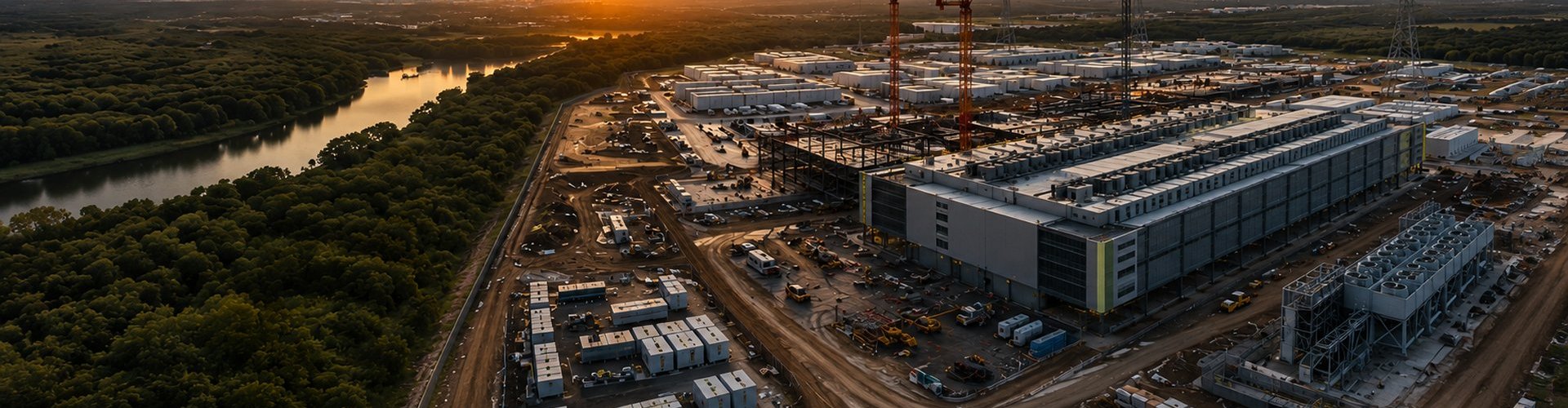
San Marcos Data Center I is a 1.2 GW AI campus on the I-35 South corridor between Austin and San Antonio, powered entirely behind the meter by natural gas. It is the flagship of CloudBurst Data Centers and Evolve Holdings, and one of the most aggressive on-site-generation designs in the corridor: the gas supply alone can produce more power than the campus is planned to consume.
| Attribute | Detail |
|---|---|
| Operators | CloudBurst Data Centers (dev-co) + Evolve Holdings (design-build), under Tye A. Johnson |
| Location | 2955 Francis Harris Lane, San Marcos / New Braunfels area, Hays County, TX |
| Distance from Austin | ~30 mi S (Austin–San Antonio midpoint) |
| Capacity | Up to 1.2 GW across three 400 MW phases; 10–12 buildings |
| Power model | Behind-the-meter natural gas; grid-independent |
| Gas supply | Energy Transfer Oasis Pipeline, 10-yr deal, up to 450,000 MMBtu/day (>1.8 GW generation potential) |
| Cooling | Closed-loop; "SuperLab" testbeds for liquid/hybrid cooling |
| Investment | $14.5B total project value (per Guadalupe County reporting) |
| First phase | 50 MW construction from Nov 2025, Q4 2026 commissioning |
| Land core | 96-acre parcel acquired Feb 2025, within a larger master-planned footprint |
| Status | Under construction (groundbreaking Nov 2025) |
What it is
CloudBurst is a Denver-based AI-data-center developer founded in 2022; Evolve Holdings is its design-build partner. Unlike the powered-land parks nearby — where a developer leases shovel-ready pads to others — CloudBurst and Evolve are vertically integrated, developing and building the campus themselves under one leadership, Tye A. Johnson (CEO of CloudBurst and founder of Evolve). They broke ground on San Marcos Data Center I in November 2025, targeting up to 1.2 GW across three 400 MW phases and 10 to 12 buildings, with the first 50 MW due to commission in Q4 2026. Guadalupe County reporting puts the total project value at $14.5 billion.
The behind-the-meter design
The defining feature is power. CloudBurst signed a 10-year agreement with Energy Transfer, the Dallas midstream operator, for up to 450,000 MMBtu per day of firm natural gas through the Oasis Pipeline — enough to generate more than 1.8 GW on site, comfortably above the campus's 1.2 GW planned demand. That headroom is deliberate: it provides redundancy and backup across the phased buildout while keeping the campus entirely behind the meter, bypassing the ERCOT interconnection queue and transmission delays that gate grid-connected projects. CloudBurst frames it directly as an answer to the industry's transmission constraints and long interconnection queues.
The design puts San Marcos in the same category as the other gas-anchored Texas campuses — Sandow Lakes' 1,200 MW plant, Fermi, the Permian behind-the-meter sites — but with an unusually high generation-to-demand ratio. CloudBurst has committed to closed-loop water cooling and runs a "SuperLab" concept for testing liquid and hybrid cooling architectures. The trade-off is honest: behind-the-meter gas carries an emissions footprint that grid-connected renewable supply does not, and air quality is a live community concern across the campus's operating life.
County-line arbitrage
The site sits at a jurisdictional seam, and the developers used it. The San Marcos Planning and Zoning Commission recommended denial of the zoning change, and the CloudBurst parcel was released from San Marcos's extraterritorial jurisdiction to sit just outside the city limits of both San Marcos and New Braunfels. The development agreement and tax abatement — roughly $500 million over 10 years, against a $500 million minimum investment — were approved by Guadalupe County Commissioners Court in April 2026, in the county next door to the San Marcos seat that resisted it. The agreement runs with the land and voids if the property is ever used for housing, locking in the industrial use. Building at a county line, where one jurisdiction approves what an adjacent one denies, is becoming a recurring feature of the I-35 South corridor's data center fights.
The adjacent corridor
San Marcos Data Center I anchors the southern stretch of the supercluster's data center buildout, alongside separate developments on separate parcels. Sabey Data Centers is planning a 786-acre campus about 1.5 miles away, on land owned by Carson Select Investments, in negotiation with the San Marcos City Council — and notably, Sabey's Round Rock campus is the one hosting TACC's Horizon supercomputer, tying this corridor back to the UT Austin institutional substrate. Further north toward Uhland, Tract's Caldwell Valley park, Prime, and Edged extend the same corridor. Per Cushman & Wakefield data through early 2026, the Austin–San Antonio corridor holds roughly 7,800 MW of planned capacity against about 1,150 MW operating — one of the fastest-scaling data center buildouts in the country.
Last updated September 11, 2026. Capacity, investment, and generation figures are the developers' and Guadalupe County's stated numbers; the >1.8 GW is gas-supply generation potential, not IT load. Sabey is a separate adjacent development. Status: under construction, first 50 MW targeted Q4 2026.
Related: Behind-the-Meter Power · Water & Cooling · Tract Caldwell Valley · Austin Supercluster · AI Data Center Exemplars
Related Coverage
Tract Caldwell Valley Technology Park | Behind-the-Meter Power | Sandow Lakes / Xebec Megasite