AustinIO > The Texas Nexus > Why Texas: The Logic of AI-Industrial Concentration
Why Texas: The Logic of AI-Industrial Concentration
A First-Principles Analysis of the Constraints That Concentrate the AI-Industrial Buildout in a Single US State
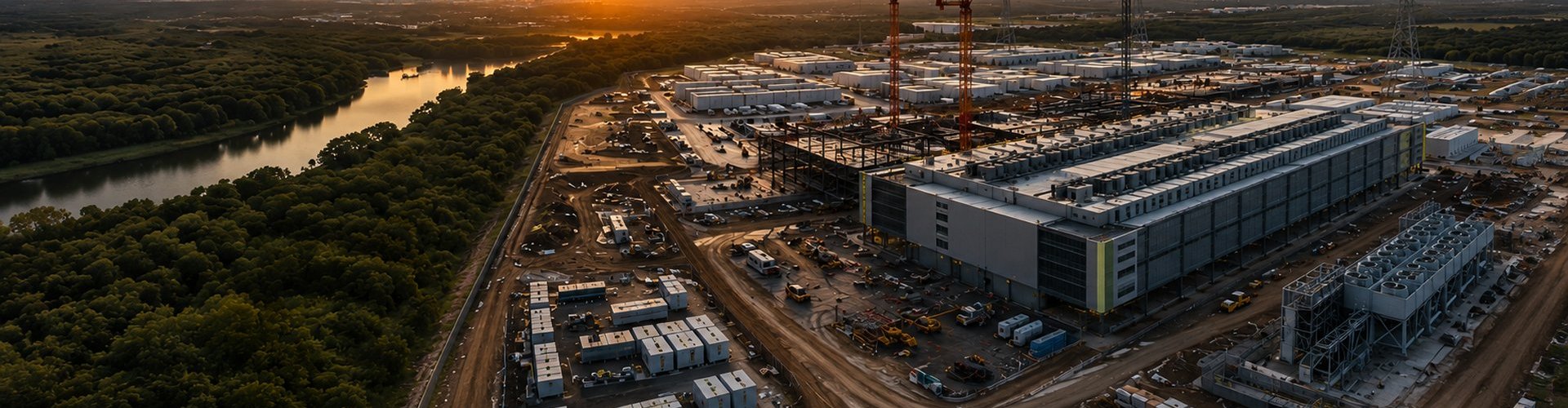
The AI-Industrial buildout in the United States is not distributing evenly across the available substrate. Texas is hosting a disproportionate share of the largest projects: SpaceX's $55-119 billion Terafab production facility at Gibbons Creek (Grimes County), Samsung's $40 billion Foundry campus at Taylor (Williamson County), Xebec Realty's 33,000-acre Sandow Lakes Advanced Manufacturing and Logistics Campus on the former Alcoa site at Rockdale (Milam County), Tesla's $5-10 billion Giga Texas North Campus expansion (Travis County), Stargate's first OpenAI-Oracle-SoftBank gigawatt-scale data center cluster at Abilene (Taylor County), Project Matador / Fermi America HyperGrid's proposed 11 GW campus (Texas Panhandle), Tract Capital's 2 GW Caldwell County Park, Vantage's 1.4 GW Frontier campus in Shackelford County, plus dozens of other multi-billion-dollar commitments. Combined committed and prospective AI-Industrial capital flowing into Texas through 2030 substantially exceeds $500 billion and could exceed $1 trillion at full multi-phase buildout — substantively more than any peer US state.
The pattern is not coincidental. It reflects a constraint-satisfaction solution where Texas uniquely satisfies a stacked set of binding physical, regulatory, and operational constraints at the scale and pace AI-Industrial buildout requires. This page works through those constraints from first principles, identifies the brownfield substrate inheritance pattern that distinguishes Texas from peer states, and demonstrates through case studies how the same underlying structural logic explains why the largest AI compute, semiconductor manufacturing, and advanced manufacturing operators have repeatedly arrived at the same conclusion: Texas is the structurally distinctive substrate that makes the announced scale and pace achievable. The deeper analytical pattern — that brownfield substrate inheritance from prior generations of US industrial development is one of the structural advantages Texas brings to AI-Industrial concentration scaling — explains why the buildout is happening here and why peer states cannot match at comparable scale within the timeline AI-Industrial operators target.
The Six Binding Constraints
A hyperscale AI-Industrial facility at the gigawatt scale faces a stacked set of binding constraints that ruthlessly narrow the feasible site set. The constraints are not optimization variables that trade off against each other — they are gating conditions, each of which must be satisfied for the project to be feasible at all. Failure on any single constraint disqualifies the site regardless of performance on other constraints.
1. Power — Multi-Gigawatt Scale, Available Now
Modern leading-edge semiconductor fabs at 100,000-wafer-starts-per-month scale draw approximately 0.5-1 GW continuous; full multi-phase buildout at 1 million WSPM scale extrapolates to 5-10 GW. AI training and inference data centers at the largest US scale draw 1-5 GW operational. Combined Texas AI-Industrial buildout through 2030 represents tens of gigawatts of new operational power demand — substantially more than any peer US state's grid can accommodate within the timeline operators target.
The binding constraint is not nameplate capacity. It is time-to-power. ERCOT interconnection queue clearance for a multi-hundred-megawatt load currently runs 5-7+ years from application to energization for greenfield sites without preceding utility justification. New construction facilities awaiting greenfield ERCOT interconnection plus new transmission line construction plus new substation buildout plus environmental review plus contested permitting can lose 8-10 years to power infrastructure development alone — longer than the facility construction itself.
Texas's structural advantage is not just ERCOT's regulatory framework (covered in detail at ERCOT Energy Sovereignty) but the broader brownfield substrate that inherits transmission infrastructure from prior generations of Texas industrial development. The Gibbons Creek Reservoir site for Terafab Grimes County inherits multi-hundred-MW transmission infrastructure from the prior Texas Municipal Power Agency coal plant (operational 1982-2018, peak ~470 MW). The Sandow Lakes site inherits multi-hundred-MW capacity from the prior Alcoa aluminum smelter (1.67 million pounds per day production, Sandow Power Plant operational 1954-2018) plus the on-site 1,200 MW natural gas power plant Xebec is building. The Permian Basin behind-the-meter substrate inherits gas-fired generation from prior oil and gas operations. Stargate Abilene's Lancium Clean Campus model inherits West Texas wind substrate from Texas's earlier wind buildout. Brownfield substrate inheritance reduces time-to-power from 5-10 years to 1-3 years — the structurally distinctive feature that makes Texas's pace achievable.
2. Water — Ultra-Pure Water at Semiconductor-Grade Specifications
A 100K-WSPM semiconductor fab consumes approximately 5-10 million gallons per day of ultra-pure water (UPW). Full multi-phase buildout at 1M WSPM extrapolates to 50-100 MGD UPW. UPW production requires source water inputs of 2-4x the UPW volume due to filtration losses. Hyperscale data centers at the gigawatt scale require additional source water for evaporative cooling at 1-5 MGD per facility, with closed-loop cooling reducing but not eliminating water demand.
Available source water at this scale within Texas concentrates near major river systems (Trinity, Brazos, Colorado), reservoirs (Gibbons Creek, Lake Travis, Lake Houston), or Gulf-adjacent groundwater systems. The binding constraint is not just availability but water rights, which in Texas operate under prior appropriation and surface water permitting frameworks that make new senior water rights extremely difficult to acquire. Most candidate sites compete with municipal water supply, agricultural water rights, and existing industrial users for limited additional allocations.
Brownfield substrate inheritance applies here too. Gibbons Creek Reservoir is approximately 2,400 acres, originally constructed by TMPA specifically for cooling water at the coal plant. Water rights at Gibbons Creek are largely intact from the prior TMPA framework — the rights flow with the property to the new owner. The reservoir's existing intake infrastructure plus discharge permitting plus water rights framework substantially compresses the water-supply timeline that greenfield sites face. Sandow Lakes inherits water rights from the prior Alcoa operations. The Permian Basin substrate uses produced water and brackish water sources unavailable to peer states. Compare: Samsung Taylor required substantial new water supply development through the Brazos River Authority plus City of Taylor coordination plus regional water planning; each additional fab in the Williamson County corridor faces increasing water-supply constraints. Arizona faces Colorado River allocation reductions through 2030. Phoenix metro fabs are increasingly constrained.
3. Land — Thousands of Contiguous Acres
The 1 TW/year compute target plus full multi-phase buildout at hyperscale requires acreage substantially beyond what single-fab campuses occupy. TSMC Arizona Phase 1+2 occupies approximately 1,100 acres for two fabs. Samsung Taylor occupies approximately 1,200 acres. Multi-phase Terafab buildout at announced scale requires plausibly 3,000-6,000 acres for full vertical integration (logic plus memory plus advanced packaging plus utilities plus supplier co-location plus buffer plus future expansion). Hyperscale data center campuses at full multi-phase buildout require 1,000-2,500 acres per gigawatt of capacity.
Contiguous brownfield acreage at this scale within reasonable proximity to a major metropolitan region is genuinely scarce in the United States. Most US sites of comparable acreage are Western federal lands (BLM, military installations), Gulf Coast petrochemical complexes (incompatible neighboring operations), or rural agricultural land with no industrial substrate. Texas's specific structural advantage is the combination of large land parcels at brownfield-substrate prices, decommissioned industrial sites with intact transmission and water rights, and regulatory frameworks that allow rapid land use conversion.
The Gibbons Creek substrate provides approximately 6,000 acres total (Charah Solutions' 2021 acquisition footprint). Sandow Lakes provides 33,000 acres total with 3,300 acres in active Phase 1 development. The Permian Basin substrate provides effectively unlimited acreage at the regional scale. Stargate Abilene's Lancium Clean Campus integrates broader West Texas land substrate. Texas Panhandle (Project Matador / Fermi America HyperGrid) provides similar regional-scale land availability. The pattern repeats: Texas has the contiguous land at the price points and regulatory friction that AI-Industrial buildout requires; peer states broadly do not.
4. Workforce — Process Engineers, Fab Operators, Technicians at Scale
A 100K-WSPM semiconductor fab employs approximately 1,500-3,000 direct operational workers; multi-phase buildout at full scale extrapolates to 8,000-15,000+ direct workers plus supplier ring multiplier of 2-3x. Hyperscale data center campuses are capital-intensive but not labor-intensive — Blueprint Taylor's $1B Phase 1 commitment projects 20-30 permanent operational jobs. Advanced manufacturing operations like Tesla Giga Texas employ tens of thousands. Combined Texas AI-Industrial workforce demand through 2030 represents hundreds of thousands of new positions.
Workforce availability constraints sort sites into three tiers. High-availability tier includes Phoenix metro (TSMC Arizona, Intel Arizona, broader semiconductor cluster), Austin metro (Samsung Taylor, Apple, broader Williamson County substrate), and Albany NY (GlobalFoundries, IBM legacy). Medium-availability tier includes Sherman TX (TI), Hillsboro OR (Intel), Boise ID (Micron), Ohio Licking County (Intel emerging), and the Brazos Valley (TAMU System engineering pipeline). Low-availability tier includes most other US sites without established semiconductor or advanced manufacturing substrate.
Texas's specific workforce advantage is multi-substrate concentration: the UT Austin engineering pipeline supplies the Williamson County corridor, the TAMU System engineering pipeline supplies the Brazos Valley substrate, the broader Texas Triangle metro substrate supports continued operator concentration, and the Heroes MAKE America program at TSTC Waco routes Fort Hood transitioning service members into Texas advanced manufacturing roles. The combined Texas engineering and advanced manufacturing workforce substrate exceeds any peer state at comparable concentration. Compare: Arizona's workforce substrate is increasingly competed at TSMC Phase 1+2+3 plus Intel Arizona scaling. New York's workforce substrate concentrates around Albany / Syracuse but does not extend to the broader state. Ohio's substrate is still ramping at Intel Licking County. California's substrate is constrained by cost-of-living friction that limits workforce flow.
5. Regulatory — Texas vs. Peer States
Federal CHIPS Act framework applies uniformly across US sites; state-level regulatory framework varies substantially. Texas's specific advantages include no state income tax (reducing operator and workforce cost basis substantially relative to California, New York, or Ohio), the Texas Semiconductor Innovation Fund plus Texas Enterprise Fund plus Texas Enterprise Zone Project Designation plus Texas CHIPS Act framework (combined Texas-specific operator incentives exceed any peer state's framework), Senate Bill 6 implementation framework for ERCOT cost allocation, the Comptroller's coordinated economic development substrate, and ERCOT itself as the FERC-excluded grid (covered at ERCOT Energy Sovereignty).
Local Texas county regulatory environment varies but rural counties like Grimes (Terafab) and Milam (Sandow Lakes) provide low-friction Commissioners Court frameworks plus Texas property tax abatement frameworks via Chapter 312 plus Chapter 313 (now JETI under HB5) plus pre-existing brownfield environmental remediation reducing TCEQ permitting friction. Compare: California's regulatory framework would extend semiconductor fab construction timeline by 2-5+ years through CEQA, water rights litigation, environmental review, and broader regulatory friction. New York's permitting framework (Micron Syracuse) is faster than California but still slower than Texas. Arizona's framework is comparable to Texas but Phoenix metro power and water constraints are increasingly binding regardless of regulatory speed.
The Texas regulatory framework's structural advantage is not just speed but consistency across the multi-decade operator commitment. AI-Industrial operators committing $50-100+ billion across multi-phase buildouts require regulatory framework continuity beyond any single political administration. Texas's framework has remained consistently favorable to AI-Industrial buildout across multiple administrations and legislative sessions. Peer states with shifting regulatory frameworks face additional risk that Texas does not.
6. Geopolitical and Customer Integration
The largest AI-Industrial operators concentrate operations across multiple Texas substrates. Tesla operations span Giga Texas at Austin (Travis County), the Robstown lithium refinery (Nueces County), and broader Texas footprint. SpaceX operations span Starbase Cameron County, McGregor engine production (McLennan County), the Bastrop semiconductor R&D facility, and the new Terafab Grimes County production fab. xAI operations span Memphis primary plus broader Tesla compute integration. Samsung concentrates at Taylor and the broader Texas semiconductor cluster. Combined Musk operating-entity portfolio (Tesla + SpaceX + xAI + Boring Company + Neuralink) maintains Texas as the operational center of gravity for US operations.
The constraint here is integration: workforce flow plus supplier ring development plus inter-facility logistics plus integrated decision-making across multiple operating entities favors proximity over distance. Texas-state-level regulatory framework continuity across all operations (vs. multi-state regulatory complexity) provides additional integration advantages. US semiconductor manufacturing geographic concentration policy under federal CHIPS Act framework favors continued investment within the established Arizona-Texas-New York-Ohio corridor; Texas's specific position within the corridor plus the established Samsung Taylor plus TI Sherman plus Brazos Valley substrate plus federal CHIPS Act funding flow supports continued operator concentration. Greenfield investment outside this corridor faces additional federal coordination friction.
The geopolitical constraint also includes federal export control compliance, defense-industrial integration (Fort Hood, SpaceX McGregor, broader Texas defense substrate), and broader national security framework continuity. Texas's specific role within the federal AI-Industrial framework supports continued operator concentration at scales that geographic substitution outside the corridor cannot match within reasonable timelines.
Brownfield Substrate Inheritance: The Structural Pattern
The deeper structural pattern visible across Texas AI-Industrial buildout is systematic targeting of brownfield substrate inherited from prior generations of US industrial development. The pattern is not accidental — it reflects that greenfield infrastructure development in the United States has become time-prohibitive at the scale and pace AI-Industrial buildout requires. Brownfield substrate inheritance is one of the structural advantages Texas brings to AI-Industrial concentration scaling that peer US states cannot match at comparable scale.
The pattern repeats across major Texas AI-Industrial commitments:
Gibbons Creek Reservoir (Terafab Production Facility, Grimes County) — former Texas Municipal Power Agency coal-fired plant operational 1982-2018, demolished and remediated by Charah Solutions 2021, ~6,000 acres with intact transmission infrastructure, water rights, and substation footprint inherited by SpaceX for Terafab production fab.
Sandow Lakes (Xebec Advanced Manufacturing and Logistics Campus, Milam County) — former Alcoa aluminum smelter operational 1954-2018 (1.67 million pounds per day production), Sandow Power Plant operational 1954-2018, 33,000 acres with intact transmission, water rights, rail infrastructure, plus on-site 1,200 MW natural gas power plant under construction.
Permian Basin (behind-the-meter data center cluster) — existing oil and gas operational substrate including transmission infrastructure, gas-fired generation capacity, produced water management infrastructure, and broader operational logistics inherited from decades of Texas oil and gas industry. Behind-the-meter natural gas generation deployments (paralleling Permian-style buildouts at Sandow Lakes, CloudBurst / Evolve San Marcos, prospective Stargate sites) leverage existing oil and gas infrastructure substrate.
Stargate Abilene (Taylor County) — broader Lancium Clean Campus model leveraging West Texas wind substrate, transmission infrastructure inherited from Texas's earlier wind buildout (Roscoe Wind Complex and adjacent operations), plus continued ERCOT capacity expansion supporting gigawatt-scale data center buildout.
Texas Panhandle (Project Matador / Fermi America HyperGrid, near Amarillo) — proposed 11 GW campus leveraging existing Texas Panhandle wind substrate, agricultural land conversion at scale unavailable in peer states, and broader regional infrastructure substrate.
Tract Caldwell County Park — 1,515-acre data center technology park at intersection of high-tension transmission, Kinder Morgan Permian Highway gas pipeline, and long-haul fiber. Site previously evaluated by Micron Technology for multibillion-dollar semiconductor fab (selected New York instead 2022); the substrate and infrastructure originally developed during the Micron evaluation now supports Tract's 2 GW buildout.
Skybox Datacenters / Prologis Hutto Megasite — Williamson County substrate with transmission infrastructure inherited from the broader Samsung Taylor-anchored Oncor buildout (covered at the Georgetown-Hutto-Taylor Datacenter Corridor Samsung Oncor Effect treatment).
The structural pattern: Texas's prior generations of industrial development (coal-fired generation, aluminum smelting, oil and gas extraction, wind buildout) created infrastructure substrate (transmission, water rights, land parcels, regulatory framework, supplier rings) that AI-Industrial buildout now inherits and repurposes. Peer states broadly do not have comparable brownfield substrate at the scale and concentration AI-Industrial buildout requires. California's brownfield substrate concentrates in coastal urban areas with regulatory and political friction. New York's brownfield substrate concentrates in upstate former manufacturing regions with limited current power and water infrastructure. Ohio's brownfield substrate is more substantial but less concentrated than Texas's. Arizona's brownfield substrate is limited to Phoenix metro with binding water constraints.
The 2018-2026 interim eight-year window between Texas's prior generation industrial site decommissioning and AI-Industrial buildout demand allowed regulatory simplification (decommissioning completed, environmental remediation completed, parcel-by-parcel property disposition completed) that made the substrate available at the precise moment AI-Industrial demand emerged. Texas's structural advantage is partly historical accident plus partly intentional state-level economic development coordination — neither factor is easily replicable in peer states.
Why Not Alternative States
Working through what didn't get selected clarifies the constraint-satisfaction analysis:
Why not Arizona (TSMC, Intel concentration) — Phoenix metro water constraints (Colorado River allocation reductions through 2030) increasingly binding. Arizona Public Service interconnection queue saturation. Workforce competition with TSMC Phase 1+2+3 plus Intel Arizona scaling plus broader Phoenix semiconductor cluster. Phoenix metro land prices escalating. Distance from Tesla / SpaceX / Musk operating-entity Texas portfolio. Arizona's specific advantages (regulatory speed, federal CHIPS Act flow) match Texas; the specific disadvantages (water, distance) do not.
Why not New York (Micron Syracuse, GlobalFoundries Malta) — distance from Texas-concentrated Musk operating-entity portfolio. Higher cost basis (state income tax, regulatory framework, labor costs). Workforce competition with Micron multi-decade buildout. Less integrated with broader AI-Industrial supplier ring. Brownfield substrate available in upstate former manufacturing regions but limited current power and water infrastructure relative to Texas.
Why not Ohio (Intel Licking County) — distance from Texas-concentrated Musk operating-entity portfolio. Intel Licking County workforce competition still ramping. Less developed semiconductor supplier ring vs. Texas. Cost basis higher than Texas (state income tax, regulatory framework). Brownfield substrate more substantial than peer states but less concentrated than Texas.
Why not California — regulatory framework would extend semiconductor fab construction timeline by 2-5+ years through CEQA, water rights litigation, environmental review, and broader regulatory friction. State income tax framework substantially raises operator and workforce cost basis. Available large land parcels concentrate in inland regions with limited workforce substrate. California's specific disadvantages (regulatory speed, cost basis) substantively rule out California for the largest AI-Industrial commitments regardless of other advantages.
Why not Gulf Coast petrochemical regions — petrochemical operational substrate creates contamination, traffic, and regulatory compatibility friction. Hurricane risk and broader weather event exposure. Workforce availability mostly petroleum-focused. Existing Gulf Coast industrial substrate has limited contiguous acreage available at the scale AI-Industrial buildout requires.
Why not Southeast US (Georgia, Florida, North Carolina) — workforce substrate adequate for some AI-Industrial categories but limited semiconductor research substrate. Power infrastructure adequate but not hyperscale-ready at the pace AI-Industrial operators target. Regulatory framework variable by state but generally friction higher than Texas. Brownfield substrate limited at the scale Terafab-equivalent operators require.
The constraint-satisfaction analysis: Texas uniquely satisfies all six binding constraints at the scale AI-Industrial buildout requires within the timeline operators target. Peer states satisfy some constraints but fail on at least one binding constraint at hyperscale. Substitution to alternative states extends timeline by 5-10 years through binding power and water constraints alone — beyond what AI-Industrial operators can absorb given the competitive dynamics of the AI compute and semiconductor manufacturing markets.
Texas-Specific Structural Advantages
Beyond the brownfield substrate inheritance pattern and the constraint-satisfaction analysis, Texas brings several structural advantages that compound across the AI-Industrial buildout:
ERCOT as FERC-excluded grid — covered in detail at ERCOT Energy Sovereignty. The structural pattern is that ERCOT operates outside FERC jurisdiction, supporting more rapid interconnection queue clearance, more flexible cost allocation frameworks, and more direct Texas-state-level coordination than peer state grids embedded in the broader Eastern or Western Interconnections. The 233-410 GW interconnection queue plus Senate Bill 6 implementation plus Interconnection and Grid Analysis organization redesign plus continued ERCOT capacity expansion supports the continued AI-Industrial buildout pace.
No state income tax — reduces operator and workforce cost basis substantially relative to California (13.3% top marginal), New York (10.9%), Ohio (3.99%), and other peer states. The compounding effect across multi-decade operator commitments plus workforce migration patterns substantially favors Texas-based operations.
Texas Semiconductor Innovation Fund and Texas CHIPS Act framework — Senate Bill 1083 (2023) established the Texas CHIPS Act with $698.3 million initial allocation across the Texas Semiconductor Innovation Fund (TSIF), the Texas Semiconductor Innovation Consortium (TSIC), and broader semiconductor research substrate. Subsequent allocations have continued scaling. The combined Texas-specific operator incentives plus the Texas Enterprise Fund plus Texas Enterprise Zone Project Designation plus Texas Skills Development Fund plus the broader Texas Comptroller-coordinated economic development substrate exceed any peer state's framework.
Federal CHIPS Act framework continuity — Texas's specific position within the federal CHIPS Act geographic concentration (Arizona-Texas-New York-Ohio corridor) supports continued federal funding flow. Samsung Taylor received federal CHIPS Act funding; TI Sherman received federal CHIPS Act funding; broader Texas semiconductor cluster anchored by UT Austin TIE NGMM plus Texas A&M Semiconductor Institute plus broader research substrate supports continued federal framework continuity. SemiconductorX compares fab buildout across Texas, Arizona, Ohio, New York and other states in U.S. Semiconductor Reshoring.
Multi-substrate workforce — UT Austin engineering pipeline plus TAMU System engineering pipeline plus broader Texas Triangle metro substrate plus Heroes MAKE America veteran pipeline plus continued in-migration supports continued operator workforce attraction at scales no peer state matches at comparable concentration. Combined Texas higher education engineering enrollment exceeds 100,000 students across UT System, A&M System, plus other major engineering programs.
Geographic centrality — Texas's specific position between East Coast and West Coast US plus broader North American freight network plus broader Mexican manufacturing substrate (Maquiladora corridor) plus Gulf Coast petrochemical and energy substrate supports continued integrated operations at scales single-region operations cannot match.
Regulatory framework continuity — Texas's regulatory framework has remained consistently favorable to AI-Industrial buildout across multiple administrations and legislative sessions. The framework continuity is itself a structural advantage that operators committing $50-100+ billion across multi-decade timelines specifically value.
Case Studies
The constraint-satisfaction analysis applies consistently across the major Texas AI-Industrial commitments. Brief case studies:
Terafab Production Facility (Grimes County) — $55-119B SpaceX-operated multi-phase semiconductor production fab on Intel 14A. The Gibbons Creek Reservoir brownfield substrate (former TMPA coal plant) inherits multi-hundred-MW transmission capacity, ~6,000 acres contiguous land, water rights through reservoir, and reduced regulatory friction through prior remediation completion. TAMU System engineering substrate provides workforce; Brazos Valley regional integration supports continued supplier ring. Highway 30 corridor connects to broader US Hwy 79 corridor freight network. The site selection is a constraint-satisfaction solution where Gibbons Creek essentially uniquely satisfies all six binding constraints at the scale Terafab requires. Full case study at Terafab Production Facility (Grimes County) spotlight.
Sandow Lakes / Xebec Advanced Manufacturing and Logistics Campus — 33,000-acre former Alcoa aluminum plant site purchased 2021 by Xebec Holdings LLC for $240M. The brownfield substrate (former Alcoa smelter operational 1954-2018, Sandow Power Plant operational 1954-2018) inherits multi-hundred-MW transmission, water rights from prior aluminum operations, rail infrastructure from prior bauxite-to-aluminum logistics, plus on-site 1,200 MW natural gas power plant under construction. Phase 1 development of 30M+ sqft committed; Q3 2026 occupancy target. The site selection's brownfield substrate inheritance pattern parallels Terafab Grimes County at substantially larger geographic scale.
Stargate Abilene — first OpenAI-Oracle-SoftBank gigawatt-scale data center cluster within the broader $500 billion nationwide Stargate venture. Lancium Clean Campus model integrates broader West Texas wind substrate, transmission infrastructure inherited from Texas's earlier wind buildout, ERCOT capacity expansion. Site selection leverages Taylor County substrate at scales Phoenix metro could not accommodate within timeline.
Permian Basin Behind-the-Meter Data Center Cluster — gas-fired generation inherited from existing oil and gas operations supports continued data center buildout outside ERCOT interconnection queue dependency. The Permian substrate provides effectively unlimited acreage at the regional scale plus existing logistics and supplier infrastructure that peer states cannot match.
Project Matador / Fermi America HyperGrid (Texas Panhandle) — proposed 11 GW campus near Amarillo leveraging existing Texas Panhandle wind substrate, agricultural land conversion at scale unavailable in peer states, plus regional infrastructure substrate. Substrate acquisition pattern parallels Sandow Lakes at larger geographic scale.
Tract Caldwell County Park — 1,515-acre data center technology park at intersection of high-tension transmission, Kinder Morgan Permian Highway gas pipeline, and long-haul fiber. The site previously evaluated by Micron Technology for multibillion-dollar semiconductor fab demonstrates that the substrate's value preceded Tract's specific commitment; infrastructure substrate developed during the Micron evaluation now supports Tract's 2 GW buildout.
Skybox Datacenters / Prologis Hutto Megasite — Williamson County substrate with transmission infrastructure inherited from the broader Samsung Taylor-anchored Oncor buildout. The "Samsung Oncor Effect" (covered in detail at the Georgetown-Hutto-Taylor Datacenter Corridor) describes how Samsung's $17B Taylor fab requirements brought Oncor (5th-largest US electric utility) into eastern Williamson County with major transmission infrastructure that Oncor would not otherwise have developed at comparable scale or schedule. The transmission capacity built to serve Samsung effectively opened the door for data center operators that need reliable, large-scale electricity access at multi-hundred-megawatt scale.
The pattern across all case studies: brownfield substrate inheritance plus constraint satisfaction explains the site selection. Greenfield alternatives in peer states would extend timeline by 5-10+ years through binding constraints. Texas's structural advantage compounds across each successive commitment as the brownfield substrate inheritance pattern becomes more deeply established.
The Deeper Pattern
The structural pattern across the AI-Industrial buildout in Texas reflects three deeper analytical observations:
The pace of US infrastructure development has fallen substantially below the pace AI-Industrial buildout requires. ERCOT interconnection queue clearance for greenfield sites runs 5-10 years. New transmission line construction runs 3-7 years. New water rights development runs 2-5 years. New environmental permitting runs 1-3 years. Combined greenfield site development can lose 8-15 years to infrastructure plus permitting friction alone — substantially longer than the construction itself. The AI-Industrial buildout's announced pace (multi-billion-dollar projects breaking ground within months of announcement, gigawatt-scale operations targeted for 2026-2030) is fundamentally incompatible with greenfield infrastructure timelines. Brownfield substrate inheritance is the only viable path to the announced pace.
Texas's prior generations of industrial development created brownfield substrate at scales no peer state matches. Texas's coal-fired generation buildout (1960s-2000s), aluminum smelting (mid-20th century), oil and gas operations (since 1900s), wind buildout (2000s-2020s), and broader industrial substrate created transmission infrastructure, water rights, land parcels, regulatory frameworks, and supplier rings that AI-Industrial buildout now inherits. Peer states with smaller prior industrial substrates (California's coastal urban concentration, New York's upstate decline, Ohio's manufacturing transition) have less brownfield substrate to inherit at comparable scale and concentration. The Texas advantage is partly historical accident — the result of multi-generational industrial development decisions that happened to position Texas substrate for AI-Industrial repurposing — and partly intentional state-level economic development coordination.
The constraint-satisfaction pattern compounds across successive commitments. Each AI-Industrial commitment to Texas strengthens the substrate that subsequent commitments require: workforce concentration grows, supplier ring development extends, regulatory framework continuity reinforces, ERCOT capacity expansion accelerates, federal CHIPS Act flow concentrates, broader operator-attraction infrastructure scales. The Samsung Oncor Effect at Williamson County, the broader Brazos Valley Semiconductor Concentration emerging around RELLIS substrate, the broader Permian Basin behind-the-meter substrate, and the broader Texas Panhandle wind-and-data-center substrate all demonstrate the compounding effect. Peer states face the inverse pattern: each Texas commitment makes peer state alternatives relatively less attractive.
The AI-Industrial buildout in the United States is concentrating in Texas because Texas uniquely satisfies the binding constraints at the scale and pace operators target. The brownfield substrate inheritance pattern is the structurally distinctive feature that enables Texas to satisfy the constraints; peer states cannot replicate the pattern within reasonable timelines. The compounding effect of successive commitments strengthens Texas's position at each step. The combined pattern explains both why the buildout is happening here and why peer states cannot match at comparable scale within the timeline AI-Industrial operators require.
Related Coverage
Terafab: Global Case Study | Brazos Valley Semiconductor Concentration | Texas Triangle Cluster | Texas Panhandle Nexus | Trans-Pecos & West Texas Nexus | Gulf Coast Nexus | Brownfield Inheritance | ERCOT Energy Sovereignty