AustinIO > The Texas Nexus > Brazos Valley Semiconductor Concentration > Terafab Gibbons Creek
Terafab Gibbons Creek
SpaceX Semiconductor Production Fab at Gibbons Creek Reservoir, Grimes County
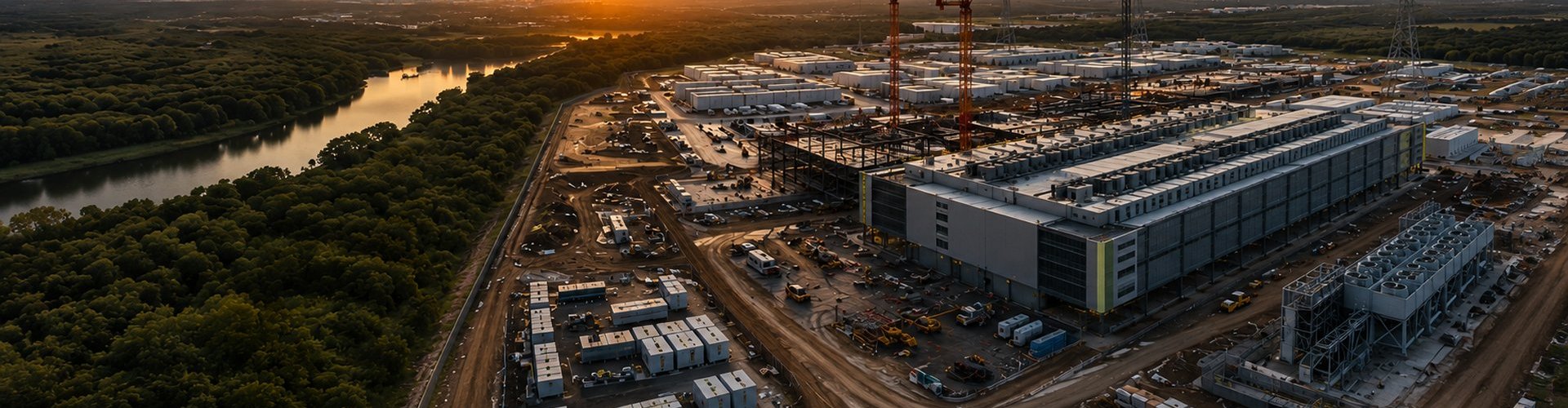
Terafab is a vertically integrated semiconductor plant that SpaceX and Tesla are building at the former Gibbons Creek coal plant site in Grimes County, Texas, about 20 miles east of Bryan-College Station, 70 miles northwest of Houston and 90 miles northeast of Austin. SpaceX describes a single building of about 100 million square feet, at least 2.5 miles long and roughly 10 times the footprint of Tesla Giga Texas, which would make it the largest building on Earth by floor area. SpaceX confirmed the project at a Grimes County Commissioners Court question-and-answer session on August 5, 2026, and Governor Greg Abbott announced it on August 6 with a first-phase commitment of $16.8 billion. County filings put the full four-phase buildout at up to $119 billion.
Terafab is the volume-production half of a two-site program. The Research Fab at the Giga Texas North Campus in Travis County broke ground April 22, 2026. On Tesla's first-quarter 2026 earnings call, Elon Musk said SpaceX handles high-volume manufacturing at Grimes County and Tesla runs the smaller research and development (R&D) pilot line at Giga Texas. The Grimes County plant will make, package and test AI logic and memory chips:
- Low-power inference chips for Tesla Optimus humanoid robots and Cybercab robotaxis
- High-power chips for SpaceX's planned space-based data centers
- Compute silicon toward the program's announced target of 1 terawatt (TW) of new compute per year
The plant anchors the Brazos Valley Semiconductor Concentration, alongside the Texas A&M research fabs and the Substrate Inc. project at the RELLIS Campus in Bryan.
Site and Land
The Texas Municipal Power Agency (TMPA), a joint power agency owned by the cities of Bryan, Denton, Garland and Greenville, ran the Gibbons Creek Steam Electric Station, a coal-fired plant of about 470 megawatts (MW), from 1982 until 2018. Charah Solutions bought the plant and reservoir in February 2021 for demolition and remediation; that property covered 6,166 acres, including a reservoir of about 3,500 acres with its dam and spillway.
WIT TECH LLC, a Wyoming company with a Palo Alto, California registered address and deeds signed by Jared Birchall, who runs Musk's family office, began buying land near the reservoir on May 27, 2026. Its purchases include the former TMPA raw-water pump station on the Navasota River that feeds the Gibbons Creek basin. By August 24, 2026, Grimes Central Appraisal District records showed WIT TECH holding 41 parcels totaling 7,720.7 acres, about 1.5% of the county, with new deeds filed almost daily. The county's reinvestment zone for the project covers more than 22,000 acres around the reservoir.
The site's street address is on Timberwolf Trail off Texas Highway 30. Highway 30 connects the site west to Bryan-College Station, the Texas A&M Semiconductor Institute (TSI) at the RELLIS Campus, the Cyclotron Institute, AggieFab Nanofabrication and Substrate Inc.'s prospective $10-13 billion Project Factory One. The site also sits at the eastern end of the US Hwy 79 Corridor.
Why Gibbons Creek
A production fab at this scale needs power, water, land and workers on one site, and Gibbons Creek supplies all four from infrastructure built for the TMPA coal plant. The same pattern of new industry landing on retired industrial sites appears across Texas and is covered at Brownfield Inheritance and Why Texas: The Structural Logic of AI-Industrial Concentration.
Power
A production fab at 100,000 to 1 million wafer starts per month draws 0.5-10 gigawatts (GW) of continuous power depending on phase. A greenfield site connecting that load to the grid run by the Electric Reliability Council of Texas (ERCOT) faces a large-load interconnection queue of five to seven years or more, plus three to five years of new transmission construction (see ERCOT Large-Load Interconnection). SpaceX avoids that queue by generating its own power: the June 2026 county agreement documents describe SpaceX-built natural gas plants with the fab load kept off the ERCOT grid, and SpaceX told the Commissioners Court on August 5 that excess power would be sent back to the grid. The former TMPA plant left behind a grid interconnection point, substation footprint and transmission rights-of-way that can carry that export. The approach matches the behind-the-meter power model used by large Texas data center campuses.
Water
Full multi-phase buildout would need an estimated 50-100 million gallons per day of source water for ultrapure water production. TMPA built Gibbons Creek Reservoir for coal plant cooling, and the reservoir, its water rights, the Navasota River intake and the discharge permitting history transfer with the property. SpaceX has committed to use recycled surface water from the reservoir and no local groundwater, and the county agreement requires 30 days' notice to the county before SpaceX applies for any groundwater permit. Statewide water pressure on large industrial users is covered at Texas Water Supply Stress.
Contiguous Land
Full vertical integration (logic, memory, advanced packaging, utilities, supplier sites and buffer) needs 3,000-6,000 contiguous acres. Contiguous industrial land at that scale within commuting range of a major metro is scarce in the United States. Giga Texas sits on about 2,500 acres that are largely committed to the North Campus expansion, the Optimus factory, Cybercab production, the Cortex AI training clusters and the Research Fab.
Workforce
The site is within commuting reach of Bryan-College Station and draws on both Houston (about 70 miles) and Austin (about 90 miles). The Texas A&M University System supplies a top-10 engineering school, the largest research spending in Texas, an enrollment larger than UT Austin's, and the Texas A&M Semiconductor Institute, which is scheduled to open in 2028.
Alternatives Considered
| Alternative | Constraint It Fails |
|---|---|
| Williamson County near Samsung Taylor | Contiguous acreage; ERCOT queue saturation |
| Permian Basin | Workforce: petroleum-focused engineering base, more than 400 miles from major metros |
| Arizona | Water (Colorado River allocation cuts) and distance from the Texas operations of Tesla and SpaceX |
| Gulf Coast petrochemical complex | Contamination risk and regulatory conflict with fab cleanliness requirements |
Moving to any of these sites would add an estimated 5-10 years through power and water work alone. SpaceX told the Iola Independent School District (ISD) board that without the Texas tax agreements it would likely have moved the project to another state.
The Research Fab and the Production Fab
Terafab splits research from production into two buildings because leading-edge process development cannot share line time with high-volume revenue production, and a volume line cannot absorb experimental recipe changes.
| Dimension | Research Fab (Giga Austin) | Production Fab (Grimes County) |
|---|---|---|
| Location | Giga Austin North Campus, Travis County | Gibbons Creek Reservoir, Grimes County |
| Operator | Tesla-led with Intel as foundry partner | SpaceX-operated (TeraFab AI, LLC filing entity) |
| Scale | A few thousand wafer starts per month (experimental) | 100,000 to 1 million wafer starts per month at full scale; 100 million sq ft, at least 2.5 miles long |
| Primary Role | Rapid iteration of process recipes, transistor architectures and packaging variants | Volume manufacturing of validated designs: logic, memory, advanced packaging and testing under one roof |
| Capital | $3B Tesla initial; $25-30B realistic equipped cost | $16.8B first phase; up to $119B across four phases |
| Status (October 2026) | Groundbreaking April 22, 2026; foundations and slab work under way | Tax agreements in force; site clearing under way since August 2026; SpaceX targets limited operations toward the end of 2027 |
The Research Fab is covered in full at Terafab Research Fab at Giga Texas.
Process Technology: Intel 14A and TSMC Talks
On Tesla's first-quarter 2026 earnings call on April 22, Musk said Terafab would use Intel 14A, Intel's next leading-edge node after 18A (a roughly 1.4-nanometer-class process). Musk said that "by the time Terafab scales up, 14A will be probably fairly mature or ready for prime time." The choice made Tesla the first major announced external customer for 14A. The node uses High-NA (high numerical aperture) extreme ultraviolet (EUV) lithography, PowerDirect backside power delivery (the successor to PowerVia on Intel 18A) and Intel's advanced packaging. Musk has also cited 2-nanometer production targets, which points to more than one node at full buildout.
Intel joined Terafab as its first named foundry partner on April 7, 2026. On October 3, 2026, Musk confirmed discussions with TSMC about Terafab, writing "Just discussions, but something may come of it." Bloomberg reported on October 7 that Intel will keep working with Musk on Terafab. No financial terms for either foundry's role have been published.
The Free Electron Laser Light Source
On August 6, 2026, the day SpaceX released facility renderings, an artist's impression circulated on X showing a ring of structures with what looked like a particle accelerator running under the building. Joshua Steinman posted the image, and Beff Jezos (founder of Extropic and a former Google quantum computing engineer) suggested Musk was planning a free electron laser (FEL) as the EUV light source. Musk posted "FEL FTW."
Every EUV scanner in production today is built by ASML and uses laser-produced plasma (LPP): a carbon dioxide laser hits molten tin droplets about 50,000 times per second to emit 13.5-nanometer EUV light. LPP works, but it converts little of its input energy into usable light, and each scanner carries its own power-hungry source. An FEL makes EUV light by sending a high-energy electron beam through an undulator, a row of alternating magnets that drives the electrons in a zigzag path so they emit coherent radiation. The accelerator runs to hundreds of meters, which is why conventional fabs do not use one. A single FEL serving many scanners in a 100-million-square-foot fab spreads that capital cost across far more tools, while the per-scanner energy and maintenance cost of LPP grows with every tool added.
The leading FEL-EUV startup is xLight of Palo Alto, chaired by former Intel CEO Pat Gelsinger:
- On June 2, 2026, the US Department of Commerce finalized a $150 million CHIPS and Science Act incentive award to xLight, structured as a government equity stake.
- xLight earlier raised $40 million in a round led by Playground Global.
- xLight is building its first FEL system at the Albany NanoTech Complex in New York and plans to demonstrate a prototype in 2028.
- xLight is targeting wavelengths shorter than the 13.5 nanometers ASML scanners use today, which would allow finer patterning.
Bits&Chips reported that ASML studied FEL internally and set it aside because the efficiency gain did not justify the cost, an assessment made before a fab of Terafab's size was proposed. ASML could build scanners that accept an external FEL beam; either way, ASML scanners would still perform the exposure steps downstream of the light source.
Capital and Customers
| Figure | Source | What It Represents |
|---|---|---|
| $5 billion | Grimes County agreement (June 2026) | Minimum investment required by 2030 |
| $16.8 billion | SpaceX, Tesla and Governor Abbott (August 6, 2026) | Confirmed first-phase commitment |
| $35-45 billion | Morgan Stanley (before the filing) | Analyst estimate of the first phase |
| $55 billion | SpaceX tax abatement filing (May 2026) | Initial-phase figure SpaceX first gave the county |
| $119 billion | SpaceX tax abatement filing (May 2026) | Full four-phase buildout |
| $1.66 billion | KBTX reporting (September 2026) | Value of the tax break tied to Terafab |
SpaceX's S-1 registration statement for its initial public offering (IPO), filed May 20, 2026, describes only "a general framework for the future development of Terafab" agreed with Tesla. The filing states that specific projects will need separate agreements, that intellectual property rights, financial terms and timelines are not final, and that "neither Tesla nor Intel are obligated to remain a part of the project." For scale, the global semiconductor industry spends $200-250 billion a year on capital equipment and plants, so the $119 billion buildout would equal about half of one year's worldwide spending.
The chips go to Musk's own companies:
- Tesla: self-driving inference for Cybercab and the wider vehicle fleet, and Optimus humanoid robots
- xAI: training compute
- SpaceX: orbital compute for Starlink and its successors, including radiation-tolerant chips for low Earth orbit (LEO)
- Tesla and SpaceX: ground AI data centers
Musk has described the decision as a supply problem: "We either build the Terafab, or we don't have the chips, and we need the chips, so we build the Terafab."
Permitting and Approvals
| Date | Body | Action |
|---|---|---|
| May 5, 2026 | SpaceX | Announced the potential Grimes County project and filed for tax abatement |
| June 4, 2026 | Grimes County Commissioners Court | Approved a Chapter 312 property tax abatement and a Chapter 381 economic development agreement |
| July 14, 2026 | Iola ISD and Anderson-Shiro Consolidated ISD boards | Each approved all four phases of JETI agreements, 5-2 on every phase |
| July 21, 2026 | Governor Abbott | Signaled approval of the JETI agreements |
| August 5, 2026 | Grimes County Commissioners Court | Public question-and-answer session with SpaceX; SpaceX confirmed the JETI agreements were signed and active |
| August 6, 2026 | Governor Abbott | Announced the project, a $30 million Texas Enterprise Fund (TEF) grant and JETI qualification |
The county terms, under Chapter 312 of the Texas Tax Code and Chapter 381 of the Texas Local Government Code, are:
- 100% abatement on buildings and equipment for 10 years, 2027 through 2036
- A $10 million payment to the county within 60 days of signing, plus $35,000 toward county legal fees
- From 2037 through 2061, the county collects taxes but returns to SpaceX any amount above $20 million a year
- Minimum investment of $5 billion by 2030 and 1,800 jobs by 2035, with no penalty at 90% of the job goal
- SpaceX builds its own fire station and wastewater treatment plant, and keeps facilities at least 500 feet from existing homes, churches and schools
- If SpaceX walks away or defaults, it repays up to three years of abated taxes
The school district agreements fall under the Texas Jobs, Energy, Technology and Innovation Act (JETI), the state program that replaced the Chapter 313 school tax limitations. SpaceX told the Iola ISD board it would like to start phase one construction before the end of 2026.
At the August 5 session, the first time SpaceX representatives faced Grimes County residents directly, SpaceX Environment, Health, Safety and Medical Lead Jordan Buss described the project as vital to the United States, citing dependence on foreign-made chips and the supply chain disruptions of the COVID-19 pandemic. SpaceX representative Riley Trennell said civil work would begin almost immediately. SpaceX committed publicly to 3,000 permanent jobs, from food service and janitorial work to semiconductor fabrication engineering, with most hires expected from Grimes and neighboring Brazos counties. SpaceX projects more than $100 million a year in combined county and school district taxes at peak facility value, and about $60 million a year to the county alone once the agreement expires.
Construction Status
Groundbreaking took place in August 2026. By late September, aerial video showed the site cleared of trees and covered in burn piles, and residents along Highway 90 near Anderson, a town of fewer than 300 people, reported heavy construction traffic. SpaceX expects limited operations to begin toward the end of 2027.
Open Issues
- Records dispute: In July 2026, the office of Texas Attorney General Ken Paxton ruled that most Terafab records, including the tax abatement application and land acquisition records, are public. SpaceX sued Paxton and Grimes County in the 126th District Court in Travis County in September 2026 to block their release. State Representative Gina Hinojosa, the Democratic nominee for governor, has requested correspondence between Governor Abbott's office and Musk's companies, with a response due around October 13.
- State data center permit pause: On September 21, 2026, Governor Abbott directed the Texas Commission on Environmental Quality (TCEQ) to stop issuing new data center permits while ERCOT, the Public Utility Commission and the Texas Water Development Board audit grid and water strain; the TCEQ report is due October 19. Grimes County Judge Joe Fauth said the pause does not apply to Terafab because it is classified as a chip plant with a data center only for its own operations. The governor's office has not said either way.
- Remaining permits: TCEQ air quality permits for the on-site gas generation, water and wastewater permits, and federal compliance under the CHIPS Act framework and export controls.
- Community concerns: Grimes County Citizens for Responsible Development (GCCRD), a resident group, has tracked the project since before the May 2026 filing and pressed for protections on water, roads, traffic and rural character in a county of about 30,000 residents. Reuse of a former industrial site reduces some land-use concerns but not concerns about the pace and scale of construction.
Related Coverage
Substrate / Project Factory One | Texas A&M Semiconductor Institute / RELLIS | AggieFab Nanofabrication Facility | Center for Microdevices and Systems | Terafab Research Fab Giga Texas | Terafab: Global Case Study
