AustinIO > The Austin Supercluster > Sandow Lakes / Xebec Megasite
Sandow Lakes / Xebec Megasite
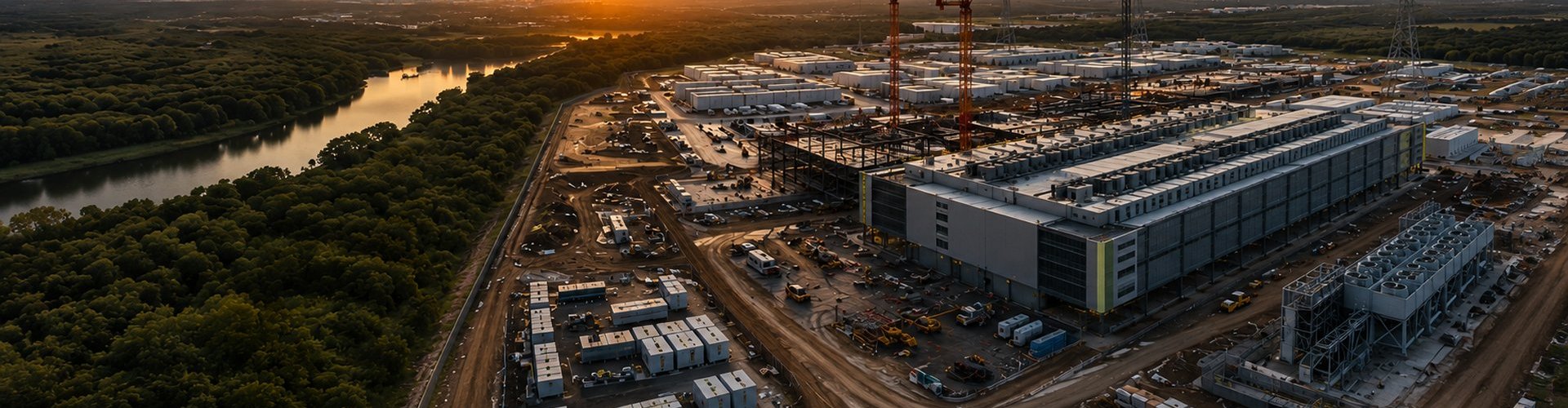
Sandow Lakes is the clearest single instance of the recursion this network documents: a dead aluminum smelter that now makes solar cells, trains frontier AI models, mines bitcoin, and generates its own power — four industries on one 33,000-acre parcel at once. It is a multi-tenant industrial megasite, not a single facility, and the most concentrated expression of brownfield inheritance in Texas.
| Attribute | Detail |
|---|---|
| Owner / developer | Xebec Holdings (Dallas), via affiliate SLR Property I, LP |
| Location | FM 1786 south of US 79, Milam and Lee Counties, TX |
| Distance from Austin | ~25 mi NE (15 mi E of Taylor / Samsung) |
| Size | ~33,000 acres (~50 sq mi), connected by 15 on-site lakes |
| Prior industrial life | Alcoa aluminum smelter + coal power + mining (1951–2017) |
| Power | ~1.5 GW ERCOT-connected today, scaling to ~3.9 GW by 2028 (Oncor) |
| Phase 1 | AMLC / "The Switch" — 3,300 acres, 35M sq ft targeted, first occupancy Q3 2026 |
| Financing | $240M Alcoa acquisition (2021); $475M BentallGreenOak commitment; Sandow MUD #1 tax-exempt bonds (no city annexation required) |
| Industries on site | Solar manufacturing, AI training, bitcoin mining, power generation |
| Supercluster role | US 79 corridor-edge node (just outside Austin MSA counties) |
| Status | Master-planned redevelopment underway; multiple tenants building |
What it is
Xebec Holdings acquired the former Alcoa complex from Alcoa Corporation in November 2021 for $240 million, and is redeveloping it as what JLL calls the only megasite in Texas — the one site combining power, water, rail, natural gas, fiber, and interstate access at gigawatt-and-multi-million-square-foot scale. What makes Sandow distinctive is not any single tenant but the combination: four different industries, under different operators, running on one inherited industrial platform. The smelter that closed because US electricity prices made aluminum uneconomical is now a site that manufactures solar cells, trains AI, mines cryptocurrency, and builds its own generation — the recursion made physical on a single parcel.
The tenant roster
Sandow is best understood through who occupies it. Five operators span four industries across the footprint.
| Tenant | Industry | What they run at Sandow |
|---|---|---|
| T1 Energy (G2 Austin) | Solar manufacturing | 5 GW solar cell factory, ~$850M, ~1,800 jobs, first production H2 2026 |
| Riot Rockdale | AI training | Anthropic-leased campus on the inherited 700 MW-era grid connection |
| Bitdeer | Bitcoin mining | One of North America's largest mines, inside the original 1950s smelter buildings |
| Sandow Lakes Energy | Power generation | Planned 1,200 MW behind-the-meter gas plant on the former power-plant footprint |
| Stargate Milam ("Freebird") | AI training | OpenAI workload; built and operated by SB Energy (SoftBank), 1.2 GW, on the Sandow parcel |
T1 Energy: the exact inversion
The anchor tenant of the Phase 1 campus is Austin-based T1 Energy, whose G2 Austin facility is a 5 GW solar cell manufacturing plant — roughly $850 million and 1,800 jobs, with first production in the second half of 2026. T1 leased and holds a purchase option on 100 acres at the AMLC, announced March 2025. The plant will produce advanced TOPCon solar cells, addressing what T1 calls a critically underserved leg of the US solar supply chain, and it is one node of the company's three-facility Texas footprint alongside G1 Dallas and its Austin headquarters. Full company detail on the T1 Energy page.
The historical inversion is exact and worth stating plainly: the Alcoa smelter closed because US electricity prices made aluminum smelting uneconomical, and the same site is now manufacturing the solar cells that generate cheap electricity. The industry that died from the cost of power is replaced by the industry that lowers it, on the same ground, drawing on the same inherited grid connection.
The inherited platform
Sandow is one of the anchor cases of brownfield inheritance — the pattern where the AI-industrial buildout occupies infrastructure an earlier industry left ready. The Alcoa operations, dating to 1951, left roughly 33,000 contiguous acres, water rights established in the 1950s, a 700 MW-era grid connection, rail, natural gas, and the on-site lakes originally built for smelter and power-plant cooling. That platform is why multiple tenants could energize here faster than any greenfield site: the binding constraints were resolved decades earlier for a different occupant. The one financing wrinkle worth noting is Sandow Municipal Utility District No. 1, established by the Texas Legislature in 2023, which funds water, sewer, and road infrastructure through tax-exempt bonds without requiring city annexation — a structural advantage over peer sites that depend on it.
Corridor-edge position
Sandow sits just outside the official Austin MSA counties — it is in Milam and Lee, not Travis, Williamson, Bastrop, Hays, or Caldwell. But the county line is a Census boundary, not an economic one. The site is 15 miles east of Taylor on the US 79 corridor, running on the same Samsung-driven Oncor transmission scaling and the same workforce shed as the Williamson County data center spine. It functions as a corridor-edge extension node of the Austin Supercluster: structurally integrated with the buildout, geographically just beyond its formal core. Combined with Samsung Taylor, the Skybox/Prologis Hutto campus, and the Terafab production fab at Gibbons Creek, it helps make the US 79 corridor one of the most concentrated AI-industrial buildouts at sub-corridor scale in the country.
Related Coverage
US 79 Data Center Corridor | Cedar Creek Data Center Cluster | I-35 South Data Center Corridor | Giga Austin Nexus | Brownfield Inheritance | OpenAI's Texas Compute