AustinIO > Texas AI & Hyperscalar Data Centers > AI Data Center Exemplars > Data City, Texas
Data City, Texas
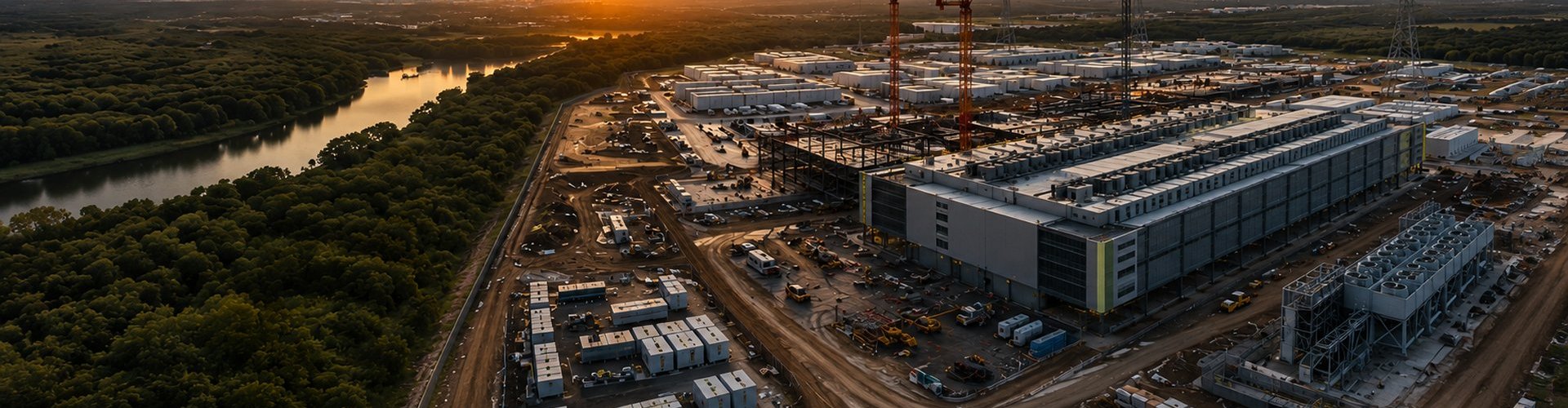
Data City is the exemplar of the frontier end of the behind-the-meter model: a 50,000-acre campus designed to be fully islanded from the grid and powered, ultimately, by green hydrogen drawn from salt-dome storage. It is the most ambitious self-sufficiency claim in the state, and the earliest-stage.
| Attribute | Detail |
|---|---|
| Operator | Energy Abundance Development Corp (Houston) |
| Location | Near Laredo, Webb County, TX (South Texas) |
| Distance from Austin | ~235 mi S |
| IT capacity | 300 MW phase 1; up to 5 GW at full build; 15M+ sq ft leasable |
| Power model | Behind-the-meter, fully islanded from ERCOT |
| Generation | Wind, solar, batteries, dual-fuel gas → 100% green hydrogen (Piedras Pintas salt-dome storage) |
| Cooling | Direct-to-chip liquid cooling (centralized) |
| Workload | AI + cloud (colocation) |
| Compute chip | Designed for Nvidia Blackwell and Rubin |
| Known tenants / workloads | Merchant colocation; tenants not yet named |
| Investment | Not disclosed |
| Timeline | Phase 1 (300 MW, 1M sq ft) targeted 2026; 5 GW in later phases |
| Status | Planned / early development |
Why it exists here
Data City sits on 50,000 acres near Laredo because the site pairs South Texas wind and solar with proximity to the company's salt-dome hydrogen storage. Energy Abundance Development Corp — formerly Green Hydrogen International — announced the project in March 2025 as the world's largest behind-the-meter data center hub, built in phases from a first 300 MW and 1 million square feet toward 5 GW and over 15 million square feet of leasable space.
The power model
Data City is the hydrogen variant of behind-the-meter power, and the most fully islanded design in the state: the campus is intended to take no power from ERCOT at all. It combines wind, solar, batteries, and dual-fuel gas turbines, running initially on Texas-produced natural gas and shifting over time to 100% green hydrogen sourced from the company's adjacent 2 TWh Hydrogen City salt-dome storage at the Piedras Pintas Salt Dome. The storage is charged by dedicated wind and solar. If it works as designed, it is the closest thing to a genuinely off-grid gigawatt campus in Texas.
The hydrogen transition is what makes this a frontier case rather than a conventional off-grid gas build. Salt-cavern hydrogen storage at data center scale is unproven, and the phased plan reflects that — gas first, hydrogen as the technology and economics mature.
The cooling and chips
The campus is designed around centralized direct-to-chip liquid cooling and specified to support Nvidia's Blackwell and Rubin generations — the rack densities that make air-cooling impractical. Liquid cooling and high-density silicon are, again, the paired choice.
Hydrogen City: the project underneath
Data City is best understood as the offtaker for a hydrogen project that came first. Its developer, Energy Abundance Development Corp, began as Green Hydrogen International, and its flagship is Hydrogen City — an integrated green-hydrogen production, storage, and transport hub centered on the Piedras Pintas Salt Dome in Duval County, connected to Data City and the Gulf Coast by pipeline. The salt dome is the asset: phase one develops two storage caverns, the dome could ultimately support an estimated 50, and fully built out those caverns could hold on the order of 6 TWh of energy as stored hydrogen — the long-term reserve that would let a data center run through the hours when wind and sun do not deliver.
Hydrogen City is enormous on paper. The stated build grows to 60 GW of wind and solar feeding electrolyzers, producing more than 2.5 billion kilograms of green hydrogen a year, with phase one — 2 GW of electrolyzers and two storage caverns — targeted to begin operations in 2026. Most of that hydrogen was conceived for export as green ammonia and sustainable fuels through Corpus Christi and Brownsville, not for compute. Data City is what changed the plan: an anchor customer that consumes the hydrogen on site rather than shipping it, turning a merchant-export project into a captive power source.
This is the inversion that makes the site distinctive. Every other campus in this set secures power as an input to the data center. At Data City the sequence runs the other way — the hydrogen project is the parent, and the data center is the load that makes its economics close. It is the clearest instance of the pattern where the generation is the business and the compute is its customer. The caution is the same as the salt-dome storage itself: Hydrogen City is a years-old announcement whose full scale remains unbuilt, and green-hydrogen timelines have slipped across the industry, so the headline figures are ambitions, not a schedule.
What runs here
Data City is a merchant colocation hub, so its tenants and their workloads are not named — it will host whichever operators lease space, on the chips they choose within the Blackwell/Rubin envelope the facility is built for. There is no model family to infer here. The honest framing is early-stage colocation capacity with an ambitious power thesis and no announced tenants.
Where it fits
Data City is the outer edge of the exemplar set — where Meitner co-locates renewables with gas firming and GW Ranch anchors on gas, Data City bets on hydrogen and full grid isolation. It is the least proven and the most conceptually pure: a campus that generates, stores, and consumes all its own energy, bypassing the grid entirely. Whether it is built as designed is an open question; as a statement of where the self-sufficiency logic ultimately leads, it is the clearest one in Texas.
Last updated September 11, 2026. Figures are the developer's phased plan; the hydrogen transition is unproven at this scale and tenants are not announced. Status: planned / early development.
Related: Behind-the-Meter Power · Water & Cooling · ERCOT Large Load Interconnection · Brownfield Inheritance · AI Data Center Exemplars
Related Coverage
MSB Matrix Data Center Campus | Meitner Energy Center | AWS GW Ranch | Fermi America — Project Matador | Texas Green Hydrogen Hub | Behind-the-Meter Power