AustinIO > Texas AI & Hyperscalar Data Centers > AI Data Center Exemplars > AWS GW Ranch
AWS GW Ranch
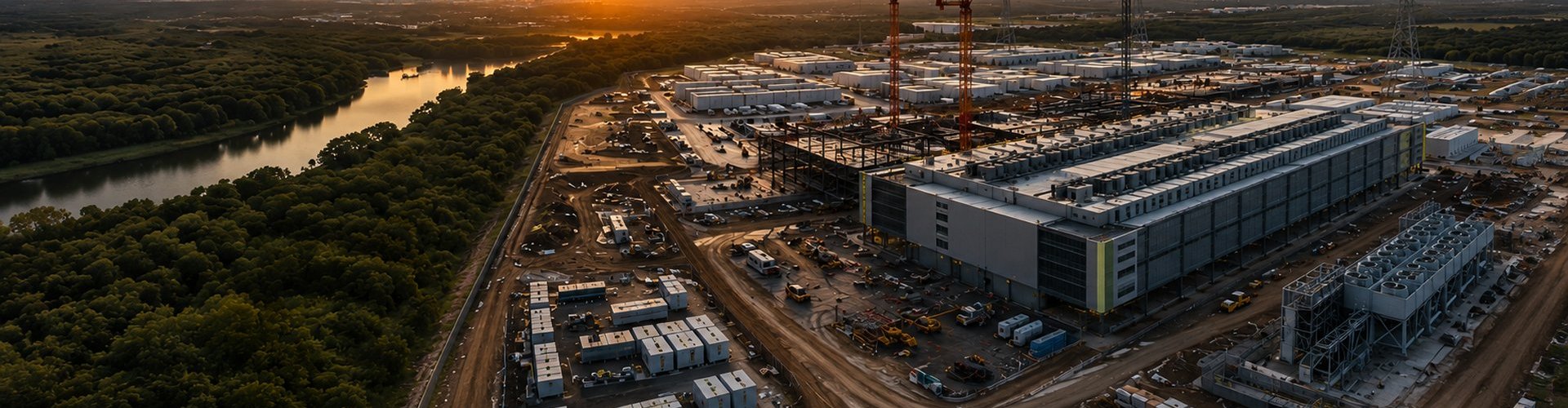
AWS's GW Ranch is the largest behind-the-meter footprint in Texas by land and by generation nameplate: an 8,000-acre Permian Basin campus with its own multi-gigawatt power plant, built to run without waiting on the grid. It is the clearest case of the fully off-grid, generation-first model, and the one whose numbers are most often misread.
| Attribute | Detail |
|---|---|
| Operator | Amazon AWS; Pacifico Energy built the generation |
| Location | Pecos County, TX (Permian Basin, west Texas) |
| Distance from Austin | ~330 mi W |
| IT capacity | Not disclosed (three ~189,000 sq ft buildings permitted so far) |
| Power model | Behind-the-meter, off-grid gas-anchored |
| Generation | Up to 7.65 GW gas (35 turbines), up to 750 MW solar, 1.8 GW battery |
| Cooling | Not disclosed; arid-region siting |
| Workload | AI + cloud (AWS Trainium / Nvidia) |
| Compute chip | AWS Trainium and Nvidia GPUs |
| Known tenants / workloads | AWS first-party and cloud tenants; no named external lab at this site |
| Investment | ~$300M per building disclosed; campus total not stated |
| Emissions | Permitted upward of 30M metric tons CO2/year |
| Timeline | Acquired from Pacifico; Amazon confirmed Aug 2026; first buildings Dec 2026 |
| Status | Under construction |
Why it exists here
GW Ranch sits in Pecos County because the Permian Basin offers what a self-powered campus needs: cheap land at 8,000-acre scale, abundant natural gas at the wellhead, and an oil-and-gas industrial base that already understands large point loads. Amazon acquired the site from Pacifico Energy, which had developed the generation, and confirmed ownership in August 2026. Three buildings of roughly 189,000 square feet each are permitted at about $300 million apiece, with Gensler designing.
The power model
GW Ranch is the off-grid end of the behind-the-meter spectrum. Its generation is anchored by up to 7.65 GW of natural gas across 35 turbines, supplemented by as much as 750 MW of solar and 1.8 GW of battery storage. This is the same architecture xAI used at Memphis: build the plant, run the load behind it, connect to the grid only at the margin if at all.
The 7.65 GW figure is the number most often quoted as GW Ranch's capacity, and it is wrong to read it that way. That is the generation nameplate — the size of the power plant, not the data center. Amazon has never disclosed an IT load for the site. Quoting 7,650 MW as the campus's compute capacity overstates it by an unknown but very large margin. The honest figures are the three permitted buildings; the rest is the plant that will feed them.
The trade-offs
The off-grid model buys speed and independence at an environmental cost that shows up in the permits. GW Ranch is permitted for upward of 30 million metric tons of CO2 per year, among the largest such authorizations attached to any data center in the country. That number is the reason behind-the-meter gas draws scrutiny even as it solves the interconnection problem, and it is the trade every off-grid gas campus in Texas is making in some form.
What runs here
GW Ranch runs AWS Trainium and Nvidia silicon, which makes it Amazon first-party infrastructure: it serves AWS cloud tenants and Amazon's own workloads. Amazon's large Anthropic commitment runs through the Project Rainier campuses in Indiana and Mississippi, not confirmed at GW Ranch, so the honest statement here is the general one — AWS capacity for AWS customers, with no named external lab tied to this specific site.
Where it fits
GW Ranch is AWS's Texas generation-first flagship, the counterpart to Project Eagle near Houston, which is grid-connected. Where Meitner shows the co-located-renewables model and Fermi shows the nuclear-and-gas model, GW Ranch is the pure gas-at-scale case: the fastest way to stand up multiple gigawatts of firm power is to build it yourself in the oil patch. It is the exemplar of self-sufficiency taken to its logical limit, emissions and all.
Last updated September 11, 2026. Generation figures are nameplate, not IT load; AWS does not disclose per-site compute capacity. Status: under construction, first buildings December 2026.
Related: Behind-the-Meter Power · Water & Cooling · ERCOT Large Load Interconnection · Brownfield Inheritance · AI Data Center Exemplars
Related Coverage
Microsoft Pecos (Project Kilby) | Fermi America — Project Matador | Crusoe Abilene Microsoft (Campus 2) | Data City, Texas | Meitner Energy Center | Behind-the-Meter Power | Permian Basin Energy