AustinIO > Texas AI & Hyperscalar Data Centers > AI Data Center Exemplars > Meitner Energy Center
Meitner Energy Center
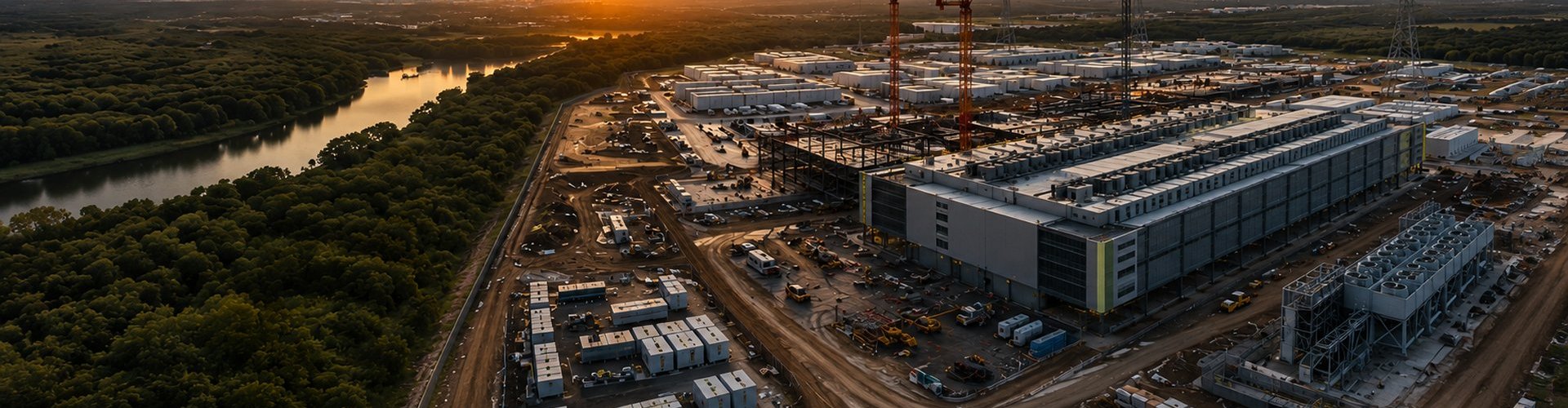
Google's Meitner Energy Center is the clearest single expression of the model the Texas AI buildout converged on: a data center that generates its own power on site, pairs it with wind, solar, and storage, and cools without evaporating water. It is named for the physicist Lise Meitner, sits in the Texas Panhandle, and is the first US campus built on Google's in-house generation capability after its acquisition of Intersect Power.
| Attribute | Detail |
|---|---|
| Operator | Google, with Intersect Power (Alphabet subsidiary) developing the generation |
| Location | Gray and Roberts counties, near Pampa and Miami, TX (Panhandle) |
| Distance from Austin | ~500 mi NW |
| IT capacity | Up to 840 MW across four buildings, ~2.25M sq ft |
| Power model | Behind-the-meter, co-located with new generation |
| Generation | 1+ GW wind and solar, 3 GWh battery storage, on-site gas for firming |
| Cooling | Air-cooled; water limited to domestic use |
| Workload | AI training + cloud (Google TPU) |
| Compute chip | Google TPU (Tensor Processing Units) |
| Known tenants / workloads | Google first-party (Gemini, Google Cloud); specific runs not disclosed by site |
| Investment | ~$14B (tracker estimate; not a Google disclosure) |
| Program tie-in | Google's $40B Texas program (announced Nov 14, 2025) |
| Timeline | Ground broken late 2025; announced Jun 4, 2026; online 2027–2028 |
| Status | Under construction |
Why it exists here
Meitner sits in Gray and Roberts counties for the same reason the Panhandle draws so much of this buildout: it is where Texas wind is strongest and land is cheapest, far from the contested aquifers and dense suburbs of the central corridor. Four data center buildings totaling roughly 2.25 million square feet require up to 840 MW — a load Google chose to serve with its own generation rather than an ERCOT interconnection that could take years to clear.
The power model
Meitner is the co-located-with-new-generation case of behind-the-meter power in its purest form. Rather than draw from the grid and buy renewable credits after the fact, Google builds the generation on the same site: more than a gigawatt of wind and solar, 3 GWh of battery storage to bridge the gap between intermittent supply and a flat around-the-clock load, and on-site natural gas for firming when wind and sun fall short. The campus can connect to the grid at the margin, but its primary supply is the plant beside it.
This is the first US site built on capability Google now owns outright. Alphabet acquired Intersect Power for roughly $4.75 billion in March 2026, bringing generation development in-house instead of contracting for it. Google's Haskell County site is the second on the same model, paired with Intersect's Quantum Clean Energy Project. Meitner is where the strategy debuted.
The water choice
Meitner is air-cooled, which limits its water use to domestic consumption — drinking, sanitation, and the like — rather than the millions of gallons a day an evaporative campus of this size would draw. In a region where water is the constraint most likely to draw community opposition, air-cooling is a deliberate trade: it costs more electricity to reject heat without evaporation, but the campus generates its own electricity, so the trade is one Google is well positioned to make. Power self-sufficiency and water self-sufficiency reinforce each other here.
What runs here
Meitner runs Google TPUs, which makes it first-party Google infrastructure: it serves Gemini training and inference and Google Cloud tenants rather than an outside lab's workload. That much follows from the chips. What does not follow is any claim about a specific model or run — Google distributes a given training run across many campuses and does not disclose which executes where, so no one outside the company can say a particular Gemini version was trained at Meitner. The honest statement is the general one: TPU capacity serving Google's own models and cloud customers, at a scale that puts it among the company's frontier-training sites.
This distinguishes Meitner from the merchant sites elsewhere in Texas. Where Stargate Abilene runs OpenAI on Oracle's cloud and the Anthropic-contracted campuses run one named lab's training, Meitner is Google building for Google. The tenant question answers itself; the run-level detail stays private.
Where it fits
Meitner is one node of Google's $40B Texas program, announced by Sundar Pichai from the company's Midlothian campus on November 14, 2025. Where Midlothian and Red Oak are grid-connected campuses in the Dallas–Fort Worth cluster, Meitner is the Panhandle's generation-first flagship — the site that shows what Google's Intersect acquisition was for. It is the exemplar every other operator's behind-the-meter campus is measured against: not a data center that found some clean power, but a power plant and a data center designed as one asset.
Last updated September 11, 2026. Capacity and investment figures are the best public estimates; Google does not disclose per-site power or capital. Status: under construction, online 2027–2028.
Related: Behind-the-Meter Power · Water & Cooling · ERCOT Large Load Interconnection · AI Data Center Exemplars · Texas Energy Nexus
Related Coverage
Data City, Texas | IREN Sweetwater | AWS GW Ranch | MSB Matrix Data Center Campus | Microsoft Pecos (Project Kilby) | Behind-the-Meter Power | Water & Cooling in Large Facilities