AustinIO > The Texas Nexus > Terafab: Global Case Study
Terafab: Global Case Study
Tesla and SpaceX Chip Manufacturing Measured Against the World's Largest Semiconductor Programs
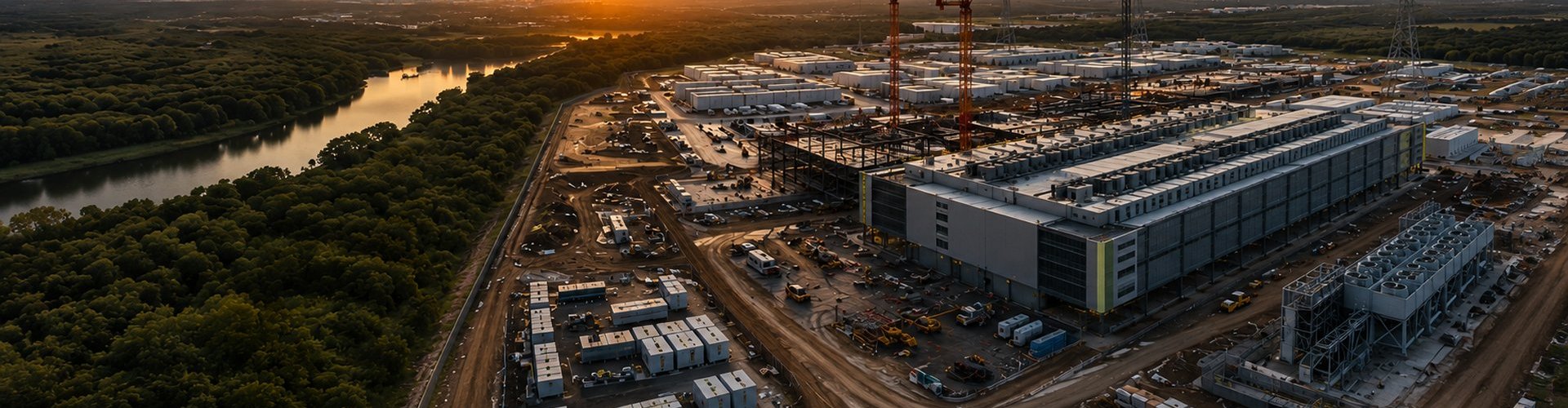
Terafab is the semiconductor manufacturing program of Tesla and SpaceX, with xAI (rebranded SpaceXAI, the AI division of SpaceX, in July 2026) as the third partner and Intel as foundry partner. It runs as two Texas plants: a Tesla-run Research Fab on the North Campus of Tesla Giga Texas in Travis County and a SpaceX-run Production Fab at the former Gibbons Creek coal plant site in Grimes County. Elon Musk unveiled Terafab in Austin on March 21, 2026, with a target of 1 terawatt (TW) of new AI compute per year: 100-200 gigawatts (GW) for use on Earth and 1 TW for satellites in orbit. SpaceX, Tesla and Governor Greg Abbott confirmed the Grimes County plant on August 6, 2026, with a $16.8 billion first phase, and county filings put the full four-phase buildout at up to $119 billion.
Terafab differs from the other large chip programs in the world on these points:
- Output target: 1 TW of compute per year, which Bernstein estimates would take $5-13 trillion of plants and equipment.
- Vertical integration: chip design, lithography masks, logic, memory, advanced packaging and testing in one program, with the chips going into products the same companies build.
- Two sites, two operators: a dedicated research fab run by Tesla and a dedicated production fab run by SpaceX, about 90 miles apart.
- Captive customers: nearly all output goes to Tesla, SpaceX and xAI.
- Orbital compute: chips for SpaceX's AI1 orbital data center satellites, including radiation-tolerant designs.
Site, permitting and construction detail for each plant is at Terafab Gibbons Creek and Terafab Research Fab Giga Texas. The reasons the program landed in Texas are at Why Texas: The Structural Logic of AI-Industrial Concentration, and its place among the state's other industrial anchors is at The Texas Nexus.
Capital Scale Against Other Chip Programs
| Program | Operator | Capital | Scope |
|---|---|---|---|
| Terafab | SpaceX (Production Fab) and Tesla (Research Fab) | $16.8B first phase; up to $119B across four phases; Bernstein estimates $5-13T to reach 1 TW per year | Logic, memory, advanced packaging and testing; target of 100-200 GW of Earth compute plus 1 TW of space compute per year |
| TSMC Arizona | TSMC | $165B total ($65B first phase; $100B added March 2025) | Six fabs, two advanced packaging plants and a research and development (R&D) center in Phoenix |
| Intel Arizona and Ohio | Intel | About $50B in Arizona; $28B for two Ohio fabs (cut from an original plan of up to $100B for eight) | Leading-edge logic and advanced packaging; first Ohio fab now due to produce in 2030-2031 |
| Samsung Taylor | Samsung Foundry | More than $45B across announced phases | 2nm gate-all-around (GAA) logic; Fab 1 ramping to volume in 2027 |
| Micron Clay (near Syracuse, New York) | Micron | $100B over 20 years | Four dynamic random-access memory (DRAM) fabs; groundbreaking January 2026, first production late 2030, full campus 2045 |
| TSMC Hsinchu (lifetime) | TSMC | More than $200B cumulative over several decades | Multi-fab cluster across many process nodes |
| Project Factory One (RELLIS) | Substrate Inc. | $10-13B initial; projected economic impact above $108B over 40 years | Commercial chip manufacturing described in state filings as "first of its kind in the United States" |
By announced capital, Terafab's $119 billion buildout ranks below TSMC's $165 billion Arizona program and TSMC's cumulative spending at Hsinchu, and above Micron's $100 billion Clay campus. TSMC's Arizona and Hsinchu totals build up over several phases and decades of profitable operation; Terafab's $119 billion is one four-phase program by companies that have never run a leading-edge fab.
Terafab's output target sets it apart from every other program. Bernstein's March 24, 2026 estimate converts 1 TW a year of AI compute into wafer demand (about 22.4 million GPU wafers, 2.7 million CPU wafers and 15.8 million high-bandwidth memory (HBM) wafers a year), then into 140 to 360 new fabs of 50,000 wafer starts per month (WSPM) each at about $35 billion per fab: $5-13 trillion in total, before networking, optical, analog and power management chips. A Tom's Hardware analysis of the same target, using $25-35 billion per 2nm-class logic fab, put logic fabs alone at about $3.15 trillion at 100% yield and $3.78 trillion at 80% yield, with memory and packaging adding several hundred billion more. The global semiconductor industry spends $200-250 billion a year on plants and equipment, so Bernstein's range equals 20 to 65 years of current worldwide spending. Musk has described 100,000 to 1 million WSPM for the Grimes County plant at full scale.
Capital Figures and Funding
| Figure | Source | What It Measures |
|---|---|---|
| $3 billion | Musk, April 22, 2026 | Tesla's initial commitment for the Research Fab |
| $16.8 billion | SpaceX, Tesla and Governor Abbott, August 6, 2026 | Confirmed first phase of the Grimes County Production Fab |
| $35-45 billion | Morgan Stanley, before the county filing | Analyst estimate for meaningful chipmaking capacity |
| $55 billion | SpaceX tax abatement filing, May 2026 | Initial-phase figure SpaceX first gave Grimes County |
| $119 billion | SpaceX tax abatement filing, May 2026 | Full four-phase Production Fab buildout |
| $5-13 trillion | Bernstein, March 2026 | Plants and equipment needed to reach 1 TW of AI compute per year |
SpaceX's S-1 registration statement for its initial public offering (IPO), filed May 20, 2026, describes only "a general framework for the future development of Terafab" agreed with Tesla, with no binding timeline or budget, and states that "neither Tesla nor Intel are obligated to remain a part of the project." SpaceX priced its IPO on June 11, 2026, at $135 a share, raising about $75 billion at a valuation of $1.77 trillion, and began trading on Nasdaq as SPCX on June 12. In its first quarterly report as a public company in August 2026, SpaceX reported nearly $100 billion in cash and more than $18 billion of quarterly capital spending, more than $12 billion of it on AI infrastructure. Terafab was not named on the analyst call.
The established chipmakers fund their buildouts from existing businesses: TSMC from foundry profits, Intel from its integrated chipmaking cash flow, Samsung from the wider Samsung Group. Terafab draws on Tesla's $3 billion Research Fab commitment, SpaceX's IPO proceeds and cash, and whatever capital Intel or another foundry partner contributes. The gap between the $119 billion filing and Bernstein's $5-13 trillion range leaves three paths:
- Phased growth: the $119 billion covers logic and initial packaging, and later phases for memory, more logic, more packaging and orbital compute push spending toward Bernstein's range. The four-phase structure of the Grimes County filings fits this path.
- Reduced target: the $119 billion is the full buildout, and the 1 TW figure stays a stated ambition. Announced chip programs often finish smaller: Intel cut Ohio from up to $100 billion for eight fabs to $28 billion for two.
- Larger capital base: SpaceX public-market capital, further Tesla allocation, federal CHIPS and Science Act awards and Texas incentives fund growth beyond current public commitments.
AustinIO expects a mix of the three: a phased buildout reaching $119 billion over 5-10 years, further growth over the following decade, and a scaled-back orbital target while Earth-based logic and memory production keep expanding.
Vertical Integration
The March 21, 2026 announcement covered chip design, lithography mask production, logic fabrication, memory production, advanced packaging and testing in one program. Intel joined as foundry partner on April 7, 2026, and on Tesla's first-quarter earnings call on April 22, Musk named Intel 14A (Intel's next leading-edge process after 18A, roughly 1.4-nanometer class) as the Terafab process. On October 3, 2026, Musk confirmed discussions with TSMC ("Just discussions, but something may come of it"), and Bloomberg reported on October 7 that Intel will keep working with Musk on Terafab. Neither foundry's financial terms have been published.
The chips span Tesla's AI5 inference processor (design finished April 2026, built at Samsung Taylor and TSMC Arizona), the AI6 and AI7 generations that the Research Fab develops, xAI training silicon and SpaceX satellite silicon. SemiconductorX covers the chip architecture, process nodes and foundry choices in Tesla Terafab Supply Chain.
| Operator | Chip Design | Manufacturing | End Products |
|---|---|---|---|
| TSMC | Customers (Apple, NVIDIA, AMD, Qualcomm and others) | Foundry and advanced packaging | None |
| Samsung | Partly in-house (Exynos), mostly external customers | Foundry plus Samsung memory | Galaxy phones and other Samsung electronics |
| Intel | In-house CPUs and other Intel products | Own fabs, now opened to outside customers such as Microsoft through Intel Foundry | Processors sold to computer makers |
| Apple with TSMC | Apple in-house | TSMC | iPhone, Mac and other consumer electronics, plus Apple software |
| Terafab | Tesla, SpaceX and xAI in-house | Research Fab, Production Fab and Intel process technology | Vehicles, Cybercab robotaxis, Optimus humanoids, Starlink and AI1 satellites, Starship and Dragon spacecraft, AI training and inference data centers |
Apple with TSMC is the closest peer, but it serves consumer electronics only. Because the same companies control both the chip design and the fab, Tesla can develop process recipes for a specific chip architecture, tune memory and packaging variants for a specific product, and move yield learning from the Research Fab to the Production Fab without a customer contract in between. A chip designer buying from an outside foundry works from that foundry's fixed process design kit (PDK). Software updates delivered over the air (OTA) to vehicles and robots feed back into the requirements for the next chip.
Research Fab and Production Fab
Leading-edge chipmakers develop new processes at dedicated research and development fabs, because experimental recipes cannot share line time with high-volume revenue production. TSMC uses Fab 12 in Hsinchu, Intel uses D1X in Hillsboro, Oregon, and Samsung uses S1 in Giheung, South Korea. Those companies organize research and production in one of two ways:
- Single-campus clusters (TSMC Hsinchu, Samsung Giheung, Intel Hillsboro): research and production on one campus, with research line time competing with production scheduling.
- Distributed production (TSMC in Arizona, Japan and Germany; Intel in Arizona, Ohio, Oregon and Israel): volume fabs spread across countries for supply resilience, with research kept at the home campus.
Terafab places a small research fab (a few thousand wafer starts per month) at Giga Texas under Tesla and the volume fab (100,000 to 1 million wafer starts per month at full scale) at Grimes County under SpaceX, about 90 miles apart. Research pace does not depend on the production schedule, and the two sites are close enough for engineers and validated recipes to move between them. The Research Fab sits next to the Optimus humanoid line, Cybercab production and the Cortex AI training clusters in the Giga Austin Nexus. The Production Fab takes the power connection, reservoir, water rights and land left by the Texas Municipal Power Agency (TMPA) coal plant, a pattern covered at Brownfield Inheritance, and anchors the Brazos Valley Semiconductor Concentration.
Customers
Terafab chips go to the Musk companies:
- Tesla: inference for Cybercab and the wider vehicle fleet; Optimus humanoid robots, with a long-term target of 10 million units a year; the Cortex 1 and Cortex 2 training clusters at Giga Texas.
- SpaceX: avionics for Starlink (tens of thousands of satellites at full constellation), Starship and Dragon; orbital compute for AI1 satellites.
- xAI: training and inference compute.
- Tesla and SpaceX: ground AI data centers.
| Operator | Customer Base | Largest Customer Share |
|---|---|---|
| TSMC | Apple, NVIDIA, AMD, Qualcomm, MediaTek and other fabless designers | Apple, about 20-25% of revenue |
| Samsung Foundry | Samsung internal plus Qualcomm, NVIDIA and Tesla | Samsung internal, about 50% of foundry revenue |
| Intel | Intel products plus Intel Foundry customers such as Microsoft | Intel internal, about 90% or more of manufacturing revenue |
| Terafab | Tesla, SpaceX and xAI | Musk companies, about 100% |
Tesla, SpaceX and xAI now buy from outside foundries and compete with other customers for leading-edge capacity. SpaceX told investors in June 2026 that it relies mostly on TSMC, and Chief Financial Officer Brett Johnsen said, "We need to make sure that we have assured supply of silicon." A captive fab removes that allocation competition for the companies it serves.
Orbital Compute
SpaceX plans orbital data centers: solar-powered satellites carrying AI chips in sun-synchronous low Earth orbit (LEO), cooled by radiating heat to space and linked to users through Starlink laser links. Before its IPO, SpaceX set a target of 1 GW of orbital AI compute by the end of 2026, scaling to 100 GW within three and a half years. Terafab's 1 TW space target is 10 times that 100 GW figure.
The first satellite design is AI1:
- Compute payload of up to 250 kilowatts (kW) peak and 175 kW average
- Solar arrays producing 210 kW
- 160 square meters of deployable liquid radiators
- Wingspan of 75 meters (246 feet) and deployed height of 30 meters (98 feet)
On August 4, 2026, SpaceX announced that Nvidia will help design the Starmind compute payload for AI1, using Nvidia Rubin GPUs and Vera CPUs in the first generation. SpaceX will build the satellites at its Gigasat factory in Bastrop, with mass production and first deployments as early as 2027, and plans to move to custom Terafab silicon in later versions.
Chips for orbit need process changes for radiation tolerance (hardened cell libraries, error-correcting memory, redundant control paths and resistance to total ionizing dose), listed in full at Terafab Research Fab Giga Texas under Tesla's AI7. Today, radiation-hardened chips come from specialist fabs such as those of Honeywell and BAE Systems, in small volumes and at much higher cost per wafer than commercial production. Radiation testing is available at the Texas A&M Cyclotron Institute in College Station, near the Grimes County site.
SpaceX's case for orbit rests on constraints that tighten on the ground: continuous sunlight in a sun-synchronous orbit supplies power without a grid connection, and radiative cooling needs no water. Ground data centers in Texas wait years in the large-load interconnection queue of ERCOT (the Electric Reliability Council of Texas), described at ERCOT Large-Load Interconnection, and compete for water and land. Starship's reusable launch is the cost basis SpaceX counts on to place satellites at that scale.
Milestones and Outlook
| Date | Milestone |
|---|---|
| November 2025 | Musk first proposes Terafab at the Tesla annual shareholder meeting |
| March 21, 2026 | Musk unveils Terafab in Austin |
| April 7, 2026 | Intel joins as foundry partner |
| April 22, 2026 | Research Fab groundbreaking at Giga Texas with $3 billion from Tesla; Musk names Intel 14A |
| May 20, 2026 | SpaceX files its S-1, describing a "general framework" for Terafab |
| June 4, 2026 | Grimes County Commissioners Court approves the tax abatement and economic development agreement |
| June 11-12, 2026 | SpaceX IPO prices at $135 a share, raises about $75 billion and begins trading on Nasdaq |
| August 4, 2026 | SpaceX and Nvidia announce the Starmind payload for AI1 |
| August 6, 2026 | Grimes County Production Fab confirmed with a $16.8 billion first phase |
| October 1, 2026 | Steel erection under way at the Research Fab |
| October 3, 2026 | Musk confirms discussions with TSMC |
Execution depends on these open items:
- Capital beyond the first phase: only $16.8 billion of the $119 billion buildout is confirmed, and the S-1 frames Terafab as a non-binding framework.
- Foundry partners: Intel's role and any TSMC role have no published terms, and Intel is not obligated to stay.
- Tool supply: extreme ultraviolet (EUV) lithography scanners come only from ASML, which allocates them through multi-year queues.
- Timing: SpaceX targets limited operations at Grimes County toward the end of 2027; Morgan Stanley projected in March 2026 that first Research Fab output would come no earlier than mid-2028.
- Demand: the program assumes AI compute demand keeps growing faster than outside foundries add capacity.
At the $119 billion buildout and Earth compute alone, Terafab would rank with TSMC Arizona and Micron Clay among the largest chip programs in the United States, and the only one of them whose owners also build the end products the chips go into. Reaching the 1 TW target would take capital on the scale of decades of current worldwide chip industry spending.
Related Coverage
Why Texas: The Logic of AI-Industrial Concentration | Brazos Valley Semiconductor Concentration | Texas Triangle Cluster | Terafab Gibbons Creek | Terafab Research Fab Giga Texas