AustinIO > The Austin Supercluster
The Austin Supercluster
Six industrial supernodes sit within 45 miles of each other in the Austin metro. Together they hold nine industrial domains: semiconductor fabrication, AI training compute, electric vehicle manufacturing, humanoid robotics, orbital infrastructure manufacturing, hyperscale data centers, defense technology, semiconductor design and academic supercomputing. No other US region holds that mix at this density.
A supernode is a geographic cluster where the binding constraints for an industry (land, power, permitting, workforce, network access) ease at the same time, so facilities gather there and attract more of the same. A facility belongs to the supercluster because it sits in a supernode or on a corridor that connects two of them, not because of the county it is in.
The supercluster is the wider frame around AustinIO's original Giga Austin Nexus, which covers the metro's three giga-scale manufacturing anchors: Tesla, Samsung and SpaceX. Those anchors form the supercluster's core, the Inner Triangle. Around them sit three data center corridors, the Sandow Lakes megasite, two aerospace concentrations, a defense axis and the university research base.
The Six Supernodes
The six fall into two tiers that differ in density and maturity. The core is the three manufacturing anchors of the Giga Austin Nexus, each of which meets the giga-scale test set out on that page. The second tier is three data center corridors, each qualifying through several operators building along a shared road, much of it on inherited industrial land.
The Core: Three Manufacturing Anchors
| Supernode | Geography | Profile | Anchor operators |
|---|---|---|---|
| Tesla Giga Texas | 1 Tesla Road, SE Austin (Travis County) | Model Y, Cybertruck, Cybercab robotaxi (launched Sep 3, 2026) and Optimus production on one campus, plus the Cortex AI training supercomputer, the Terafab research fab prototyping D3 orbital chips, and the Dojo supercomputer. The widest range of AI-industrial programs on any single US campus. | Tesla, xAI |
| Musk Bastrop Complex | FM 1209, Bastrop County (~30 mi SE) | Seven functions on one site: Starlink terminals (15,000/day), orbital solar cells, Starmind AI satellites (GigaSat factory, 11M sq ft planned), aerospace semiconductor packaging (largest in North America), a gas turbine blade foundry (confirmed Aug 30, 2026), Boring Company operations and Snailbrook housing. | SpaceX, Boring Company |
| Samsung Taylor | Taylor, Williamson County (30 mi NE via SH 130) | Fab 1 operational, Fab 2 under construction, a ten-fab long-term plan. Fab 1 makes Tesla AI5 chips under a $16.5B captive foundry agreement and forms the Austin-Taylor semiconductor axis with Giga Texas. | Samsung, KDC (Project Comal) |
The three connect into one value chain. Samsung makes the leading-edge logic that Tesla's autonomy compute runs on, and SpaceX packages Tesla-class AI silicon into orbital hardware. Every stage from chip design to orbital deployment happens inside the metro.
The Three Data Center Corridors
| Supernode | Geography | Profile | Anchor operators |
|---|---|---|---|
| US 79 Data Center Corridor | Williamson County (US 79 spine) | Built on inherited infrastructure: Dell's Round Rock cluster, Hutto's industrial base and Taylor's freight rail were already in place, along with the transmission Oncor built for Samsung Taylor. Skybox/Prologis PowerCampus, Iron Mountain, ASML lithography. | Skybox/Prologis, Iron Mountain, ASML |
| I-35 South Data Center Corridor | New Braunfels-San Marcos-Uhland (I-35 S) | The supercluster's southward extension toward San Antonio. Pre-operational and early-construction campuses along I-35. | CloudBurst Evolve, Edged Energy, Prime (Project Snow), Tract (Caldwell Valley) |
| Cedar Creek Data Center Cluster | Cedar Creek, Bastrop County (SH 21 / FM 535) | The fastest-forming of the six: first filing July 2025, $9B+ disclosed within 14 months. Three independent hyperscale developers are assembling 4,600+ acres next to the Musk Bastrop Complex. Operational density projected within 18-24 months. | EdgeConneX ($5.6B+, CoreWeave tenant), AWS (1,300 acres), BlackChamber/Pacifico ($2.2B, Anthropic reported anchor) |
Sandow Lakes: The Corridor-Edge Megasite
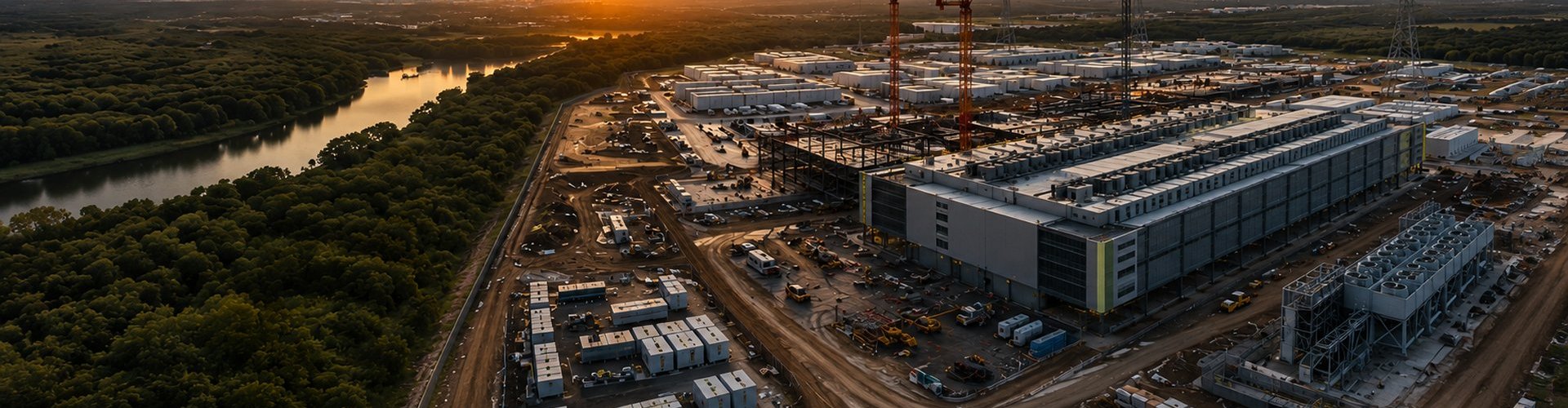
The Sandow Lakes / Xebec Megasite sits just outside the Austin metro counties, about 15 miles east of Samsung Taylor on FM 1786 south of US 79 in Milam and Lee Counties. Xebec Holdings bought the former Alcoa smelter from Alcoa in 2021 for $240 million and is redeveloping its 33,000 acres. Four industries now share the site: solar manufacturing, AI training, bitcoin mining and on-site power generation, with about 1.5 GW connected to ERCOT today and Oncor scaling it toward 3.9 GW by 2028.
The Inner Triangle and Its Corridors
The three manufacturing anchors form the densest part of the supercluster, the Inner Triangle. Workforce, supplies and institutional relationships move between them along four roads. Austin sits at the triangle's western vertex and also at the interior of the larger Texas Triangle formed by Austin, Dallas-Fort Worth, Houston and San Antonio.
| Corridor | Connects | Function |
|---|---|---|
| SH 130 | Giga Texas ↔ Samsung Taylor (35 mi) | Silicon-to-manufacturing axis. AI5 chips fabricated at Taylor drive Tesla FSD, Optimus and Cybercab. |
| SH 71 | Austin ↔ Musk Bastrop Complex (~30 mi) | Logistics spine. Starlink terminals and Starmind satellites move west toward Austin distribution; SpaceX teams commute. |
| US 79 | Round Rock → Hutto → Taylor | Data center spine, running from Dell's Round Rock cluster through Hutto to Samsung Taylor. |
| SH 21 / FM 535 | Musk Bastrop Complex ↔ Cedar Creek (~5 mi) | Emerging power-and-compute axis. The satellite factory and the data center cluster share grid infrastructure and construction labor. |
The Compounding Loop
Each part of the supercluster feeds the next:
- The manufacturing anchors generate demand for AI compute.
- That demand brings data center clusters such as Cedar Creek.
- The data centers need more power than the grid can deliver on their timeline.
- The power gap drives on-site generation: SpaceX builds a gas turbine blade foundry at Bastrop, and BlackChamber/Pacifico builds 710 MW of on-site gas at Cedar Creek. SpaceX also answers it by moving compute to orbit.
- The new power capacity makes the next manufacturing anchor viable.
The orbital answer shows the loop end to end. Starmind satellites are built five miles from the Cedar Creek data centers, powered by solar cells made next door, launched from Starbase 350 miles south, and run on D3 chips fabricated at Terafab 90 miles east and radiation-tested at the Texas A&M Cyclotron Institute 15 miles from there. Every step sits inside the supercluster or its extension corridors.
Three Layers Across the Supernodes
Research, aerospace and defense run through several supernodes at once.
Research: The UT Austin Nexus
The UT Austin Nexus is where federal, state, commercial and defense programs share one campus and one talent pool. It includes the Texas Institute for Electronics (TIE), home of the DARPA Next-Generation Microelectronics Manufacturing facility on the old Sematech site; the Texas Advanced Computing Center (TACC), whose Horizon system comes online in 2026 at a Round Rock data center inside the US 79 corridor; the Cockrell School of Engineering, which supplies engineers to Tesla, Samsung Taylor, the chip design houses and the defense base; and the Army's T2COM headquarters. Around it sit roughly two dozen semiconductor firms, including Applied Materials, NI, AMD, NXP, Silicon Labs, Cirrus Logic, Arm, Apple and Intel. The base traces to George Kozmetsky, who brought MCC to Austin in 1983 and Sematech in 1987.
Aerospace: Two Concentrations
The southern concentration is the Musk Bastrop Complex: Starlink terminals, Starmind orbital AI satellites, solar cells and packaging under SpaceX, the hardware that moves compute from ground data centers to orbit. The northern one is forming around Cedar Park and Hutto: Firefly Aerospace (Blue Ghost, the first commercial Moon landing, March 2025), the CTSDC Spaceport and Defense Innovation Campus, CesiumAstro ($470M satellite communications HQ) and potentially Blue Origin's Project Blue Hub ($674M, approved Aug 2026). The northern cluster covers launch, lunar and defense aerospace. Both are covered on the Austin Aerospace-Space Corridor page.
Defense
Defense centers on the US Army Transformation and Training Command (T2COM), formed by merging Army Futures Command and TRADOC into one four-star headquarters in downtown Austin, alongside the Army Software Factory and offices of DIU and AFWERX. Commercial defense firms have grown around it, including Saronic Technologies (Port Alpha, a $3.2B autonomous shipyard) and Allen Control Systems (the Bullfrog counter-drone station). Golden Dome, the national missile defense program, draws on all of it: SpaceX builds Starshield satellites at Bastrop ($6.45B in contracts), Anduril and Palantir co-develop command-and-control software in Austin, SkyWater fabricates Trusted Foundry defense chips, and BAE Systems builds sensors. Details are on the Golden Dome Texas Corridor page.
How Austin Compares
Austin has all nine domains: seven at supernode density (fabs, AI compute, EVs, robotics, orbital, data centers, defense) and two as supporting base (chip design and academic supercomputing). No other region reaches more than four, and four only when coastal California from San Jose to San Diego counts as one region.
| Region | Domains at density | Principal gap |
|---|---|---|
| Austin Supercluster | 7 of 9 (+2 supporting) | All nine present |
| Coastal California (composite) | 3-4 of 9 | Design, AI software and defense, but no manufacturing or robotics concentration; spans 400 miles |
| Phoenix | 3 of 9 | Strongest US fabs; no AI training, EV, orbital or defense at scale |
| Northern Virginia | 2 of 9 | Data centers and legacy defense; no fabs, design, vehicles, robotics or orbital. Dallas passed it as Cushman & Wakefield's top primary data center market in 2026 |
| Seattle | 3 of 9 | Software, orbital and data centers; no fabs, vehicles or defense command |
| Hsinchu | 3 of 9 | The world's deepest fab base; no AI training, EV, orbital or US-aligned defense |
| Shenzhen | 3-4 of 9 | Deepest manufacturing and drone base; constrained by US export controls on frontier compute |
Related Coverage
Texas AI & Hyperscalar Data Centers | Austin Strategic CapEx Nexus | Texas Energy Nexus | UT Austin Nexus | The Texas Nexus | Austin Startup Nexus