AustinIO > Texas AI & Hyperscalar Data Centers > Texas LLM Compute Footprint
Texas LLM Compute Footprint
Texas data centers providing owned, dedicated, or leased compute capacity for the frontier labs & hyperscalers
Six organizations train and serve the U.S. frontier models: OpenAI (ChatGPT), Anthropic (Claude), Meta (Muse), Google (Gemini), Microsoft (MAI), and Amazon Web Services (Nova). All six are building in Texas at the same time, and between them they have contracted or announced roughly 12.7 GW of data center capacity in the state.
Almost none of it is running yet. 12.7 GW of contracted or announced capacity, while ~0.3 GW is actually energized and running AI workloads today (mid-2026).
That gap between contracted and energized is the single most important fact about this page. Stargate Abilene has about 300 MW live out of 1,200 MW planned, and it is the only site on this list with substantial operating AI capacity. Everything else is under construction, permitted, financed, or still awaiting a final investment decision. The 12.7 GW figure describes commitments through 2028, not machines drawing power today.
Texas attracted this buildout for three reasons, and only one of them is the usual answer. Cheap land and a permissive permitting environment matter. So does the ERCOT interconnection queue — but as an obstacle, not an advantage. The queue is long enough that four of the largest projects here bypassed it entirely by building their own generation on site, a structure called behind-the-meter power. Chevron is building 2.67 GW of gas for Microsoft at Pecos. Pacifico Energy built 7.65 GW of gas capacity for what became Amazon's GW Ranch. Crusoe integrated a 900 MW plant into the Microsoft campus at Abilene. Intersect Power, now an Alphabet subsidiary, co-locates wind, solar, and battery storage with Google's Meitner campus in the Panhandle.
Six companies arrived independently at the same conclusion: in Texas, the binding constraint is not land, capital, or chips. It is a utility interconnection queue, and the way around it is to stop asking for one.
How to read the capacity column
Data center capacity gets quoted three different ways, and the three differ by more than a factor of three at some sites on this page.
Critical IT load
The power delivered to compute equipment. This is the honest number for comparing sites, and it is the number this page uses wherever it is available.
Utility or interconnection capacity
What the grid connection can deliver. Hut 8's Beacon Point campus has a 1,000 MW interconnection agreement against 704 MW of contracted IT load. The difference is cooling, conversion loss, and headroom.
Generation capacity
The size of the power plant. At Amazon's GW Ranch, Pacifico Energy's plant is rated at 7.65 GW. That number is not the data center. Amazon has permitted three buildings at roughly 189,000 sq ft each and has never disclosed an IT load for the site. Quoting 7,650 MW as GW Ranch's capacity overstates it by an unknown but very large margin.
Blank entries in the table mean no figure is public. Several operators — Meta, Amazon, and Google among them — do not publish per-site power at all. A blank is more accurate than a guess.
Frontier AI lab/hypercaler data centers
| Tenant | Facility | Workload | Capacity (MW) |
|---|---|---|---|
| OpenAI | Stargate Abilene | AI Training + Inference | 1,200 |
| OpenAI | Stargate Shackelford | AI Training | 2,000 |
| OpenAI | Stargate Milam | AI Training | 1,200 |
| Anthropic | Nexus Hubbard | AI Training | 500 |
| Anthropic | Riot Rockdale | AI Training + Inference | 191 |
| Anthropic | Hut 8 Beacon Point | AI Training | 704 |
| Anthropic | Abernathy | AI Training | 168 |
| Anthropic | Barber Lake | AI Training | 207 |
| Anthropic | Cedar Creek | AI Training | 710 |
| Meta | Meta El Paso | AI Training + Inference | 1,000 |
| Meta | Meta Fort Worth | AI + Cloud | |
| Meta | Meta Temple | AI + Cloud | 198 |
| AWS | AWS Project Eagle | AI + Cloud | |
| AWS | AWS GW Ranch | AI + Cloud | 7,650 |
| AWS | AWS Comanche Peak (Project Spectrum) | AI + Cloud | 1,200 |
| AWS | AWS Cedar Creek | AI + Cloud | |
| AWS | AWS Round Rock | Cloud | |
| AWS | AWS San Antonio (Rockfish, Bitter Blue) | Cloud | |
| AWS | AWS Floydada | AI + Cloud | |
| Meitner Energy Center | AI Training + Cloud | 840 | |
| Google Midlothian | AI + Cloud | 375 | |
| Google Red Oak | AI + Cloud | ||
| Google Haskell County | AI + Cloud | ||
| Google Armstrong County | AI + Cloud | ||
| Google Wilbarger County | AI + Cloud | ||
| Microsoft | Microsoft Pecos (Project Kilby) | AI + Cloud | 2,000 |
| Microsoft | Microsoft Abilene (Crusoe) | AI Training + Inference | 900 |
| Microsoft | Microsoft Castroville | Cloud |
OpenAI
OpenAI's Texas capacity runs through Stargate, the joint venture with Oracle and SoftBank, and it is the most concentrated single-lab position in the state at a projected 4.4 GW across three campuses.
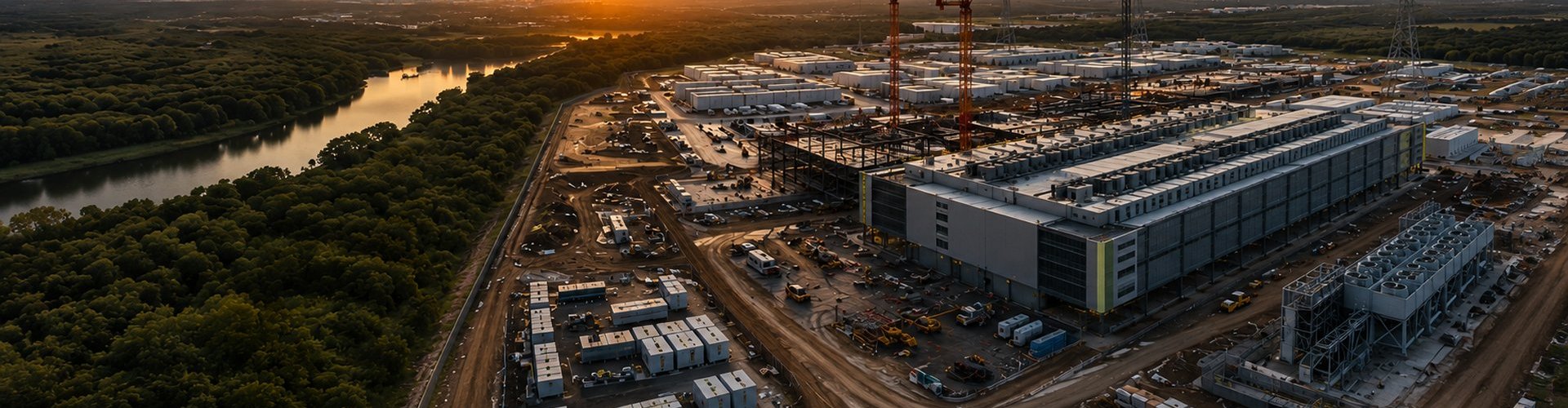
Stargate Abilene is the anchor and the only frontier AI site in Texas with meaningful live capacity. Crusoe developed it on Lancium's clean campus: eight buildings, roughly 4M sq ft on 875 acres, targeting 1.2 GW. The first two buildings, about 980,000 sq ft and 200+ MW, went from groundbreaking to operational in roughly one year. Oracle Cloud Infrastructure took its first capacity there in September 2025. Financing ran to $9.6B in debt from JPMorgan and $5B in equity from Crusoe and Blue Owl, with a separate $7.1B Newmark construction loan for the second phase.
Stargate Shackelford is 10 buildings on 700 acres near Albany, roughly 3.7M sq ft, developed by Vantage Data Centers with VoltaGrid supplying on-site gas. Announced September 2025 as one of five new Stargate sites, projected at 2.0 GW for Q4 2028.
Stargate Milam sits on the former Alcoa Sandow complex, with a Phase 1 target of 800 MW and a projected 1.2 GW at full build. Its interconnection request is pending with Bluebonnet Electric Cooperative.
The Abilene reversal is worth noting because it is the clearest evidence available that these projections move. In March 2026 Oracle and OpenAI abandoned their planned expansion beyond the initial 1.2 GW after financing talks collapsed and OpenAI's demand forecast shifted. Bloomberg reported that Nvidia put down a deposit to help line up a replacement tenant. Meta was briefly expected to take the space. Microsoft took it instead.
Anthropic
Anthropic's Texas position is the most structurally unusual on this page: roughly 1.8 GW spread across seven sites, and Anthropic owns and operates none of it.
Every Anthropic entry here is a lease, an offtake agreement, or a compute purchase from an intermediary. Four of the seven sites are converted bitcoin mining operations, which is not a coincidence — miners hold exactly what AI training needs and cannot easily get: interconnected land with power already flowing.
Beacon Point is the largest and the most layered. Hut 8 is building a 1 GW campus on 525 acres in Nueces County, near Corpus Christi, secured by a 1,000 MW interconnection agreement with AEP Texas. Two 15-year leases of 352 MW each cover 704 MW of contracted IT load, carrying $19.6B in base-term value and up to $50.2B with renewals. Hut 8 financed Phase 1 with $4.25B in senior secured notes at 6.129%, maturing 2042. The buildings follow Nvidia's DSX reference architecture. Energization is scheduled for Q1 2027, with the first data hall in Q3 2027.
The arrangement behind it runs four deep. Hut 8 builds and owns the campus. Nvidia holds the lease. Lambda installs Nvidia chips and sells the resulting compute. Anthropic buys that compute under a reported $35B, six-year agreement covering roughly 350 MW. The Wall Street Journal reported the structure and Reuters confirmed it through a single source; Anthropic, Nvidia, Lambda, and Hut 8 have all declined to comment or not responded. The lease terms are the only figures in a company filing.
Nexus Hubbard is a 2,800-acre campus in Hill County where Nexus Data Centers built speculatively through 2025 and signed Anthropic in March 2026. Four leases cover about 500 MW initially against a stated site ultimate of 7.7 GW, powered by on-site gas turbines with 1.6 GW of initial generation. Google guarantees the lease and power obligations in exchange for roughly 20% project equity, effective on completion, and Anthropic will run Google TPUs there rather than Nvidia hardware.
Barber Lake and Abernathy are both Fluidstack operations with Google financial backing. Barber Lake is Cipher Mining's former bitcoin site at Colorado City, about 207 MW of critical IT fully leased to Fluidstack, with Google backstopping $1.73B of the obligations for warrants equal to roughly 5.4% of Cipher. Abernathy in Hale County is 168 MW of critical IT on 120 acres, formed in October 2025 as a TeraWulf–Fluidstack joint venture; TeraWulf later sold its entire 50.1% stake to Fluidstack.
Riot Rockdale is a 20-year lease worth about $9.1B at roughly $198 per kW per month, on the site of the former Alcoa aluminum smelter. Capacity phases in at 96 MW in December 2027 and 191 MW by June 2028. The land is cleared and graded; nothing is built.
Waco and Cedar Creek are earlier. The Wall Street Journal reported leases near Waco paired with a dedicated 1.6 GW gas plant, with no developer or acreage public. At Cedar Creek in Bastrop County, Anthropic is reported to be in talks for a 2,842-acre campus with a planned 710 MW gas plant, against organized local opposition.
Meta
Meta has three Texas campuses and discloses less about them than any other operator here.
Meta El Paso is the company's 29th data center and its largest Texas commitment. Ground was broken in October 2025 at $1.5B and 1.2M sq ft; in March 2026 that was raised to $10B and 1 GW by 2028. The power arrangement is the notable part: El Paso Electric grid supply plus 813 modular natural gas generators totaling 366 MW, at a cost of $473M. A BlackRock strategic venture now develops the campus, with Meta as construction manager and initial sole occupant. Meta has separately contracted more than 5,000 MW of clean power to the Texas grid.
Meta Fort Worth has operated since 2017 and has been expanded repeatedly. Meta does not disclose its capacity.
Meta Temple is roughly $800M across about 900,000 sq ft in Bell County, targeting late 2027.
Microsoft
Microsoft's Texas footprint is four distinct things, and only one of them is new construction on owned land.
Microsoft Pecos, announced 22 June 2026, adds roughly 2 GW to Microsoft's global capacity over five to seven years. Chevron subsidiary Energy Forge One signed a 20-year power purchase agreement to supply it through Project Kilby, a co-located 2.67 GW gas plant running behind the meter, using GE Vernova turbines and Solar Turbines equipment from Caterpillar, with selective catalytic reduction for nitrogen oxide control. First power is expected in 2028. Chevron targets a final investment decision by the end of 2026, which makes this the only site on this page whose capital commitment is not yet final. Cooling is closed-loop, taking only an initial water charge and drawing brackish non-potable groundwater. Chevron projects more than $10B in lifetime state and local tax revenue.
Microsoft Abilene is the capacity OpenAI walked away from. Crusoe announced on 27 March 2026 that Microsoft would occupy a new 900 MW campus adjacent to Stargate: two buildings at 336 MW critical IT each, plus a dedicated on-site power plant with medium-voltage battery storage and closed-loop non-evaporative liquid cooling. The first building energizes in mid-2027, bringing the combined Abilene site to about 2.1 GW across both campuses.
San Antonio is where Microsoft's Texas presence actually lives. Roughly eight facilities are operational or in development across Bexar and Medina counties. Texas Research Park anchors the far west side on 300+ acres, with 90 more acres acquired at Wiseman and Loop 1604. In Medina County Microsoft has assembled over 1,000 acres, including SAT 82 at Castroville ($482M, 244,675 sq ft, completing early 2028) and a second building at 3580 FM 471 North (about $400M, 195,670 sq ft, completing July 2028) filed as colocation, meaning Microsoft would sublet space.
Google has more Texas locations than any operator on this page — six owned campuses, a leased cloud region, and financial exposure to two more sites listed under Anthropic — under a $40B statewide program Sundar Pichai announced from Midlothian on 14 November 2025.
Meitner Energy Center is the most technically distinctive site in the state. Four buildings totaling roughly 2.25M sq ft across Gray and Roberts counties in the Panhandle, requiring up to 840 MW. Generation is built on the same site rather than drawn from ERCOT after the fact: more than 1 GW of wind and solar, 3 GWh of battery storage, and on-site gas for firming. The campus is air-cooled, so water use is limited to domestic consumption. It is named for the physicist Lise Meitner. Ground was broken in late 2025 and the campus was formally announced 4 June 2026.
Meitner is the first US output of Alphabet's March 2026 acquisition of Intersect Power for roughly $4.75B. Google now develops co-located generation in-house rather than contracting for it. Google Haskell County is the second site on that model, paired with Intersect's Quantum Clean Energy Project, which began operating in June 2026.
Midlothian and Red Oak form the Dallas–Fort Worth cluster in Ellis County. Midlothian runs to 375 acres and five buildings, the fifth filed in March 2026 at $880M. Red Oak is 165 acres with a $600M initial commitment. Armstrong County and Wilbarger County are in development. The us-south1 cloud region in Dallas runs on leased colocation and is distinct from the owned Ellis County campuses.
AWS
Amazon has the most Texas sites of any operator here and discloses the least about them. Seven locations, and a public IT load figure for none of them.
GW Ranch in Pecos County is the largest by land: 8,000 acres acquired from Pacifico Energy, confirmed by Amazon in August 2026. Three buildings of about 189,000 sq ft each are permitted at roughly $300M apiece, with Gensler designing. Power is fully behind the meter — 35 gas turbines rated up to 7.65 GW, plus up to 750 MW of solar and 1.8 GW of battery storage. Permitted emissions run upward of 30M metric tons of CO2 per year. First buildings are due December 2026.
Project Eagle near Boling in Wharton County covers roughly 2,700 to 3,000 acres southwest of Houston. Filings with the Texas Department of Licensing and Regulation on 25 June 2026 covered four buildings at 189,060 sq ft and $300M each, totaling $1.2B; six more were added in August 2026, taking the campus toward 10 buildings. The Houston Chronicle puts the full program at $10B. Construction runs September 2026 to September 2027.
Comanche Peak is a nuclear-adjacent campus co-located with Vistra's plant at Glen Rose, filed in early 2026 and widely reported at 1,200 MW, though Amazon has not confirmed a figure.
San Antonio is Amazon's longest-standing Texas footprint, assembled from 2020 under the Rockfish project name, with two further filings in March 2026: Bitter Blue on Donop Road at about 120,000 sq ft and $65M, and a COPT Potranco core-and-shell building of 141,979 sq ft for a single tenant.
Cedar Creek, Round Rock, and Floydada are earlier stage. Cedar Creek is 1,300 acres acquired in May 2026 with no building filings. Round Rock is 149 acres Amazon has held since 2021; the City Council approved annexation and rezoning on 11 January 2026, splitting the site between a last-mile delivery station on the north half and a data center with substation on the south, though no site development permit has been filed. Floydada was filed in August 2026 with few details public.
Structural patterns
Behind-the-meter generation is now the default at scale
Every Texas project above 800 MW on this page — Meitner, GW Ranch, Pecos, Abilene, Hubbard, Shackelford — builds or contracts its own generation rather than queuing for an ERCOT interconnection. Six organizations reached that conclusion independently, which makes it a structural fact about the Texas grid rather than a preference of any one operator.
Bitcoin miners became the fastest path to energized land
Barber Lake, Abernathy, Riot Rockdale, and Beacon Point all sit on infrastructure originally built to mine bitcoin. Miners spent 2018 through 2024 acquiring interconnected sites with cheap power in west and central Texas. When training demand arrived, those sites were the only ones where power was already flowing. Hut 8, Riot, Cipher, and TeraWulf have all converted or leased out capacity, and in every case the AI contract dwarfs the mining revenue it replaced.
The labs increasingly do not own their compute
Anthropic owns none of its 1.8 GW. OpenAI's capacity runs through Oracle, Crusoe, Vantage, and SoftBank. Microsoft's largest new Texas AI capacity is leased from Crusoe. Only Google, Meta, and Amazon build on their own balance sheets, and even Google guarantees rather than owns at Hubbard and Barber Lake.
Financial exposure and operational control have separated
Beacon Point runs four parties deep — Hut 8 owns, Nvidia leases, Lambda operates, Anthropic buys. Google carries the lease risk at Hubbard, Barber Lake, and Abernathy while Anthropic runs the compute. Reading these sites by tenant alone misses who is actually exposed.
Two counties hold projects from competing companies
Milam County has Stargate's Sandow Lakes site and Riot's Rockdale campus, both on the old Alcoa footprint, about 5 miles apart. Bastrop County has Amazon's 1,300 acres at Cedar Creek and the separate 2,842-acre campus Anthropic is negotiating for.
Constraints
The ERCOT interconnection queue is the reason for the behind-the-meter pattern. Hut 8's Beacon Point was reported in August 2026 as possibly among 23 projects cleared through the current review period, with initial energization scheduled for Q1 2027 and roughly two quarters of schedule buffer. Projects without their own generation are exposed to this timeline; projects with it are not.
A statewide moratorium on new data center projects was announced 3 August 2026. Its effect on the permitting- and filing-stage sites here is unresolved. Round Rock, Cedar Creek, Floydada, and the Anthropic Bastrop campus are the most exposed.
Water is the constraint operators are pre-empting. Meitner is air-cooled. Pecos uses closed-loop cooling with brackish non-potable groundwater. Microsoft's Abilene campus and Crusoe's other buildings use closed-loop non-evaporative liquid cooling. In a state where the buildout is concentrated in the Panhandle and west Texas, evaporative cooling is becoming difficult to permit.
Local opposition is now a scheduling risk. Project Eagle in Wharton County and the Bastrop campus both face organized resistance. Amazon withdrew a 7.2M sq ft proposal in Louisa County, Virginia in July 2025 after similar opposition, so this is not a Texas-only pattern, but Texas is where the density is highest.
Related Coverage
OpenAI's Texas Compute | Anthropic's Texas Compute | Meta's AI Data Center Financing | Meta Temple Data Center | AI Data Center Exemplars | Texas Data Center Moratorium | Stargate Abilene (Campus 1) | Behind-the-Meter Power