AustinIO > Texas AI & Hyperscalar Data Centers > OpenAI's Texas Compute
OpenAI's Texas Compute
OpenAI's roughly 4.4 GW of planned Texas compute runs through a single program: Stargate, the joint venture with Oracle and SoftBank. Where Anthropic's footprint is seven scattered structures and Meta's is off-balance-sheet joint ventures, OpenAI's is concentration — three campuses, one financing stack, one operating model, repeated. The distinctive feature is not how the sites differ but how alike they are, and what happened at the one site where the plan changed.
The three Texas campuses
| Campus | County | Developer / hardware owner | Capacity | Status |
|---|---|---|---|---|
| Stargate Abilene | Taylor | Crusoe (developer) / Oracle (hardware, OCI) | 1.2 GW (~0.3 GW live) | Operational (partial) |
| Stargate Shackelford | Shackelford | Vantage (developer) / Oracle (hardware) | 2.0 GW projected | Under construction |
| Stargate Milam "Freebird" | Milam | SB Energy builds and operates | 1.2 GW | Under construction |
One program, one stack
Stargate is a $500 billion program announced in January 2025 and structured around four equity funders: OpenAI (operational lead), SoftBank (financial lead), Oracle, and MGX, the Abu Dhabi sovereign vehicle. Every Texas campus sits inside this one JV, and each runs the same layered stack: OpenAI is the demand and the workload; Oracle provides the cloud (Oracle Cloud Infrastructure) and, at most sites, owns the hardware; developers like Crusoe and Vantage build the campuses; SoftBank supplies capital and, at Milam through SB Energy, owns the hardware itself. All sites serve OpenAI's workloads.
This is the opposite of a scattered footprint. Anthropic assembled seven different deals with seven different owners; OpenAI concentrated its Texas capacity in one program and repeated the model across three sites. The trade-off is exposure: concentration delivers scale and coordination, but it also means a single financing or forecasting problem propagates across the whole portfolio — which is exactly what happened at Abilene.
Stargate Abilene: the flagship
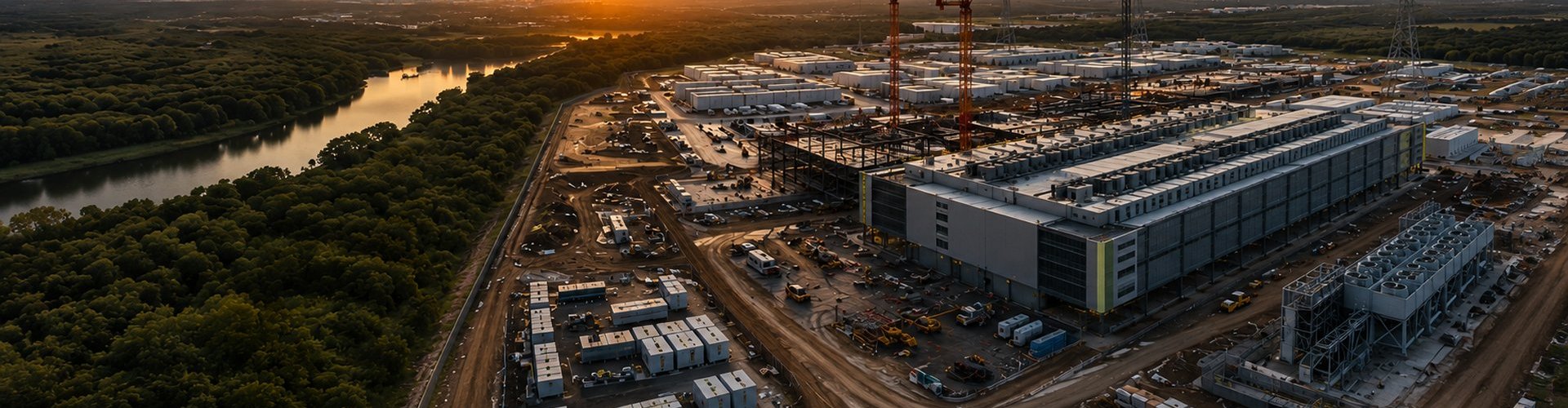
Abilene is the anchor and the only Stargate site with substantial live capacity — roughly 0.3 GW of a planned 1.2 GW, running on Oracle Cloud Infrastructure. Crusoe developed it on Lancium's clean campus: eight buildings, about 4 million square feet on 875 acres, designed to support up to 450,000 Nvidia GB200 GPUs. Financing ran to $9.6 billion in debt from JPMorgan and $5 billion in equity from Crusoe and Blue Owl, with a $7.1 billion Newmark construction loan for the second phase. Crusoe topped out the final building in late 2025, with full completion expected mid-2026. It is the proof that Stargate could deliver operating data centers, not just announcements.
The Abilene reversal
Abilene is also the clearest evidence anywhere that these projections move. In March 2026, OpenAI and Oracle abandoned a planned 600 MW expansion beyond Abilene's initial 1.2 GW, after financing talks stalled and — in Bloomberg's description — OpenAI's "often-changing demand forecasting." Nvidia reportedly put down a deposit to help line up a replacement tenant. Meta was briefly expected to take the space. Microsoft took it instead, and Crusoe now builds a separate 900 MW campus for Microsoft adjacent to the original site, bringing the combined Abilene footprint to about 2.1 GW across two operators.
The reversal did not touch the other Stargate sites — Shackelford, Milam, and the out-of-state campuses proceeded on schedule — but it is the single documented case of a frontier lab's compute forecast shifting mid-build and capacity changing hands. In a portfolio built on concentration, it is the reminder that even the most committed-looking gigawatts are forecasts until they are energized.
What runs here
All three Texas Stargate campuses serve OpenAI's workloads — training and inference — which makes OpenAI the named tenant across the program, a sourced fact rather than an inference. The hardware is Nvidia (GB200 at Abilene, moving toward Vera Rubin at newer sites), owned by Oracle at Abilene and Shackelford and by SoftBank's SB Energy at Milam. As with every operator, OpenAI does not disclose which specific models or runs execute at which campus. What is public is the tenant and the program; the run-level detail is not.
Where it fits
OpenAI's Texas compute is the concentration case among the three frontier labs. Anthropic owns nothing and spreads across seven structures; Meta finances off its balance sheet through private-capital joint ventures; OpenAI pours nearly all its Texas capacity into one program with fixed partners and repeats it at scale. Each is a different answer to the same problem of building gigawatts fast, and reading them side by side is the clearest way to see that the frontier buildout has no single model — only a few competing ones.
Last updated September 11, 2026. Capacities are Stargate program projections; only Abilene has substantial live capacity (~0.3 GW). Figures from Stargate announcements and reporting. Status: Abilene partial, others under construction.
Related: Stargate Abilene · Microsoft Abilene (Crusoe) · Anthropic's Texas Compute · Meta's AI Data Center Financing · Texas Energy Nexus
Related Coverage
Anthropic's Texas Compute | Meta's AI Data Center Financing | Texas LLM Compute Footprint | AI Data Center Exemplars | Texas Data Center Moratorium | Stargate Abilene (Campus 1)