AustinIO > The Texas Nexus > Texas Triangle Cluster > Austin Aerospace-Space Corridor > Blue Origin — Project Blue Hub
Blue Origin — Constellation Park
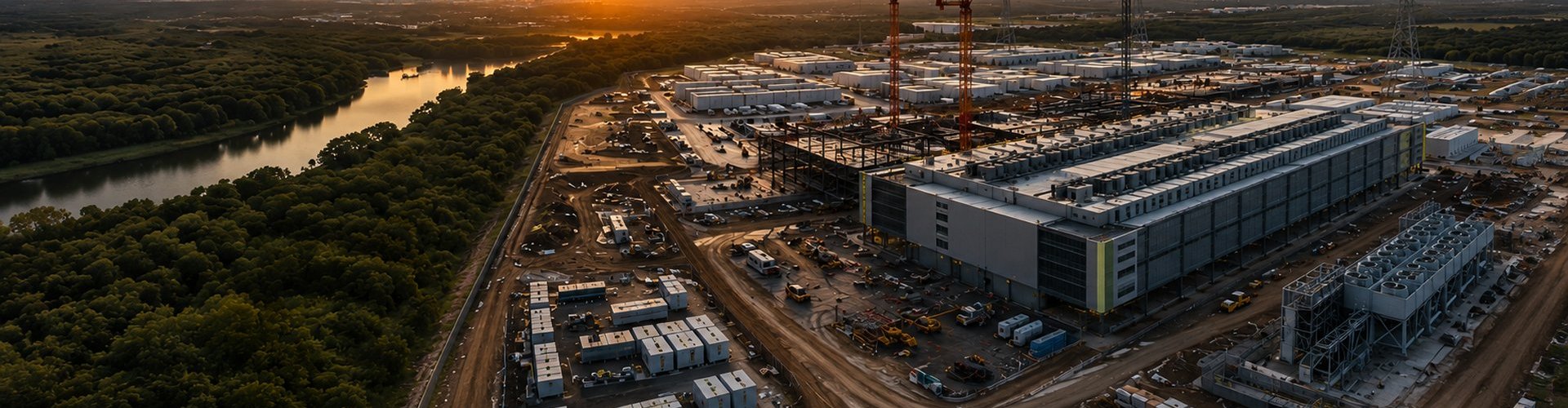
Blue Origin's Constellation Park is a $550 million manufacturing and research and development (R&D) campus in Hutto, Williamson County, about 30 miles northeast of Austin and 11 miles west of the Samsung Taylor fab. Texas Governor Greg Abbott announced the project on October 8, 2026, with a statement from Blue Origin CEO Dave Limp. Blue Origin Manufacturing, LLC plans a capital investment of $554.8 million in a 1.3-million-square-foot, multi-building complex and more than 2,000 jobs over 10 years. The campus will build satellites and ground equipment for TeraWave, Blue Origin's satellite communications network, plus satellite subsystems such as solar arrays and avionics. It is Blue Origin's first manufacturing site in Texas and the newest anchor in the Austin Aerospace-Space Corridor.
The state's share is an $18.17 million Texas Enterprise Fund (TEF) grant, a performance-based award for projects Texas wins against out-of-state sites, plus a $10,000 Veteran Created Job Bonus. Local agreements came first: the Hutto City Council and the Hutto Economic Development Corporation (EDC) approved incentive agreements on August 7, 2026, and the Williamson County Commissioners Court approved an economic development agreement on August 20. The August local filings carried higher investment figures, $650 million to $674 million over 10 years; the state announcement set the capital investment at $554.8 million.
Facility Summary
| Attribute | Detail |
|---|---|
| Project name | Constellation Park (called Project Blue Hub during site selection) |
| Location | Hutto Crossing development, Hutto, Williamson County, Texas: about 30 miles northeast of Austin and 11 miles west of Samsung Taylor, beside Colovore Hutto |
| Facility size | About 1.3 million sq ft across several buildings: manufacturing, R&D, warehouse and logistics space, with cleanrooms, environmental test chambers and automated assembly lines |
| Capital investment | $554.8 million (state announcement, October 8, 2026); local agreements in August cited $650 million to $674 million |
| Jobs | More than 2,000 over 10 years; about $88,000 average annual salary, averaged over the first five years (Williamson County agreement) |
| Products | TeraWave satellites, Project Quartz ground antennas, satellite subsystems (solar arrays, avionics, telecommunications hardware) |
| Timeline | Construction to start in early 2027; first satellite assembly lines targeted for late 2027, in step with the first TeraWave launches |
| State incentives | $18.17 million Texas Enterprise Fund grant; $10,000 Veteran Created Job Bonus |
| Local approvals | Hutto City Council and Hutto EDC incentive agreements (August 7, 2026, 5-2 vote); Williamson County Commissioners Court economic development agreement (August 20, 2026, unanimous) |
| Local commitments | 15 paid summer internships for Williamson County high school students; career and technical education work with Hutto Independent School District (ISD); workforce partnerships with Texas State Technical College and Temple College |
| Entity | Blue Origin Manufacturing, LLC |
| Status | Confirmed October 8, 2026, by the Office of the Texas Governor and Blue Origin. Blue Origin had also evaluated a Florida site (reported as Project Horizon, 800,000 sq ft on the Space Coast) |
| Existing Texas operations | Launch Site One (Corn Ranch), Van Horn, Culberson County: New Shepard suborbital launch and landing (38 flights, paused since January 2026); more than 550 Blue Origin employees in Texas |
What Constellation Park Will Build
Constellation Park is a satellite factory. SatNews describes it as the primary assembly and integration hub for Blue Origin's satellite and ground systems, built to shorten assembly cycles and move finished spacecraft to New Glenn launches faster. The state announcement and trade coverage list these product lines:
- TeraWave spacecraft: satellites for the TeraWave constellation, Blue Origin's network for enterprise, data center and government customers.
- Project Quartz ground equipment: tracking antennas with 3.7-meter apertures and S-band and X-band links for Quartz, Blue Origin's ground station network.
- Satellite subsystems: solar arrays, avionics, telecommunications hardware and other spacecraft components.
Blue Origin announced TeraWave on January 21, 2026. The constellation has 5,280 satellites in low Earth orbit (LEO) and 128 in medium Earth orbit (MEO), 5,408 in all, joined by optical (laser) crosslinks. LEO user links run on Q/V-band at up to 144 gigabits per second (Gbps); MEO optical links carry up to 6 terabits per second (Tbps). Upload and download speeds are symmetric. Blue Origin is targeting about 100,000 customers and plans to begin deployment in the fourth quarter of 2027.
TeraWave competes in the satellite communications market led by SpaceX Starlink. SpaceX builds Starlink user terminals at its Bastrop factory in Bastrop County and is building the GigaSat factory for AI1 orbital data center satellites at the same complex. Hutto also lies on the US 79 Data Center Corridor, where Colovore and other operators are building data centers of the kind TeraWave lists as customers.
The October 8 announcement does not assign Blue Moon lunar landers, Orbital Reef station modules, Blue Ring vehicles or New Glenn stages to Hutto. Those programs stay at Blue Origin's existing plants in Kent, Washington; Huntsville, Alabama; and Merritt Island, Florida.
Blue Origin's Programs
Jeff Bezos founded Blue Origin in 2000. The company is headquartered in Kent, Washington, and CEO Dave Limp leads a workforce of more than 11,000 across Washington, Alabama, Florida and Texas. In July 2026 Blue Origin began raising $10 billion, its first outside equity, at a reported valuation of about $130 billion; Bezos confirmed the round on October 7, 2026, and said an initial public offering (IPO) is possibly several years away.
| Program | What It Is | Status (Oct 2026) | Contract Value |
|---|---|---|---|
| TeraWave | Satellite communications network: 5,280 LEO and 128 MEO satellites with optical crosslinks, up to 6 Tbps on MEO links. Ground segment through Project Quartz antennas | Announced January 2026. Satellites to be built at Constellation Park in Hutto. Deployment to begin in the fourth quarter of 2027 | Customer contracts not disclosed |
| New Glenn | Heavy-lift reusable launch vehicle, 98 m tall and 7 m in diameter. First stage: seven BE-4 engines burning liquid methane and liquid oxygen (methalox). Second stage: two BE-3U engines burning liquid hydrogen and liquid oxygen (hydrolox). 45,000 kg to LEO. First stage designed for 25 or more flights | Three flights: NG-1 (January 2025) reached orbit and lost its booster; NG-2 (November 2025) made the first booster landing; NG-3 (April 2026) flew the first reused booster and landed it, but one BE-3U upper-stage engine underperformed and the AST SpaceMobile BlueBird 7 satellite was left too low and deorbited. On May 28, 2026, the NG-4 vehicle exploded during a static fire at Launch Complex 36 (LC-36), Cape Canaveral, destroying the third booster and damaging the pad. Blue Origin says New Glenn will return to flight by the end of 2026 | 12 Amazon Leo (formerly Project Kuiper) launches booked with options for 15 more. National Security Space Launch (NSSL) certification in progress with the US Space Force |
| Blue Moon Mark 2 (Artemis HLS) | Crewed lunar lander for NASA's Artemis program under the Human Landing System (HLS) contract. Carries two to four astronauts to the lunar south pole for surface stays of up to 30 days. Three BE-7 engines burning liquid hydrogen and liquid oxygen (LH2/LOX). 20 t of payload to the lunar surface in reusable mode. National team: Lockheed Martin, Boeing, Draper, Astrobotic, Honeybee Robotics | Full-scale prototype delivered to NASA Johnson Space Center (JSC) in Houston for astronaut training (early 2026). Uncrewed demonstration targeted for 2027. Crewed landing on Artemis V targeted for 2029-2030. Blue Origin is investing "well north" of the contract value; total program cost is about $7 billion | $3.4 billion NASA Human Landing System contract (May 2023) |
| Blue Moon Mark 1 | Uncrewed cargo lunar lander that precedes Mark 2, built to deliver payloads and demonstrate landing technologies | Pathfinder mission targeted for 2026 on New Glenn, delayed by the New Glenn stand-down. Will demonstrate technologies for Mark 2 crewed missions | Company-funded |
| Orbital Reef | Commercial space station in LEO, billed as a "mixed-use business park" for research, manufacturing and tourism. 830 m³ pressurized volume, crew of 10. Joint program with Sierra Space; team includes Boeing, Redwire, Genesis Engineering and Arizona State University | In development under NASA's Commercial LEO Development Program (CLDP). Targeting initial operations around 2028 or later. Life support system milestones passed | NASA CLDP funding (initial award December 2021). One of three commercial station programs NASA selected to succeed the International Space Station (ISS) |
| Blue Ring | Orbital transfer vehicle (space tug) for payload delivery, satellite servicing and logistics from geosynchronous orbit (GEO) through cislunar space to interplanetary destinations. 3,000-4,000 m/s of velocity change (delta-V). 4,000 kg of payload across 13 EELV Secondary Payload Adapter (ESPA) ports. Chemical and electric propulsion | Pathfinder flew on NG-1 (January 2025). First operational mission, carrying Scout Space Owl and OpTech Caracal space domain awareness sensors, waits on New Glenn's return to flight. Pentagon-funded national security missions in the pipeline | Defense and commercial contracts (values undisclosed) |
| BE-4 Engine | Oxygen-rich staged combustion methalox engine, 2,400 kN (550,000 lbf) of thrust. Powers New Glenn (seven per first stage) and United Launch Alliance (ULA) Vulcan Centaur (two per first stage) | In production in Huntsville, Alabama. Has powered all three New Glenn flights and multiple Vulcan launches | ULA supply contract (ongoing) |
Existing Texas Footprint
Blue Origin has operated Launch Site One, also called Corn Ranch, near Van Horn in Culberson County since 2006. New Shepard has flown 38 times from the site and carried 98 people above the Kármán line, the 100 km boundary of space. On January 30, 2026, Blue Origin paused New Shepard for at least two years and moved those resources to its lunar program. Launch Site One is a launch and landing site, not a factory: New Shepard vehicles are built in Kent, Washington, and shipped to West Texas. Blue Origin had more than 550 employees in Texas before the Hutto announcement.
Constellation Park adds a factory in Central Texas, inside a corridor that already holds these aerospace and silicon sites:
- Musk Bastrop Complex, Bastrop County: SpaceX Starlink terminals, GigaSat satellites, semiconductor packaging
- Firefly Aerospace, Cedar Park: launch vehicles and lunar landers
- SpaceX McGregor, McLennan County: Raptor and Merlin engine test
- Samsung Taylor, Williamson County: leading-edge logic fab, 11 miles east of the Hutto site
- Terafab Research Fab at Tesla Giga Texas, Travis County: semiconductor process research
Hutto sits on US 79 between Round Rock and Taylor, part of the US 79 Deep-Tech Corridor. Hutto Mayor Mike Snyder called the city "an anchor point on the Highway 79 tech corridor" in the October 8 announcement.
Related Coverage
Firefly Aerospace | CTSDC Spaceport Cedar Park | US Hwy 79 Deep Tech Corridor | SpaceX McGregor Engine Factory