AustinIO > The Austin Supercluster > Giga Austin Nexus > Musk Bastrop Complex > SpaceX Gigasat Factory
SpaceX Gigasat Factory
Orbital Data Center Satellite Manufacturing in Bastrop County
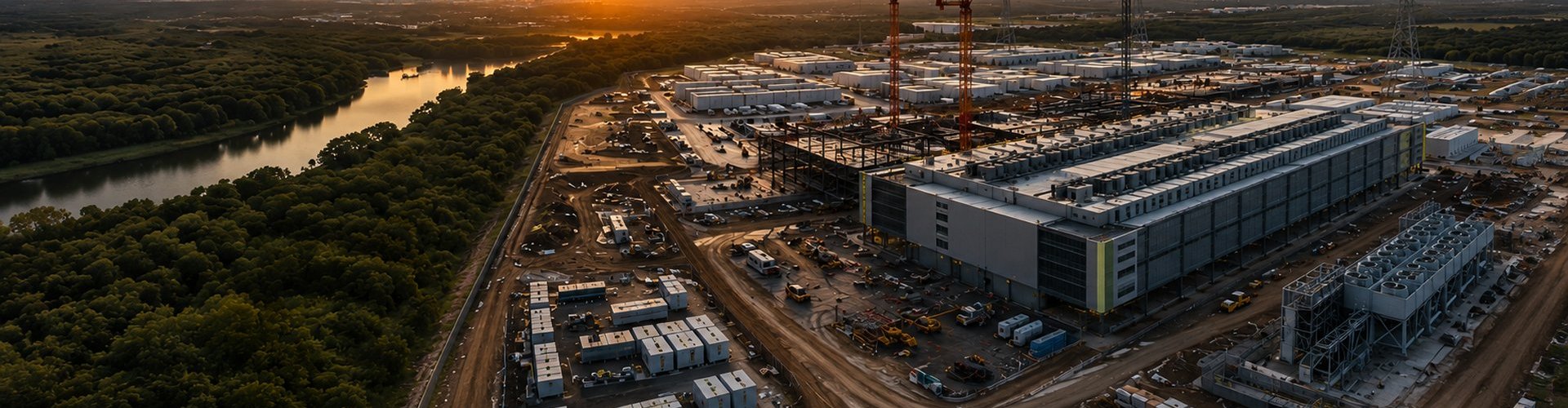
The SpaceX Gigasat factory is an 11-million-square-foot satellite manufacturing campus on more than 1,000 acres that SpaceX and other Musk companies own or hold under contract along FM 1209 (Farm to Market Road 1209) in Bastrop County, Texas, about 30 miles southeast of Austin. It sits inside the Musk Bastrop Complex, next to the existing SpaceX Starlink factory. The factory is planned to build AI1, SpaceX's first orbital data center satellite, together with the solar cells, circuit boards and ground hardware that go into the Starlink and AI satellite fleets.
SpaceX CEO Elon Musk unveiled Gigasat on June 8, 2026, four days before SpaceX began trading on Nasdaq under the ticker SPCX. The initial public offering (IPO) priced at $135 per share on June 11 and raised about $75 billion, the largest IPO on record. On the first trading day, June 12, the stock closed at $160.95, a 19% gain that valued SpaceX near $2.1 trillion. SpaceX presented orbital AI compute to investors as a growth line alongside the Starlink broadband business.
At 11 million square feet, Gigasat would exceed the 10-million-square-foot main building at Tesla Giga Texas by floor area. Bloomberg reported in May 2026, from Bastrop County permit filings, that SpaceX is building a 10 GW (gigawatt) solar cell plant at the site, with two floors producing 5 GW of cells each per year.
Site and Campus
| Item | Detail |
|---|---|
| Location | FM 1209, Bastrop County, about 30 miles southeast of downtown Austin |
| Land | More than 1,000 acres owned or under contract by SpaceX and other Musk companies |
| Planned floor area | About 11 million square feet |
| Solar cell plant | 10 GW per year (two floors of 5 GW each); a 1.5-million-square-foot solar cell building was under construction in June 2026 |
| Starlink production and warehouse space | Expanding to 1.5 million square feet; Bastrop County approved an enterprise project nomination for an $855 million Starlink expansion on May 26, 2026 |
| Current SpaceX workforce at Bastrop | 1,590 employees (June 2026), with SpaceX hiring 100-150 more |
| Announced | June 8, 2026 |
| Production target | Meaningful AI satellite output by the end of 2027 |
SpaceX has not announced an investment total or a job count for Gigasat itself. The Bastrop workforce and expansion figures above cover the whole SpaceX operation on FM 1209.
AI1: The Orbital Data Center Satellite
AI1 is SpaceX's first-generation orbital data center spacecraft: the equivalent of one AI server rack in low Earth orbit (LEO), surrounded by solar arrays, radiators, communications, propulsion, shielding and a structure built to survive launch and years in vacuum. Musk confirmed in June 2026 that the AI satellite constellation is named Starmind, after an xAI trademark filing surfaced.
| Specification | AI1 |
|---|---|
| Compute power | 150 kW (kilowatts) peak, 120 kW sustained average |
| Ground equivalent | Roughly one Nvidia GB300 rack (about 140 kW) |
| Orbit | LEO at about 600 km; Starmind is planned for sun-synchronous orbit for near-constant sunlight |
| Wingspan | About 70 meters (wider than a Boeing 747-8) |
| Deployed height | About 20 meters |
| Power density | About 70 kW per ton |
| Solar array | 150 kW rated at 250 W/m² (watts per square meter), based on Starlink V3 arrays |
| Thermal management | Vertically oriented, double-sided deployable liquid radiators (up to about 110 m²) with redundant pumping loops |
| Compute payload position | Center of the structure, between the solar arrays and radiators |
| Compute silicon (initial) | Nvidia Rubin GPUs (graphics processing units) and Vera CPUs (central processing units) |
| Compute silicon (target) | D3, a custom radiation-tolerant chip; meaningful production volume targeted for the end of 2027 |
| Links | Laser links to other AI1 satellites and to Starlink; downlink by antenna or laser |
| Starship payload | 30-50 AI1 satellites per launch |
SpaceX engineer Ian Dahl described AI1 as simpler than a Starlink broadband satellite because it does not need the large phased-array antennas used for consumer downlink. AI1 reuses Starlink V3 hardware (solar arrays, thermal systems and laser inter-satellite links) around a compute payload built from modular, interchangeable units. Musk called the design SpaceX's "first best effort" and said the company was making no promises about deployment timing or constellation size.
On August 4, 2026, alongside its first quarterly results as a public company, SpaceX announced that Nvidia is co-developing the AI1 compute payload with Rubin GPUs and Vera CPUs. Musk said SpaceX chose Nvidia exclusively because its GPUs "are the best." SpaceX Vice President Michael Nicolls has described Starmind as clusters of about 10 satellites joined by roughly 10 terabits per second of laser bandwidth.
Production and Scale Targets
| Milestone | Target | Implied Satellite Count |
|---|---|---|
| Prototype launches | Two AI1 prototypes, early 2027 | 2 |
| Meaningful Gigasat production volume | End of 2027 | Not stated |
| 1 GW per year of orbital compute | End of 2027 | About 6,700 AI1 satellites per year at 150 kW each |
| Commercial deployment | As early as 2028 (IPO filing) | Not stated |
| 100 GW per year | 2030 (aspirational) | About 100 times the 2027 rate |
| Terawatt-level orbital compute | Long-term goal | Not stated |
Starlink had about 11,150 satellites on orbit in early October 2026. Reaching 1 GW per year by the end of 2027 would mean launching more AI1 satellites in one year than the whole current Starlink constellation, which depends on Starship flying at high cadence. Musk has cited ambitions of multiple Starship flights per hour at full scale.
SpaceX asked the Federal Communications Commission (FCC) in early 2026 to authorize up to one million satellites for orbital compute, at altitudes of 500-2,000 km, and the FCC accepted the filing in February. SpaceX's Space Safety page, published October 6, 2026, uses one million Starmind satellites as its planning ceiling.
Investors at pre-IPO presentations led by SpaceX President Gwynne Shotwell and Chief Financial Officer Bret Johnsen were told to expect first orbital compute demonstrations in late 2027, per Reuters. Those flights are proof-of-concept tests, not revenue service. The S-1 registration statement (the IPO prospectus filed with the Securities and Exchange Commission) gives deployment timing as "as early as 2028" and states that SpaceX intends to compete where AI demand has strained terrestrial power grids and data center capacity.
Compute Silicon and Chip Packaging
The first AI1 satellites will fly Nvidia Rubin-class silicon. Johnsen said later versions will rely on chips from Terafab, the chip program SpaceX, Tesla and xAI launched in Austin in March 2026. Musk introduced D3 (Dojo 3) at that launch as a radiation-hardened chip designed to run hotter than terrestrial parts, repurposing Tesla's Dojo architecture for space. SpaceX targets meaningful D3 production volume by the end of 2027.
The planned path for orbital silicon runs through several Texas sites:
- Design: Tesla AI silicon teams at Giga Texas and other design centers
- Fabrication: Samsung Taylor or Terafab Gibbons Creek
- Packaging: the SpaceX advanced packaging plant at Bastrop
- Satellite integration: Gigasat
- Launch: SpaceX Starbase at Boca Chica, on Starship
The Bastrop packaging plant is part of a $280 million expansion backed by a $17.3 million Texas grant and announced in 2025. Reuters reported on April 10, 2026, that SpaceX had begun installing equipment there and was aiming for production by the end of 2026, with some delays. The first products are RF (radio frequency) chips for Starlink hardware. Packaging of AI compute silicon for orbit at Bastrop is a later step and has no published date.
Vertical Integration at the Factory
The campus is designed to produce most of the upstream supply chain on site, from solar wafers to finished satellites:
| Production Stage | Output |
|---|---|
| Solar ingots and wafers | Silicon feedstock for solar cells (on-site production) |
| Solar cell manufacturing | 10 GW per year (two 5 GW floors); under construction |
| Printed circuit boards (PCBs) | Circuit boards for satellite and terminal electronics |
| Silicon-based electronic components | Board-level electronic assemblies |
| Semiconductor advanced packaging | RF chips for Starlink first; radiation-tolerant compute modules later |
| User terminals and gateways | Ground hardware (existing Starlink terminal operation) |
| AI1 satellite final assembly | Complete orbital data center spacecraft |
| Satellite development and test | Qualification, environmental testing and integration checks |
The solar cell plant sets the upper limit on constellation growth, because every AI1 satellite carries about 150 kW of solar array and the constellation's power budget can grow only as fast as cell output. Commercial photovoltaic supply is dominated by Chinese manufacturers, so building cells in-house gives SpaceX control of both supply and cost. No other satellite maker produces everything from solar ingots to finished spacecraft at a single site.
Central Texas Space Manufacturing
Gigasat joins a growing group of space hardware plants in Central Texas:
- SpaceX Starlink Factory Bastrop: Starlink user terminals, with a goal of 10 million kits per year by the end of 2026
- SpaceX McGregor (McLennan County): Raptor engine production and testing for Starship
- Blue Origin Project Blue Hub (Hutto, Williamson County): a $550 million manufacturing and R&D (research and development) complex announced October 8, 2026
- Firefly Aerospace (Cedar Park): launch vehicles and lunar landers
The Austin aerospace and space corridor page maps these sites together.
Open Questions for 2027
SpaceX's case for orbital compute is that AI data centers on the ground are limited by grid power, and satellites in orbit get continuous solar power, radiate heat to space, and need no land or grid interconnection approvals. The scale targets of 1 GW by the end of 2027, 100 GW by 2030 and terawatt-level compute later have no precedent in either the satellite or the data center industry. Events in 2027 will test them:
- Whether the two AI1 prototypes launch and show that the thermal, power and compute design works in orbit
- Whether D3 custom silicon reaches production volume on the stated timeline
- Whether Gigasat reaches meaningful satellite output by the end of 2027
- Whether Starship reaches the launch cadence needed to deploy thousands of AI1 satellites per year
- Whether AI1 thermal and mass figures hold up, a point independent engineering critics have challenged and prototype flight data will begin to settle
Related Coverage
SpaceX Starlink Factory Bastrop | Bastrop Blades & Vanes Foundry | Terafab Gibbons Creek | SpaceX Starbase
