AustinIO > Texas AI & Hyperscalar Data Centers > AI Data Center Exemplars > Amp Z (Project Lufkin)
Amp Z (Project Lufkin)
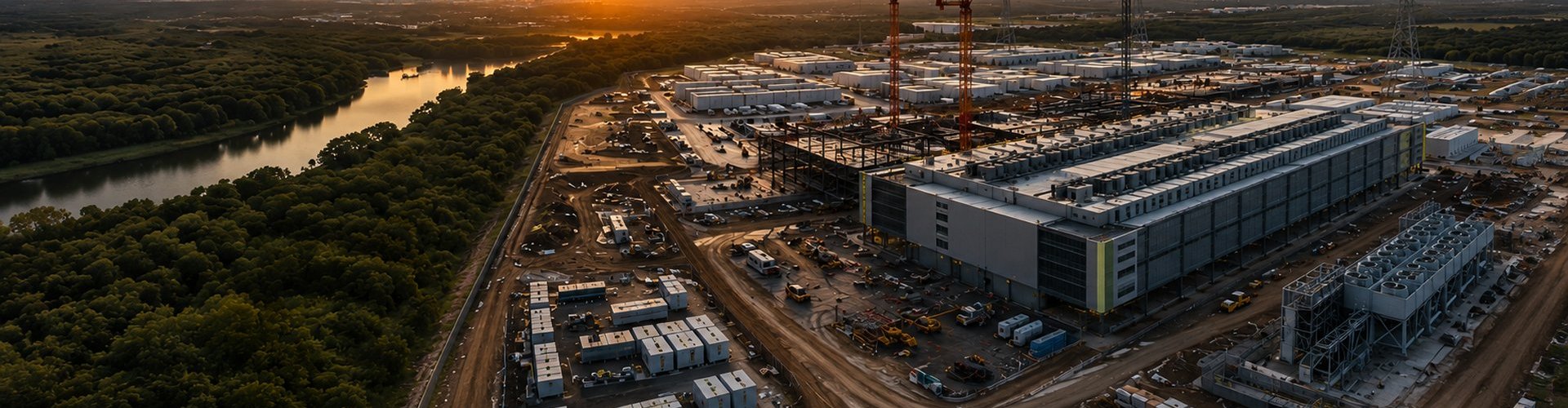
Amp Z's Project Lufkin is the exemplar of brownfield inheritance: a gigawatt-scale AI campus rising on the footprint of a newsprint mill, reusing the industrial platform an earlier era left behind. The historical loop is exact — a mill killed by the digital transition, rebuilt as infrastructure for the AI layer that displaced it.
| Attribute | Detail |
|---|---|
| Operator | Amp Z Champion Data Center Holdings (Amp Energy platform) |
| Location | East of Lufkin, Angelina County, TX (East Texas) |
| Distance from Austin | ~200 mi E |
| IT capacity | 2.1 GW by 2029 (55 MW inherited → 175 MW 2026 → 1.1 GW 2028) |
| Power model | Grid step-up plus behind-the-meter gas |
| Generation | Oncor grid + 1 GW on-site Longleaf gas plant (Chapter 381 abatement) |
| Prior industrial life | Southland Paper Mills newsprint, 1940–2007 |
| Inherited platform | ~1,041 acres, dedicated municipal water system, 55 MW tie, rail, FTZ |
| Workload | AI + cloud (colocation) |
| Compute chip | Not specified (merchant colocation) |
| Known tenants / workloads | Merchant colocation; tenants not yet named |
| Investment | ~$1.05B first phase; ~$1.5B with on-site generation |
| Timeline | 175 MW late 2026; 1.1 GW 2028; 2.1 GW by 2029 |
| Status | Under development |
Why it exists here
The Southland Paper mill east of Lufkin ran newsprint from 1940 to 2007 — the first commercial plant to make newsprint from southern pine. When it closed after 67 years, it left behind a fully permitted heavy-industrial platform that Amp Z is now inheriting rather than rebuilding. Amp Z Champion Data Center Holdings, a subsidiary of the Amp Energy platform capitalized in part by a $374 million Carlyle investment, is developing the site as Project Lufkin.
What it inherited
This is the brownfield inheritance pattern in full. The site carries county-jurisdiction industrial zoning, a designated Opportunity Zone with Foreign Trade Zone eligibility, rail via the line built to serve the mill, roughly 1,041 acres (expandable toward 4,000), and — most consequentially — a dedicated municipal water system built by the City of Lufkin specifically to serve heavy industry at the site, available to a successor without touching the city's residential supply. Above all it inherited a 55 MW grid interconnection with an on-site substation, wired to Oncor.
The inversion is precise: the mill was built to end Texas newspapers' dependence on Canadian newsprint, and it closed as the digital transition erased newsprint demand. The site is now being rebuilt as physical infrastructure for the compute layer that displaced newsprint in the first place, on the same pad, drawing the same water rights, stepping up from the same 55 MW connection that once ran a paper machine.
The power model
Project Lufkin phases against the inherited electrical envelope. The existing 55 MW paper-mill connection is planned to reach 175 MW by late 2026 and 1.1 GW by 2028 through Oncor agreements, with an additional 1 GW of behind-the-meter self-generation from the proposed Longleaf gas plant — sited on the property under a 10-year Chapter 381 county tax abatement — bringing total campus capacity to 2.1 GW by 2029. Initial capital is about $1.05 billion, rising to roughly $1.5 billion once on-site generation is counted.
What runs here
Project Lufkin is a merchant colocation campus, so its compute silicon and tenants are not yet named — it will host whatever operators lease space, on whatever chips they bring. Unlike the first-party hyperscaler sites, there is no model family to infer from the hardware here, because the hardware is the tenant's choice. The honest statement is that this is gigawatt-scale colocation capacity being built ahead of announced tenants.
Where it fits
Amp Z is the brownfield exemplar of the exemplar set — where Meitner and GW Ranch build generation on open land, Lufkin inherits an entire industrial platform from a dead industry and steps it up. It sits alongside the Alcoa-Sandow sites and Terafab's Gibbons Creek reservoir as proof that the fastest path to a powered, watered, permitted campus is often to occupy one an earlier industry already built.
Last updated September 11, 2026. Capacity figures are the developer's phased plan; tenants are not yet announced. Status: under development.
Related: Behind-the-Meter Power · Water & Cooling · ERCOT Large Load Interconnection · Brownfield Inheritance · AI Data Center Exemplars
Related Coverage
MSB Matrix Data Center Campus | IREN Sweetwater | AWS GW Ranch | Microsoft Pecos (Project Kilby) | Fermi America — Project Matador | Brownfield Inheritance | Behind-the-Meter Power