AustinIO > Texas AI & Hyperscalar Data Centers > AI Data Center Exemplars > Sailfish Comanche Circle
Sailfish Comanche Circle
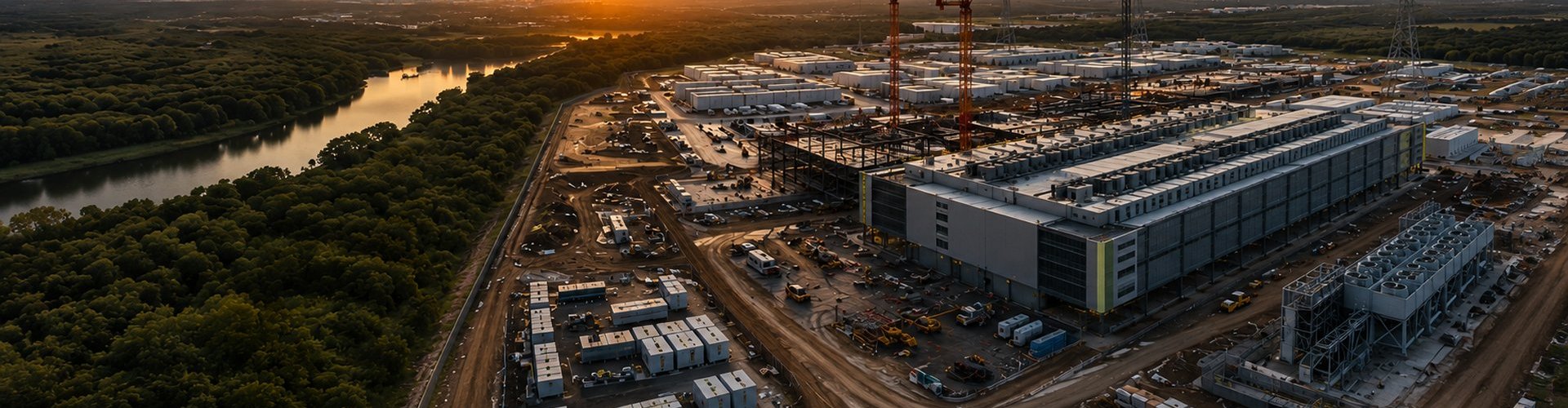
Comanche Circle is the exemplar of the merchant data-center-park model: not a single campus but a master-planned community of nine campuses on 2,600 acres, powered by modular behind-the-meter gas islands and sold to tenants as subdivided, pre-powered pads. It is also the clearest speculative-platform case in the set — a real-estate bet on demand, still being tenanted.
| Attribute | Detail |
|---|---|
| Developer | Sailfish Digital Ventures / Sailfish Investors (Ryan Hughes) |
| Location | Tolar, Hood County, TX (SW of Fort Worth) |
| Distance from Austin | ~150 mi N |
| Capacity | 3.2 GW Phase I (five campuses); up to 5 GW across nine campuses |
| Campus | 2,600 acres master-planned park |
| Power model | Modular behind-the-meter gas power islands + on-grid |
| Phase I layout | Campus A 1,000 MW, B/C/D 600 MW each, E ~400 MW |
| Future generation | ~400 acres reserved for SMRs and solar (longer lead time) |
| Cooling | Closed-loop |
| Workload | AI + cloud (colocation) |
| Compute chip | Tenant-supplied |
| Known tenants / workloads | Merchant park; in talks with hyperscalers, none named |
| Timeline | Up to 600 MW within 24 months of announcement; remainder late 2027–2028 |
| Status | Planned / early development |
Why it exists here
Comanche Circle sits on 2,600 acres in Tolar, Hood County, southwest of Fort Worth, chosen for transmission access and proximity to natural gas. Sailfish — a real-estate platform founded by Ryan Hughes, previously of Cushman & Wakefield and HighBrook — is developing it not as one data center but as a master-planned park of nine campuses. The premise, in Hughes's words, is that traditional grid interconnections cannot keep pace with hyperscaler demand, so the park delivers its own power in modular blocks.
The power-island model
The distinctive unit here is the behind-the-meter power island: a self-contained block of on-site gas generation sized to a campus, deployed in modules rather than as one plant. Phase I comprises five campuses totaling 3.2 GW — Campus A at 1,000 MW, three campuses at 600 MW, and a fifth around 400 MW — with the full nine-campus build reaching up to 5 GW. Sailfish plans to deliver up to 600 MW within 24 months via power islands, then fill in the remainder through 2027 and 2028 with more islands plus on-grid power. Roughly 400 acres are reserved for longer-lead-time generation, including on-site small modular reactors and solar.
This is the merchant-park variant of the model. Where Crusoe Abilene builds one campus for one tenant and Amp Z reuses one industrial site, Comanche Circle subdivides a large parcel into many pre-powered campuses and leases them out — a data-center equivalent of a master-planned business park, where the developer's product is powered, permitted land at modular scale.
The speculative caveat
Comanche Circle is the clearest speculative-platform case among the exemplars, and the page should say so. Sailfish is finalizing site plans and talking with hyperscalers about conceptual layouts; the nine-campus, 5 GW vision is contingent on funding and customer demand materializing. The company has publicly committed the project to Governor Abbott's data center standards and to funding its own interconnection under SB 6 — positioning itself as an executable project rather than a speculative queue-filler — but as of now it is a powered-land bet ahead of signed tenants, not a committed build.
What runs here
As a merchant park, Comanche Circle's tenants bring their own silicon, so no chip or model family can be inferred — the developer sells powered pads, not compute. Tenants are in discussion but unnamed. The honest framing is modular, pre-powered colocation capacity being marketed ahead of committed tenants.
Where it fits
Comanche Circle is the merchant-park exemplar, distinct from every single-campus site in the set. It shows the model taken to a real-estate logic: rather than build a data center, build the powered, permitted platform and subdivide it. It is also the clearest reminder that much of the announced Texas pipeline is optionality — powered land positioned for demand that has to arrive for the full vision to be built.
Last updated September 11, 2026. The nine-campus, 5 GW plan is contingent on funding and demand; tenants are not named. Status: planned / early development.
Related: Behind-the-Meter Power · Water & Cooling · ERCOT Large Load Interconnection · Brownfield Inheritance · AI Data Center Exemplars
Related Coverage
Amp Z (Project Lufkin) | Crusoe Abilene Microsoft (Campus 2) | Fermi America — Project Matador | Meitner Energy Center | Nexus Hubbard | AWS GW Ranch